x




.jpg)
The Future Will Be Built by Communities, Not Corporations Alone
For more than a century, large corporations have been among the most powerful forces shaping the economy.
They created products.
They created jobs.
They built infrastructure.
They influenced markets.
And in many ways, modern life became organised around them.
If you wanted opportunity, you often needed access to a corporation.
If you wanted income, you often worked for one.
If you wanted growth, you usually participated within structures they controlled.
That model helped create extraordinary economic expansion.
But a new pattern is beginning to emerge.
Not one that replaces corporations entirely.
But one that changes their role.
Because increasingly, some of the most powerful economic forces are no longer being created solely by corporations.
They are being created by communities.
The industrial era rewarded centralisation.
Large organisations had enormous advantages.
They could:
Size created power.
The bigger the organisation became, the greater its advantage.
This is why corporations dominated much of the economic landscape throughout the twentieth century.
Centralisation was efficient.
And efficiency created growth.
Technology changed the equation.
For the first time in history, people could connect, organise, collaborate, and coordinate at scale without necessarily needing traditional institutions to sit in the middle.
The internet reduced barriers.
Digital platforms increased reach.
Global communication became nearly instantaneous.
Suddenly, communities could do things that previously required large organisations.
And that changed everything.
Communities are not new.
Human beings have always organised into groups.
What is new is the scale at which communities can now operate.
A community can now:
This creates a new form of economic power.
Not power based primarily on hierarchy.
But power based on participation.
Large organisations often face challenges that communities do not.
They must navigate:
Communities can often move more quickly because they are driven by shared interest rather than organisational structure.
Ideas spread faster.
Feedback arrives faster.
Adaptation happens faster.
This flexibility becomes increasingly valuable in rapidly changing environments.
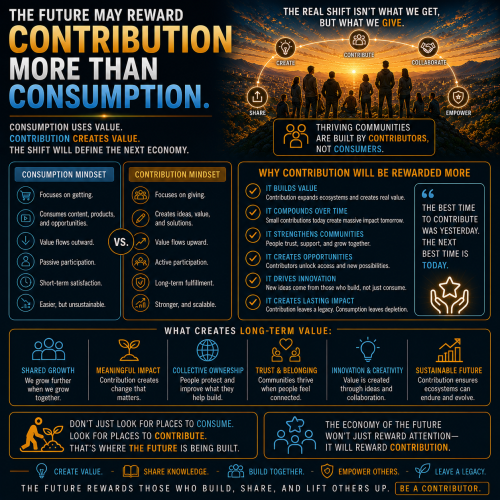
For years, many organisations viewed people primarily as audiences.
People consumed products.
People consumed content.
People consumed services.
But communities operate differently.
People are not merely consumers.
They become:
This creates a stronger connection between individuals and the systems they support.
Something important happens when people actively participate.
They stop thinking like customers.
They begin thinking like stakeholders.
Even when formal ownership is absent, participation creates emotional investment.
People care more deeply about systems they help shape.
They contribute more.
They support growth more actively.
And this creates powerful network effects.
Communities distribute responsibility.
Knowledge is shared.
Relationships are distributed.
Participation is decentralised.
This means the system is often less dependent on a single leader, a single company, or a single decision-maker.
Resilience emerges through connection.
When many people contribute to a system, the system often becomes stronger than any individual participant.
One of the most underestimated forces in the modern economy is belonging.
People increasingly seek:
Communities provide these things.
And when people feel connected to a community, they often become:
This creates economic value that traditional transactional models struggle to replicate.
Institutions remain important.
Governments matter.
Businesses matter.
Educational organisations matter.
But networks are becoming increasingly influential.
Networks move information faster.
Networks identify opportunities earlier.
Networks adapt more rapidly.
And because communities are built on networks, they increasingly become engines of innovation and growth.
Historically, opportunity often flowed from institutions downward.
Today, opportunity increasingly emerges within communities themselves.
People discover:
Through participation.
The community becomes the gateway.
Not merely the corporation.
For decades, trust was concentrated in institutions.
People trusted:
Today, trust increasingly flows through communities.
People often trust:
This shift changes how value spreads through society.
No individual knows everything.
No organisation knows everything.
But communities often develop collective intelligence.
Through shared experience, communities can:
This becomes a powerful competitive advantage.
Especially in environments where change happens quickly.
The industrial economy often rewarded competition above all else.
The emerging economy increasingly rewards collaboration.
Not because competition disappears.
But because collaboration creates leverage.
People working together inside aligned systems can often achieve outcomes that would be difficult individually.
This makes communities increasingly important economic structures.
The Beyond UBI concept has always been about more than income.
It has been about participation.
Connection.
Shared opportunity.
Ethical abundance.
And these ideas align naturally with community-driven systems.
Because communities create environments where value can be generated collectively rather than flowing exclusively through centralised structures.
As technology continues evolving, economic participation may become increasingly distributed.
People may contribute through:
Rather than relying solely on traditional organisational hierarchies.
This does not eliminate corporations.
But it changes the balance.
Power becomes more distributed.
Participation becomes more accessible.
Opportunity becomes more network-driven.
Not every community succeeds.
The communities that thrive will be those that create real value.
Value through:
Because ultimately, sustainable communities solve problems and improve outcomes for their participants.
That is what creates lasting momentum.
For generations, economic power was largely concentrated.
A relatively small number of institutions controlled most systems.
The future may look different.
More distributed.
More participatory.
More connected.
A future where communities become active builders of economic value rather than passive observers of it.
Corporations helped build the modern world.
Their influence is enormous and will remain important.
But something new is emerging alongside them.
Communities that can:
And as these communities continue to grow, they may become some of the most important economic forces of the twenty-first century.
Because the future is unlikely to be built by corporations alone.
It will increasingly be built by networks of people who choose to participate, collaborate, contribute, and grow together.
And in that future, the greatest opportunity may not come from finding your place inside a corporation.
It may come from finding your place inside a community that is actively helping shape what comes next.