x




.png)
The Real Divide of the Future Won’t Be Rich vs Poor—
It Will Be Connected vs Disconnected
For generations, society has understood inequality in relatively simple terms.
There were:
And most economic debates revolved around how to reduce the gap between these groups.
But as the world changes, a different kind of divide is beginning to emerge.
One that may become even more important than income alone.
A divide based not simply on money…
But on connection.
Because increasingly, the people who thrive are not just those who possess wealth.
They are those who are:
And those who are disconnected risk falling behind—regardless of effort or ability.
The modern economy is no longer built only on physical structures.
It increasingly runs through:
Value moves differently now.
Information spreads faster.
Opportunities emerge earlier within networks.
Growth often happens through connection rather than isolation.
This changes the nature of economic participation itself.
Connection creates access.
Access to:
And access shapes outcomes.
Two people may have similar intelligence, motivation, and work ethic…
But if one is connected to expanding systems while the other remains isolated…
Their trajectories may become dramatically different over time.
This is important.
Being disconnected is not a reflection of intelligence or worth.
Many highly capable people remain disconnected simply because:
The issue is not capability alone.
It is positioning.
Traditional economic thinking often focused on individual effort.
Work hard. Improve yourself. Compete effectively.
But in network-driven environments, isolation creates disadvantages.
Because isolated individuals:
Meanwhile, connected participants benefit from:
This creates compounding differences over time.
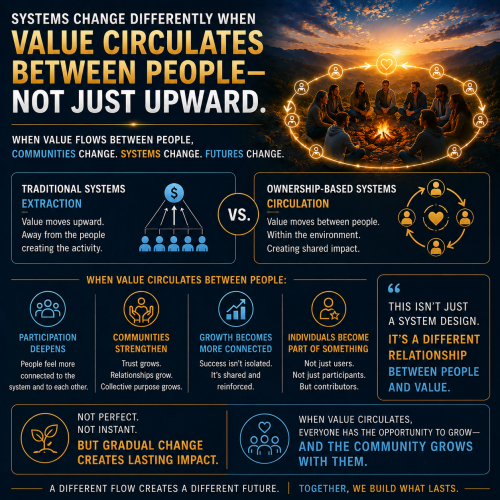
Networks amplify value.
One connection leads to another.
One opportunity leads to several more.
One system introduces access to additional systems.
This creates network effects.
And network effects compound.
The more connected you become:
Connection becomes leverage.
Historically, wealth was heavily tied to ownership of physical assets.
Land.
Factories.
Infrastructure.
Today, access is becoming just as important.
Access to:
Because access determines whether you are inside the flow of emerging value…
Or outside observing it after the fact.
Most people were raised in systems designed around industrial-era thinking.
You succeeded by:
But network economies function differently.
They reward:
This requires a different mindset.
And not everyone has adjusted yet.
Increasingly, people are beginning to realise something important:
Success is rarely isolated.
It often depends on the ecosystem around you.
The systems you participate in influence:
This is why ecosystems matter so much in modern economies.
Because ecosystems shape the flow of value.
The danger of disconnection compounds slowly.
At first, the difference may appear small.
But over time:
Meanwhile, disconnected individuals may continue operating within shrinking or stagnant structures.
And the gap widens gradually.
Not always because one group works harder…
But because one group is closer to where value is evolving.
Technology increases the importance of connection even further.
Because technology enables:
This creates enormous opportunities for connected participants.
But it can also deepen exclusion for those left outside emerging systems.
Which means the future divide may increasingly revolve around connectivity itself.
The good news is:
Connection is not purely passive.
It can be developed.
Through participation.
By:
Participation creates visibility.
And visibility creates connection.
In slower economies, people could remain passive for long periods without major consequences.
Today, things move faster.
Systems evolve quickly.
Networks scale rapidly.
Opportunities form and mature faster than before.
This means passive observation can lead to delayed positioning.
And delayed positioning reduces leverage.
Connection requires movement.
And movement often means entering unfamiliar environments.
That can feel uncomfortable.
Because new systems rarely feel fully clear at first.
But waiting for complete certainty often leads to staying disconnected while others build relationships, understanding, and position.
This connects directly to earlier posts in the series.
Security is changing.
It increasingly comes not from:
But from being connected across multiple systems.
Connection creates resilience because it reduces dependency on any single source.
One of the greatest advantages of connected systems is accelerated learning.
Within networks:
This creates an environment where connected participants evolve faster than isolated individuals trying to understand everything alone.
The future economy may increasingly favour people who are:
Not because they control everything…
But because they are inside the flow of change rather than outside reacting to it later.
This is why the future divide may not simply be about income.
It may increasingly become:
Because connection shapes access.
And access shapes opportunity.
For a long time, economic success was viewed mainly through the lens of money.
But the future may be shaped just as much by networks.
By who is connected to evolving systems…
And who remains outside them.
Because in a rapidly changing world, isolation becomes increasingly expensive.
Not only financially…
But informationally, socially, and strategically.
So perhaps the most important question going forward is no longer simply:
“How much do I earn?”
But:
“What am I connected to—and is it growing?”
Because the people who thrive in the future may not just be the wealthiest.
They may be the most connected.