x



This Is Where the Model Changes
There comes a moment in every journey where theory meets reality.
Where ideas stop being discussed…
And start being lived.
This is one of those moments.
Because up until now, much of the conversation around the future of the economy has been exactly that—a conversation.
We’ve explored:
All of these ideas point in one direction:
The future must be more participatory.
More inclusive.
More connected.
But there has always been a gap.
A gap between understanding this…
And actually experiencing it.
One of the biggest challenges in any transition is this:
You can believe in a better model…
But still find yourself operating within an old one.
You can understand participation…
But still be dependent on systems that don’t fully support it.
You can see the value of inclusion…
But struggle to find structures that make it real.
And when that happens, friction appears.
Effort increases.
Progress slows.
Momentum becomes difficult to sustain.
Not because the vision is wrong…
But because the system doesn’t yet match the vision.
Real change doesn’t happen when ideas improve.
It happens when structure aligns with intention.
When the system itself begins to reflect the principles it’s built on.
Because when that alignment happens:
And most importantly:
The experience changes.
Up until now, much of the focus has been on participation.
And rightly so.
Because participation is the foundation of any inclusive system.
But there is a level beyond participation.
A level that changes the dynamic even further.
That level is:
Ownership.
Not ownership in the traditional sense of control over assets…
But ownership as shared stake in a system.
A sense that:
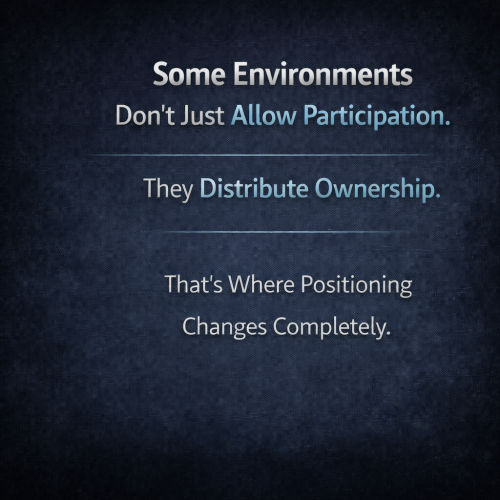
This is where things begin to shift in a much deeper way.
When people feel ownership, everything changes.
They think differently.
They act differently.
They engage differently.
Because the system is no longer external.
It becomes personal.
Ownership creates:
It transforms participation from an activity…
Into a relationship.
In many systems today, people are invited to participate.
But they are rarely invited to own.
They can:
But the underlying structure remains separate from them.
The system grows…
But they remain users of it.
And this creates a subtle but important divide:
Between those who benefit from the system…
And those who are part of the system.
What happens when that divide disappears?
What happens when people are not just participants…
But co-owners of the structure itself?
Something powerful begins to emerge.
Because now:
This creates a completely different dynamic.
One where:
A reinforcing cycle begins.
Traditional systems concentrate ownership.
A small group holds equity.
Decisions are made at the top.
Value flows outward.
In contrast, distributed ownership spreads that stake across a network.
Many people hold pieces of the system.
Not symbolic pieces…
But real ones.
And this changes power.
Because power is no longer held in one place.
It is shared.
We are entering a period where technology makes this possible at scale.
Where:
This creates the conditions for entirely new economic models.
Models that were not practical before…
But are now becoming real.
If earlier stages of the conversation were about:
Then this stage is about something more:
Moving into shared ownership.
Because ownership is what anchors people into systems.
It is what turns short-term engagement into long-term commitment.
It is what transforms users into stakeholders.
The most important part of this transition is not theoretical.
It is experiential.
You can feel the difference between:
Each level creates a deeper connection.
A stronger sense of purpose.
A greater alignment with outcomes.
And when enough people experience that shift…
Something larger begins to happen.
This is where the idea of Ethical Abundance becomes real.
Not as a concept…
But as a structure.
An economy where:
This is not about redistribution after the fact.
It is about designing systems where value is shared from the beginning.
In this new model, the individual does not disappear.
They evolve.
From:
To:
This is a more empowered role.
But also a more connected one.
Because it exists within a network.
What we are seeing is not just a new platform.
Not just a new mechanism.
But a shift in how systems are structured.
A move toward:
And when these elements come together…
They create something different.
Something more aligned with how people actually want to live, contribute, and grow.
For a long time, the conversation has been about how to fix what exists.
How to improve it.
Adjust it.
Make it more fair.
But there comes a point where improvement is not enough.
Where something new has to emerge.
This feels like one of those moments.
Not because everything is solved…
But because the model itself is changing.
And when the model changes, everything connected to it begins to change as well.
The question is no longer:
“How do we survive within the system?”
But:
“How do we participate in building what comes next?”
Because this is where it all changes.