x




Get Your FREE Affiliate Niche Profitability Calculator
.png)
Why Security Is No Longer Where People Think It Is
Security has always been one of the most powerful drivers of human behaviour.
It influences decisions.
It shapes priorities.
It defines what people are willing—or unwilling—to do.
For generations, the path to security has been clear.
Or at least, it seemed clear.
Follow this path, and you would be secure.
That was the promise.
And for a long time, it worked.
The idea of security has been built on stability.
Predictable income.
Reliable systems.
Clear structures.
You exchanged your time for money.
That money provided stability.
That stability created security.
It was a linear model:
Work → Income → Security
And because it worked for so long, it became deeply embedded in how people think.
The world that model was built for is changing.
Not slowly… but structurally.
We are seeing:
And as a result, something subtle but significant is happening:
Stability is becoming less stable.
Many of the systems people rely on for security are not as solid as they appear.
Jobs can disappear.
Industries can decline.
Companies can restructure.
Markets can shift.
And when that happens, the security that seemed reliable can change quickly.
Not because anyone did anything wrong…
But because the system itself evolved.
One of the reasons traditional security feels comforting is that it creates a sense of control.
You know:
But this control is often conditional.
It depends on external factors:
And those factors are not fully within your control.
In a changing world, the definition of security begins to shift.
From:
Stability
To:
Adaptability
Because when conditions change, the most secure position is not the most stable one…
It’s the one that can adjust.
There’s a paradox here.
What feels safe…
May actually carry risk.
And what feels uncertain…
May actually create resilience.
For example:
Relying on a single source of income may feel secure.
But it creates dependency.
And dependency increases vulnerability.
In contrast, being involved in multiple systems—even if each feels less certain—can create flexibility.
As we’ve explored in previous weeks, the world is becoming more network-driven.
And with that comes a different form of security.
Not based on a single source…
But on multiple connections.
Security begins to come from:
This is a more distributed form of security.
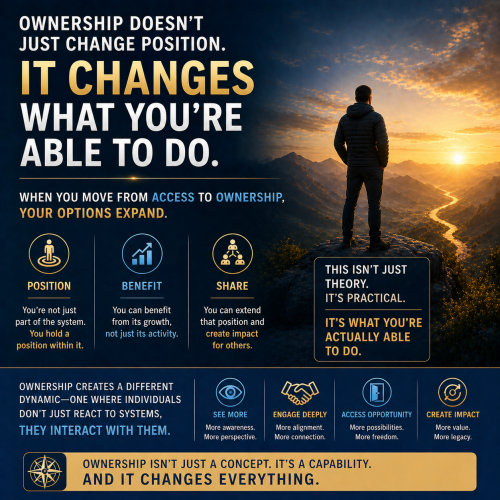
In traditional models, security came from position:
In emerging models, security comes from connection:
Because connections create:
And these are what allow you to adapt.
This may sound counterintuitive.
But participation can be a form of protection.
Because when you are actively engaged in systems:
In contrast, passive security—relying on something fixed—can leave you exposed when that thing changes.
If the world is changing, why do people still rely on traditional ideas of security?
Because they are familiar.
They have worked in the past.
They are widely accepted.
And changing your definition of security is uncomfortable.
It requires:
Security is not just practical.
It’s emotional.
People don’t just want to be secure.
They want to feel secure.
And that feeling often comes from:
Even if those structures are quietly becoming less reliable.
When security is placed in the wrong place, it creates hidden risk.
You may feel stable…
But be vulnerable.
You may feel certain…
But be exposed to change.
And by the time that becomes clear…
It can be difficult to adjust quickly.
So what does security look like in a changing world?
It may look less like:
And more like:
This is not as comfortable.
But it is more aligned with reality.
Resilience comes from:
This creates a different kind of confidence.
Not based on certainty…
But on capability.
While this shift can feel unsettling, it also creates opportunity.
Because as old models become less effective…
New models begin to emerge.
Models that:
And those who recognise this shift early…
Can position themselves differently.
Perhaps it’s time to redefine what security really means.
Not as the absence of risk…
But as the ability to navigate it.
Not as something fixed…
But as something dynamic.
For a long time, security was about holding on.
Holding on to a job.
Holding on to income.
Holding on to stability.
But the world is changing.
And in a changing world, security may no longer come from holding on…
But from being able to move.
To adapt.
To participate.
To stay connected to where value is being created.
Because the safest place is no longer a fixed position within a system…
It’s an active role within systems that continue to evolve.