x




.jpg)
Why the Future Economy Will Reward Contribution More Than Credentials
For most of the last century, credentials were one of the most valuable assets a person could possess.
A degree.
A certification.
A professional qualification.
A recognised title.
These signals helped employers determine who was capable, who was trustworthy, and who should be given opportunities.
In many ways, credentials made perfect sense.
Information moved slowly.
Employers had limited ways to evaluate people.
Institutions acted as gatekeepers, helping society identify talent and expertise.
For generations, this system worked reasonably well.
A qualification often opened doors.
A title often created opportunity.
A recognised credential could shape an entire career.
But something significant is changing.
Not because education has become unimportant.
Not because expertise no longer matters.
But because the way value is created is evolving.
And as it evolves, contribution is becoming increasingly important.
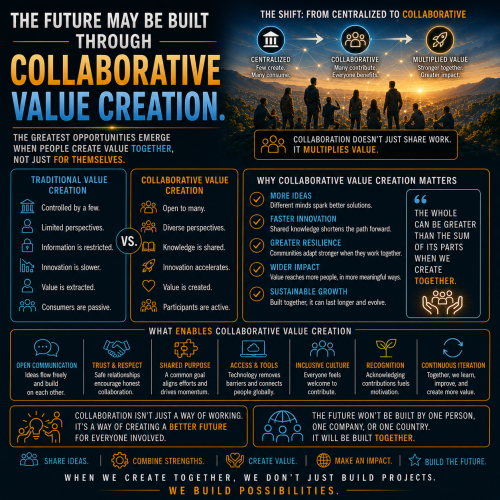
In the future economy, people may be judged less by what they have been awarded and more by what they actively create, build, share, and contribute.
The traditional economy relied heavily on credentials because institutions needed efficient ways to assess people.
A university degree signalled knowledge.
A professional licence signalled competence.
A title signalled experience.
These indicators helped organisations make decisions at scale.
When information was difficult to verify, credentials served as shortcuts.
They reduced uncertainty.
They helped create trust.
And they provided structure.
For decades, they were among the strongest predictors of economic opportunity.
The internet transformed how knowledge is distributed.
Today, information is available almost everywhere.
People can learn:
Without necessarily following traditional pathways.
This does not eliminate the value of formal education.
But it changes the balance.
Knowledge is no longer confined to institutions.
And because knowledge is more accessible, other factors become increasingly important.
In previous generations, employers often hired based on qualifications first and evidence second.
Today, many opportunities increasingly work the other way around.
People ask:
The emphasis shifts from credentials alone to visible contribution.
Because contribution creates evidence.
And evidence is difficult to ignore.
Contribution is powerful because it creates real-world impact.
A credential indicates potential.
Contribution demonstrates capability.
A certificate may suggest knowledge.
Contribution shows application.
A title may imply expertise.
Contribution proves value.
This distinction becomes increasingly important in rapidly evolving environments where traditional indicators often lag behind reality.
One challenge facing traditional credential systems is speed.
Technology evolves rapidly.
Industries transform quickly.
New opportunities emerge constantly.
Formal validation processes often move more slowly.
As a result, people who continuously contribute may develop relevant expertise faster than formal systems can recognise it.
This does not diminish the importance of education.
But it highlights the growing importance of continuous participation and practical contribution.
Communities tend to reward contribution directly.
People notice:
These contributions often generate trust more effectively than credentials alone.
Because people experience the value firsthand.
Trust becomes earned through participation rather than solely through formal recognition.
As we discussed in last week's post, builders occupy a unique position.
Builders contribute.
They create.
They experiment.
They participate.
And through that participation, they generate evidence of capability.
This creates a powerful advantage.
Instead of relying entirely on external validation, builders create their own validation through action.
Their work speaks for them.
The digital world makes contribution more visible than ever before.
People can now share:
With global audiences.
This means contribution can be seen, evaluated, and appreciated directly.
Visibility reduces the need for gatekeepers.
People increasingly assess value based on observable results rather than relying solely on institutional signals.
Opportunity often follows value creation.
When people consistently contribute:
These factors create opportunities that credentials alone may never generate.
Because contribution creates momentum.
And momentum attracts attention.
A new form of reputation is emerging.
Not reputation based purely on titles.
But reputation based on demonstrated value.
People increasingly build credibility through:
This reputation can become an asset in its own right.
And unlike traditional credentials, it evolves continuously.
If contribution becomes more important, continuous learning becomes essential.
Because meaningful contribution requires growth.
People must:
The future economy may reward those who can continuously increase the value they contribute rather than those who rely exclusively on past achievements.
This creates a more dynamic relationship between learning and opportunity.
Knowledge without application has limitations.
A person may know a great deal.
But if that knowledge never creates value, its impact remains limited.
Contribution bridges this gap.
It transforms information into outcomes.
It converts understanding into results.
And results are what ecosystems ultimately respond to.
Many younger people already operate in contribution-driven environments.
They grow audiences by creating content.
They build communities through participation.
They develop skills through projects.
They learn publicly.
They share publicly.
As a result, contribution often feels more natural than waiting for formal validation.
This shift may accelerate as digital participation becomes even more common.
Future organisations may increasingly ask:
Rather than focusing exclusively on:
Those factors will still matter.
But contribution may become the stronger differentiator.
There is another benefit to contribution that often goes unnoticed.
Contribution creates meaning.
People generally feel more fulfilled when they:
Contribution connects personal growth with collective benefit.
And this alignment can be incredibly powerful.
Because it allows individuals to thrive while strengthening the communities around them.
The Beyond UBI vision has never been about encouraging passivity.
It has always been about expanding participation.
Expanding opportunity.
Expanding human potential.
A contribution-driven economy aligns naturally with these ideas.
Because it rewards people not merely for existing within a system, but for actively strengthening it.
Participation becomes valuable.
Creation becomes valuable.
Contribution becomes valuable.
And everyone gains when more people are empowered to contribute.
The industrial era often measured success through status.
Job titles.
Income levels.
Institutional recognition.
The emerging era may increasingly measure success through impact.
What have you improved?
What have you built?
Who have you helped?
What value have you created?
These questions focus on contribution rather than position.
And that represents a profound shift.
Credentials will continue to matter.
Education will continue to matter.
Expertise will continue to matter.
But the future may increasingly reward something even more important:
Contribution.
Because in a connected world, people can see value directly.
They can experience it.
They can measure its impact.
And when contribution becomes visible, it often speaks louder than credentials alone.
So perhaps the defining question of the future economy will not be:
“What qualifications do you have?”
But rather:
“What value do you consistently contribute?”
Because as networks expand, communities grow, and participation becomes more important, the people who thrive may not be those with the most impressive certificates on the wall.
They may be the people who contribute the most meaningful value to the world around them.