x





Why the Smartest People Are No Longer Chasing Jobs—
They’re Positioning Themselves in Systems
For generations, success followed a familiar path.
Study hard.
Get qualified.
Find a good job.
Work consistently.
Climb steadily upward.
That path shaped how people thought about security, ambition, and opportunity.
A “good job” became more than income.
It became identity.
Status.
Stability.
Proof that you were succeeding within the system.
And for a long time, that model worked reasonably well.
But something is changing.
Not suddenly.
Not all at once.
But steadily enough that a new pattern is becoming impossible to ignore:
Some of the most forward-thinking people are no longer focusing primarily on jobs.
They’re focusing on systems.
A job is usually linear.
You exchange:
For income.
The structure is straightforward.
Your earning potential is often connected to:
There is nothing inherently wrong with this model.
But it has limits.
Because in most cases, your growth remains tied to your individual capacity.
A system is different.
A system can continue creating value beyond the limits of one person’s time.
That’s the key distinction.
Systems operate through:
Once established, they can grow through the involvement of many people rather than the output of one individual alone.
This creates leverage.
And leverage changes outcomes.
Because leverage allows value to expand without requiring a proportional increase in personal effort.
That is why systems often produce disproportionate results compared to isolated individual work.
Traditional career thinking is mostly linear.
You progress step by step:
But the modern economy increasingly rewards non-linear growth.
Growth that comes from:
This is why many people are beginning to think differently.
Not just:
“What job should I get?”
But:
“What systems should I position myself within?”
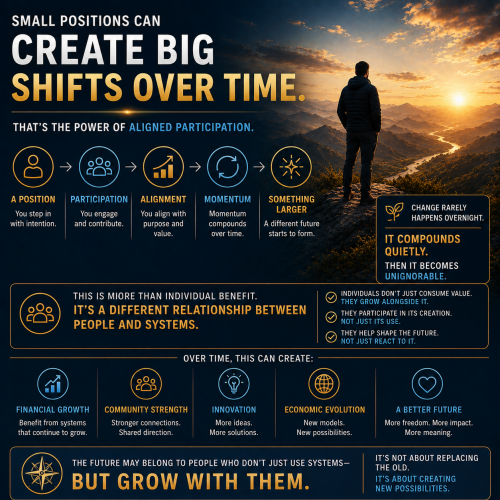
Position determines what you are connected to.
And what you are connected to shapes:
Two people can work equally hard.
But if one is positioned inside a growing system while the other is operating in a stagnant one…
Their outcomes may diverge dramatically over time.
Not necessarily because one is smarter.
But because one is positioned differently.
This is important:
The idea is not that jobs suddenly become useless.
Jobs still matter.
They provide:
But increasingly, jobs alone may not provide the same long-term leverage they once did.
Because the economy itself is becoming more network-driven and system-oriented.
And systems reward participation differently than traditional employment structures do.
In older models, leverage often came from:
In emerging models, leverage increasingly comes from:
This is a fundamentally different way of thinking about economic participation.
People who think long-term tend to notice patterns early.
And one of the biggest patterns today is this:
Systems increasingly outperform isolated effort.
Because systems can:
That’s why many forward-looking individuals are spending more time asking:
These are system-level questions.
There’s another important shift happening.
People are moving from simply working for systems…
To becoming embedded within them.
That distinction matters.
Because when you are embedded in a system:
This creates alignment between personal growth and system growth.
And that alignment can become extremely powerful over time.
One of the biggest differences between jobs and systems is ownership.
In traditional employment:
You contribute to a system…
But rarely own part of it.
You receive compensation.
But the long-term value created by the system often flows elsewhere.
Emerging models are beginning to challenge that structure.
Participation is increasingly being linked with:
This changes incentives completely.
Because now the question is not just:
“How much can I earn?”
But:
“What am I helping build—and do I share in its growth?”
For a long time, many people approached the economy passively.
They:
But network-based systems reward active participation differently.
They reward:
This creates a more participatory economic environment.
One where people are not just workers or consumers…
But active nodes within systems.
System-based thinking can feel unfamiliar.
Because it requires people to think beyond traditional structures.
There’s no single, predictable ladder.
No universally recognised path.
And that uncertainty can feel uncomfortable.
Especially for people raised to believe that security comes only from fixed roles within established systems.
But as we explored earlier this week:
Security itself is evolving.
And adaptability increasingly matters more than predictability.
We are moving into economies where networks matter more than ever.
Communities.
Platforms.
Shared ecosystems.
Distributed participation.
Value increasingly flows through these structures.
And those positioned within them early often gain advantages that compound over time.
Not because they control everything…
But because they are connected to growth while it is still forming.
In the past, people often asked:
“What career should I choose?”
Today, a more powerful question may be:
These questions lead to a different relationship with opportunity.
One based less on fixed employment…
And more on positioning.
One of the greatest advantages of being inside systems is visibility.
You begin to see:
Because participation creates perspective that observation alone cannot provide.
This is why active engagement matters so much.
Not just financially…
But informationally.
The future economy is unlikely to be defined by one rigid structure.
It will probably be fluid.
People may move across:
And those who adapt to this dynamic environment may be better positioned than those relying entirely on fixed models from the past.
Jobs are not disappearing.
But the idea that a job alone is the ultimate source of opportunity, security, and long-term growth is beginning to shift.
Because increasingly, the greatest leverage comes not from standing beside systems…
But from being positioned within them.
From participating while they grow.
From contributing while they evolve.
And from understanding that value today is increasingly created through:
So the question is no longer simply:
“What work do I do?”
It may now be:
“What systems am I connected to—and are they growing without me… or with me?”
Because the people who thrive in the future may not be those chasing the next job…
But those positioning themselves where the next wave of value is being created.