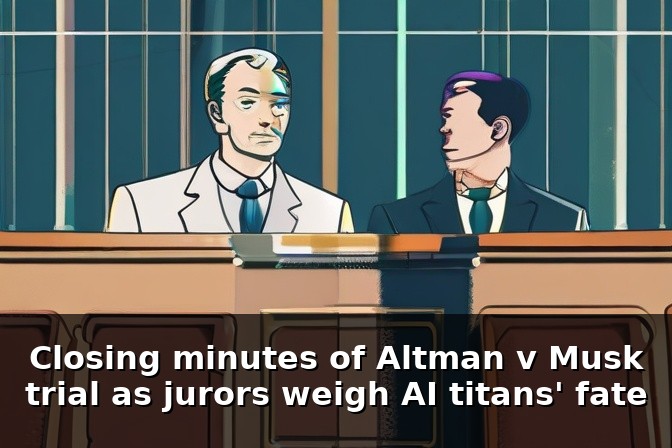
Final moments of Altman v Musk trial: jury decides fate of AI titans
The courtroom drama that has captured the tech world’s attention is reaching its climactic break point. A high-stakes dispute between Elon Musk and Sam Altman, the helm of OpenAI, has boiled down to a jury contemplating the future of artificial intelligence governance. This isn’t merely a personality clash; it’s a confrontation over who steers AI development, who bears responsibility for its risks, and how fast society should move in a technology that touches every industry.
What’s truly at stake
- control and direction: The trial centers on competing visions for OpenAI’s trajectory—whether growth and openness should supersede tight control and profit-driven incentives, or vice versa. The verdict could tilt the balance of influence in one of the most consequential tech organizations on the planet.
- responsibility and accountability: As AI systems scale, questions about safety, bias, and misalignment become more pressing. The case tests who should be held accountable when models cause harm or societal disruption—and how.
- intellectual property and data rights: The entities argue over who owns what in a landscape where data usage, training methods, and model iterations are valuable, contested assets.
- market dynamics and regulation: A verdict could ripple across the startup ecosystem, shaping how new AI tools are funded, shared, or restricted, and possibly influencing forthcoming regulatory frameworks.
- public trust: Beyond lawsuits and filings, this moment signals how the public perceives AI’s safety, transparency, and benefits—and how those perceptions feed into policy and investment decisions.
Key arguments to watch in the closing hours
On one side, the argument for disciplined governance emphasizes rigorous safety reviews, clear ethical guidelines, and a framework that prevents rapid, unbridled deployment. Proponents warn that unchecked acceleration could widen societal divides, concentrate power, and outpace regulators.
On the other side, advocates for faster, broader deployment contend that innovation thrives under openness, collaboration, and real-world feedback. They argue that responsible AI will emerge not from slowing down, but from extending blueprints for safety, accountability, and user empowerment across the industry.
Regardless of which path the jurors lean toward, the case pushes the industry to confront a fundamental tension: how to balance groundbreaking capability with responsible stewardship in a field where yesterday’s breakthroughs quickly become tomorrow’s everyday tools.
Possible verdicts and their ripple effects
- Vindication of one side: A clear ruling in favor of either Musk or Altman could set a precedent for governance models, influence funding strategies, and alter the pace at which AI platforms scale. Expect immediate shifts in partnerships and regulatory rhetoric.
- Nuanced or mixed ruling: If the jury offers a partial verdict or requires further proceedings, the industry could see a staged path forward—more transparent governance, phased waivers, or new oversight mechanisms that don’t derail innovation.
- Broader implications: Whatever the outcome, the discourse about accountability, safety commitments, and the balance between openness and control will intensify, accelerating debates among policymakers, investors, and builders.
Implications for entrepreneurs and developers
- Align ambition with responsibility: Build AI projects with clear safety benchmarks, audit trails, and user-centric safeguards from inception.
- Governance as a competitive edge: Strong governance structures can attract capital and partnerships by reducing risk and signaling long-term viability.
- Open collaboration, selective access: Explore models that combine broad collaboration with careful control where needed to protect users and the broader ecosystem.
- Prepare for regulatory clarity: Expect more explicit rules around data use, model licensing, and accountability; plan product roadmaps that can adapt to evolving standards.
What this means for the Markethive community
For entrepreneurs charting a course in AI-enabled ventures, this moment is a reminder: technology moves fastest when governance keeps pace. Prioritize transparent practices, rigorous safety protocols, and a mission-aligned strategy. Engage with peers who value responsible innovation, share learnings, and build businesses that scale with trust as a foundational asset.
As the jury delivers its verdict, the AI landscape will either settle into a new equilibrium of restraint and responsibility or accelerate toward broader deployment under renewed competitive pressure. Either way, the lessons learned will shape how you plan, partner, and prosper in this rapidly evolving frontier.