
x
Black Bar Banner 1
x

NEW: About Me Look — turn on a full-width dark About Me from your profile Configuration (Profile Page Upgrade). The Academy, profile feeds and Media Feed now read like the News Feed. See Subscriptions »

New: AI Blog Autopilot — free for the next 30 days. Switch it on by November 15th »

NEW: Smart Mail is live — free for every member. Send broadcasts, build lists and run autoresponders. Open Smart Mail »

New training: The Campaign Map. Watch it now »

A+ A−
Ads by Markethive - View All
The Blog Feed
The Blog Feed
» Blog Feed
Write a New Blog Post
Search Blog Status
Most Viewed
Most Recent
Most Shared
Alphabetical
Markethive Blog (default)
My Blog Posts
Friends' Blogs
Blog Categories
All
Advertising
Blockchain & Cryptocurrency
Business Development
Diet & Weight Loss
Environmental
Health and Wellness
History and Culture
Home and Garden
Marketing
Mentoring & Training
Money & Finance
Other
Political
Prayer & Religion
Programming & Technical
Real Estate
Search Engine Optimization
Social Media
Spirituality
Sports & Recreation
Transport
Travel & Events
Website Design
Blogging Tools & Assets
My Blog Info
Members Subscribed to You
Blogs You Are Subscribed To
Website Widget
Wordpress Plugin
Subscribe for Greater Services
Subscribe to one of many subscriptions, each one includes the previous ones.. Unlock powerful tools, advance features, to build a powerful reach.

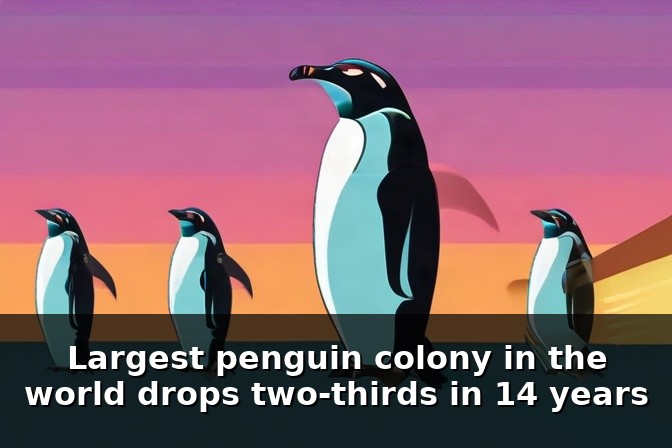
Largest penguin colony in the world drops two-thirds in 14 years

Posted by CEO Thomas Prendergast on October 10, 2026 - 12:15am


Largest penguin colony in the world drops two-thirds in 14 years

World's Largest Penguin Colony: What the Decline Tells Us

A population once hailed as the globe’s largest penguin colony has fallen by about two-thirds over the past 14 years. The drop is more than a statistic; it’s a loud signal about how rapidly Antarctic ecosystems are being reshaped. While scientists are still gathering data, the trend points to climate change as a central driver, amplifying pressures that penguins have faced for decades.

Decoding the numbers

When researchers say a two-thirds decline in 14 years, they’re describing a dramatic shift from a state of relative abundance to one where survival hinges on tighter conditions and unpredictable food access. If the colony started with N individuals, today it sits near one-third of that size. Using a simple exponential lens, that translates to roughly a 7–8% decline per year on average, though real-world dynamics wiggle year by year. The key takeaway isn’t a precise rate, but the pattern: a sustained, multi-year downturn that doesn’t reverse on its own.

That pattern matters because penguin colonies act as living barometers. They integrate the effects of ocean warmth, prey availability, breeding success, and weather all at once. When a single colony declines this steeply, it often foreshadows broader shifts in the surrounding ecosystem.

Why climate change is the likely driver

  • Sea-ice changes: Many penguin species rely on stable sea ice for breeding and feeding. Warming temperatures are altering the timing, extent, and persistence of sea ice, disrupting access to nesting sites and the pathways penguins use to reach feeding grounds.
  • Prey dynamics shift: Ocean warming reshapes the distribution and abundance of krill, fish, and squid—the staples in a penguin’s diet. When prey becomes scarcer or harder to reach, chicks face longer fasting periods, and parental duties become more strenuous.
  • Weather extremes: More frequent and intense storms can flood nests, wash away eggs, or strand chicks, especially during critical breeding windows.
  • Ocean productivity and migration: Warmer waters can alter nutrient upwelling and plankton blooms, cascading through the food chain and forcing penguins to travel farther in search of sustenance.

Other pressures on the colony ecosystem

  • As fleets chase abundant prey, penguins may encounter scarcer meals or increased travel times, draining parental energy and reducing chick survival.
  • Human activities near breeding sites, including research operations or tourism, can add stress during sensitive periods.
  • Shifts in colony density and climate-linked stressors can influence disease dynamics and overall health.

Why this matters beyond a single colony

Penguin populations function as sentinels for polar ecosystems. A steep decline in the world's largest colony doesn’t just rewrite a species’ story; it signals broader changes in Antarctic food webs, ocean health, and climate resilience. For researchers, it underscores the urgency of long-term monitoring, flexible conservation planning, and cross-border collaboration to track how warming oceans ripple through the Southern Hemisphere.

What we can do—and why it matters

  • Global and local actions to cut greenhouse gas emissions are the first line of defense against cascading impacts on ice, ocean chemistry, and marine life.
  • Expanding marine protected areas and aligning fishing quotas with ecosystem health helps secure the prey base penguins rely on.
  • Continual population censuses, remote sensing, and international data sharing improve our understanding of trends and the effectiveness of interventions.
  • Translating science into adaptive management, community engagement, and funding for Antarctic research can accelerate informed decisions in a changing climate.

Closing thoughts

The dramatic shrinkage of the world’s largest penguin colony is more than a wildlife story—it’s a climate story. It compels us to ask how resilient Antarctic ecosystems can be when warming oceans tighten food webs and ice patterns shift. By coupling robust science with proactive conservation and ambitious climate action, we can help safeguard penguin populations—and the broader Antarctic environment—for generations to come.

Thomas Prendergast (clone)
By his direction