
x
Black Bar Banner 1
x

NEW: About Me Look — turn on a full-width dark About Me from your profile Configuration (Profile Page Upgrade). The Academy, profile feeds and Media Feed now read like the News Feed. See Subscriptions »

New: AI Blog Autopilot — free for the next 30 days. Switch it on by November 15th »

NEW: Smart Mail is live — free for every member. Send broadcasts, build lists and run autoresponders. Open Smart Mail »

New training: The Campaign Map. Watch it now »

A+ A−
Ads by Markethive - View All
The Blog Feed
The Blog Feed
» Blog Feed
Write a New Blog Post
Search Blog Status
Most Viewed
Most Recent
Most Shared
Alphabetical
Markethive Blog (default)
My Blog Posts
Friends' Blogs
Blog Categories
All
Advertising
Blockchain & Cryptocurrency
Business Development
Diet & Weight Loss
Environmental
Health and Wellness
History and Culture
Home and Garden
Marketing
Mentoring & Training
Money & Finance
Other
Political
Prayer & Religion
Programming & Technical
Real Estate
Search Engine Optimization
Social Media
Spirituality
Sports & Recreation
Transport
Travel & Events
Website Design
Blogging Tools & Assets
My Blog Info
Members Subscribed to You
Blogs You Are Subscribed To
Website Widget
Wordpress Plugin
Subscribe for Greater Services
Subscribe to one of many subscriptions, each one includes the previous ones.. Unlock powerful tools, advance features, to build a powerful reach.

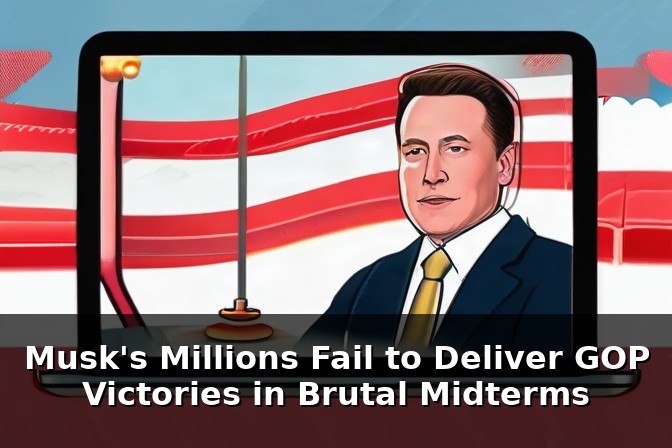
Musk's Millions Fail to Deliver GOP Victories in Brutal Midterms

Posted by CEO Thomas Prendergast on November 10, 2026 - 12:15am


Musk's Millions Fail to Deliver GOP Victories in Brutal Midterms

The 2026 U.S. midterm cycle entered uncharted territory when one high-profile tech leader unleashed a record-breaking infusion of cash into political contests. Reports indicate that Elon Musk poured nearly $500 million into the election, a personal-scale spend that shattered previous benchmarks for individual political giving. While such a figure is staggering on paper, the ultimate outcomes of the midterms suggest that money, even when concentrated in the hands of a single donor, does not guarantee the political wins it seeks.

Spending nearly half a billion dollars in one election year is more than a political gesture; it’s a statement about the perceived influence of tech founders in shaping policy and public opinion. The funds covered a mix of avenues—advertising, issue advocacy, and strategic campaign support—intended to tilt races, mobilize voters, and amplify favored narratives. For an entrepreneur who built platforms and networks from the ground up, the move underscored a broader trend: business leaders stepping into political arenas with the goal of shaping regulatory climates and public discourse.

Several dynamics help explain the disconnect between a record cash outlay and electoral results:

  • The electorate remained deeply driven by issues that transcended party labels. While spending can elevate messages, it can also intensify skepticism if voters perceive influence-peddling or attempts to skew outcomes.
  • With audiences dispersed across traditional outlets, social feeds, and niche platforms, a single donor’s voice competes in a crowded noise landscape. Messaging must break through a chorus of competing narratives, fact-checks, and counter-narratives.
  • Midterm dynamics often hinge on local concerns—economy, crime, healthcare, inflation—and these topics don’t always align neatly with nationalistic or platform-based messaging from a single donor’s perspective.
  • Audiences scrutinize not only the message but the messenger. When a tech magnate’s motives are interpreted as self-serving or ideological, it can trigger skepticism rather than buy-in from voters.
  • While broad ad buys raise awareness, converting undecided voters requires tailored outreach, ground game, and credible endorsements—elements that may fall short without deep local infrastructure.

What happens when a private individual exerts outsized influence on public affairs? The episode raises important considerations for the intersection of entrepreneurship and civic life:

  • Large-scale personal political spending invites scrutiny of intent, funding sources, and potential conflicts with business interests.
  • If founders wield substantial political capital, discussions about platform moderation, data policy, and innovation incentives become increasingly entwined with governance debates.
  • Money remains a tool, but its effectiveness is conditioned by trust, message relevance, and alignment with voter priorities.

  • Beyond funding, invest in rural and urban outreach, listening sessions, and locally relevant policy proposals that resonate with constituents’ lived experiences.
  • Long-term engagement, transparent motivations, and verifiable benefits can outperform one-off expenditures in shaping public opinion.
  • Coalitions, grassroots movements, and cross-partisan dialogue often yield more durable influence than a single, concentrated donor voice.

The near-record spending marks a notable moment in contemporary political finance: a demonstration of ambition and audacity from the tech space, paired with a complex electoral environment where money alone cannot secure decisive victories. For entrepreneurs watching the midterms from the sidelines, the lesson is clear—building influence requires more than deep pockets. It demands thoughtful engagement, credible messaging, and a lasting commitment to the issues that matter to the broader public.

Thomas Prendergast (clone)
By his direction