
x
Black Bar Banner 1
x

NEW: About Me Look — turn on a full-width dark About Me from your profile Configuration (Profile Page Upgrade). The Academy, profile feeds and Media Feed now read like the News Feed. See Subscriptions »

New: AI Blog Autopilot — free for the next 30 days. Switch it on by November 15th »

NEW: Smart Mail is live — free for every member. Send broadcasts, build lists and run autoresponders. Open Smart Mail »

New training: The Campaign Map. Watch it now »

A+ A−
Ads by Markethive - View All
The Blog Feed
The Blog Feed
» Blog Feed
Write a New Blog Post
Search Blog Status
Most Viewed
Most Recent
Most Shared
Alphabetical
Markethive Blog (default)
My Blog Posts
Friends' Blogs
Blog Categories
All
Advertising
Blockchain & Cryptocurrency
Business Development
Diet & Weight Loss
Environmental
Health and Wellness
History and Culture
Home and Garden
Marketing
Mentoring & Training
Money & Finance
Other
Political
Prayer & Religion
Programming & Technical
Real Estate
Search Engine Optimization
Social Media
Spirituality
Sports & Recreation
Transport
Travel & Events
Website Design
Blogging Tools & Assets
My Blog Info
Members Subscribed to You
Blogs You Are Subscribed To
Website Widget
Wordpress Plugin
Subscribe for Greater Services
Subscribe to one of many subscriptions, each one includes the previous ones.. Unlock powerful tools, advance features, to build a powerful reach.

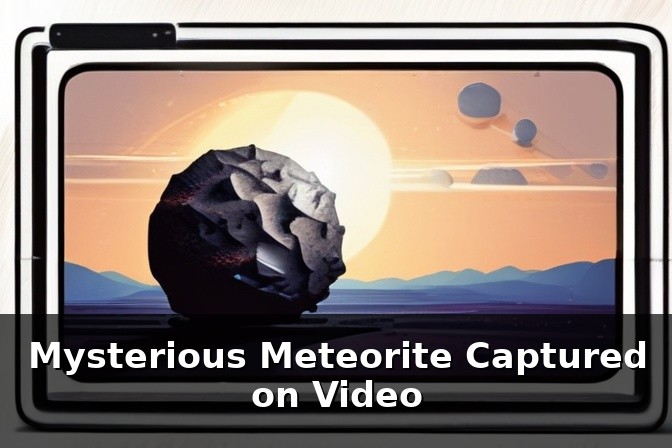
Mysterious Meteorite Captured on Video

Posted by CEO Thomas Prendergast on April 13, 2026 - 6:15pm


Mysterious Meteorite Captured on Video

A Nighttime Fireball? Exploring the Suspected Meteorite Caught on Camera

A late-night flash across the sky has people buzzing. Around 00:30 BST, an observer reported a bright light streaking through the darkness, leaving a trail of questions in its wake. In an era where personal cameras, doorbells, and security systems document daily life, strange celestial moments are more observable—and more shareable—than ever before.

What could the sight have been?

When a bright object moves across the sky, several explanations compete for the spotlight. The most talked-about candidate is a meteor, often called a shooting star. If the object was sufficiently bright and compact, it could have been a bolide—a particularly luminous meteor that sometimes detonates in the upper atmosphere. In rare cases, a meteor fragment might survive as a meteorite, though capturing such a piece on camera is exceedingly uncommon without follow-up evidence.

Beyond natural space rocks, there are plausible non-astronomical sources too. Aircraft lights or contrails can reflect sunlight or moonlight in unexpected ways, creating sudden, bright streaks. Satellite flares, especially from high-reflection systems like Starlink or Iridium satellites, can also resemble a meteor on a clear night. Cameras, lenses, and sensors may produce artifacts or lens flares that mimic a solid streak. Each explanation carries different implications for what viewers might do next.

Why this matters: from a spectacle to data

Even a single sighting can be valuable if documented properly. Meteor events, particularly brighter fireballs, contribute to our understanding of the upper atmosphere and small space debris dynamics. For communities and creators, a well-recorded incident can become an engaging story that blends science with local curiosity. It also demonstrates the power of citizen science: when everyday observers pool data—timestamps, directions, duration, and environmental conditions—the broader picture becomes clearer.

How to verify and add context to the sighting

  • note the exact place you were standing or filming, plus the local time and time zone. A rough bearing (e.g., “toward the north-northeast”) helps others triangulate observations.
  • estimate how long the object was visible and how bright it appeared relative to familiar references (stars, planets, or the Moon).
  • describe whether the streak was steady, curved, or broke apart. Any audible sound is rare for meteors, but note it if present.
  • clear skies, humidity, and light pollution levels all influence what you captured and what others could see from different angles.
  • mention the camera type, lens field of view, exposure time, and frame rate if you recorded video. Even rough notes help researchers and fellow enthusiasts assess the evidence.

Tips for future sightings

  • fixed-angle devices increase the chance of catching a long, uninterrupted trail.
  • a short, continuous clip is more valuable than a single frame cropped from a longer recording.
  • if you can, film with more than one device (phone camera, webcam, or trail camera) to compare and verify.
  • post your observations with date, time, location, and a short description. Encourage others to compare notes and submit their own footage.

What this means for the Markethive community

For entrepreneurs and creators, a skyward moment offers more than awe—it presents an opportunity. Turn a compelling sighting into a multi-part story: what was observed, how it was captured, and what it could mean scientifically. This kind of content can attract curious followers, spark discussions, and become a hub for citizen-science collaboration. By organizing crowdsourced observations, communities can build a rich, verifiable dataset that enhances credibility and engagement.

If you witnessed something similar, consider posting a detailed account and any footage you have. Invite others nearby to share their observations, too. The intersection of astronomy, media, and community-driven science is ripe for thoughtful storytelling, reliable data collection, and real-world collaboration—exactly the kind of content that resonates on entrepreneurial networks and creative platforms alike.