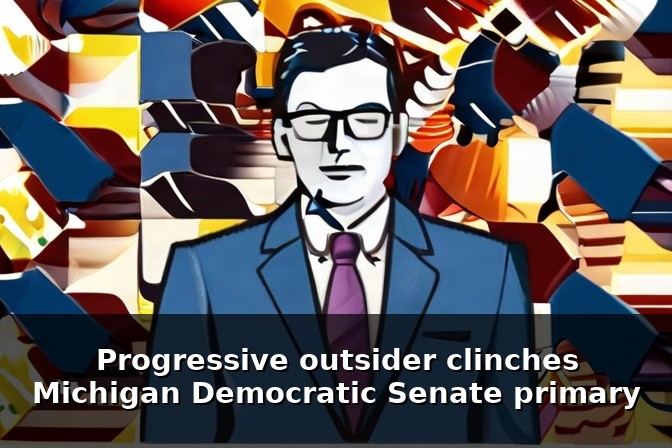
What If Abdul El-Sayed Won Michigan’s Democratic Senate Primary? A Strategic, Hyper-Local Analysis
In this speculative scenario, we examine what it would mean if Abdul El-Sayed, known for his left-leaning outsider stance and his immigrant background, captured Michigan’s Democratic Senate primary and advanced to the November race. While this is a hypothetical exercise, it highlights how a bold, grassroots candidate could reshape policy debates, campaign dynamics, and entrepreneurial organizers’ playbooks.
Who is the candidate at the center of the scenario
Abdul El-Sayed rose to prominence as a physician and public health advocate who championed preventive care, data-driven policy, and bold reforms. He hails from a family of Egyptian immigrants and has built his political identity around progressive ideals—expanding healthcare access, investing in cities, and addressing structural inequities. In this imagined path, his coalition would likely lean on urban centers, young voters, and communities seeking systemic change, with a messaging strategy that blends technocratic competence with a people-first approach.
The significance of a primary win in today’s climate
- Symbolic shift: A primary victory by a young, immigrant, progressive candidate would underscore a broader appetite for change within the Democratic base, especially in Midwest states with diverse populations and complex economic transitions.
- Electoral dynamics: Michigan’s political landscape features urban hubs, union households, and a diverse electorate. A campaign that mobilizes these blocs through digital organizing, canvassing, and issue-focused storytelling could redefine how candidates build coalitions in battleground states.
- Narrative power: The outsider profile can energize volunteers and donors who want to disrupt the status quo, while challenging more established counterparts to articulate concrete, implementable plans for jobs, healthcare, and climate resilience.
Policy implications if the candidate advances to the November race
- Healthcare and economic reform: Expect a robust push for healthcare expansion, cost controls, and stronger support for urban health infrastructure. In an auto-centric state, proposals could pair healthcare access with manufacturing resilience and worker training programs.
- Immigration and civil rights: The candidate’s immigrant background would likely shape a platform emphasizing immigrant integration, equal protection, and anti-discrimination measures—policies that resonate in diverse districts while drawing scrutiny from opponents on border and security debates.
- Industrial transition and jobs: Michigan’s economy depends on the auto sector and evolving mobility tech. A campaign could prioritize a just transition—investing in American-made electric vehicles, battery supply chains, and retraining pipelines for workers whose jobs are transformed by automation.
- Climate action and urban investment: Proposals might fuse decarbonization with infrastructure upgrades for cities and rural communities, leveraging federal funds to modernize water systems, transit networks, and resilient grids.
Campaign mechanics: what would set this race apart?
In a state with tight margins, margins of victory would hinge on a few levers: robust digital organizing, trusted messengers, and a clear, accountable plan. A primary winner with a strong online advocacy engine could convert volunteers into door-knocking squads and micro-targeted ads into real-world turnout. Fundraising would likely hinge on a mix of grassroots donors and coalition partners, coupled with a disciplined field operation that amplifies local voices and community partnerships.
Potential challenges and how to navigate them
- Name recognition and fundraising: A candidate with a reformist, insurgent brand must convert energy into sustained resources, building a diverse donor network and a storytelling pipeline that stays ahead of opposition messaging.
- Party unity: Balancing progressive ambitions with the broader party establishment’s priorities would be essential to prevent fractures that could empower adversaries in the general election.
- Opposition strategy: Expect a well-funded GOP push focusing on experience gaps, policy critiques, and debates over the pace of change in a manufacturing-heavy state.
What Markethive readers can take away
From a marketing and entrepreneurship standpoint, this hypothetical race underscores the power of purpose-driven branding, authentic storytelling, and community-based organizing. It highlights how digital channels, data-informed outreach, and local partnerships can scale a campaign the same way startups scale products. For entrepreneurs, the lesson is clear: align your mission with measurable actions, invest in grassroots networks, and continuously test messages that resonate with a diverse audience.
Bottom line
While this scenario is hypothetical, it illuminates the strategic opportunities and hurdles tied to bold, progressive campaigns in critical states like Michigan. For entrepreneurs and activists alike, the fusion of public policy and practical organizing offers a blueprint for building influence, shaping outcomes, and driving real change at the intersection of politics and business.