
x
Black Bar Banner 1
x

NEW: About Me Look — turn on a full-width dark About Me from your profile Configuration (Profile Page Upgrade). The Academy, profile feeds and Media Feed now read like the News Feed. See Subscriptions »

New: AI Blog Autopilot — free for the next 30 days. Switch it on by November 15th »

NEW: Smart Mail is live — free for every member. Send broadcasts, build lists and run autoresponders. Open Smart Mail »

New training: The Campaign Map. Watch it now »

A+ A−
Ads by Markethive - View All
The Blog Feed
The Blog Feed
» Blog Feed
Write a New Blog Post
Search Blog Status
Most Viewed
Most Recent
Most Shared
Alphabetical
Markethive Blog (default)
My Blog Posts
Friends' Blogs
Blog Categories
All
Advertising
Blockchain & Cryptocurrency
Business Development
Diet & Weight Loss
Environmental
Health and Wellness
History and Culture
Home and Garden
Marketing
Mentoring & Training
Money & Finance
Other
Political
Prayer & Religion
Programming & Technical
Real Estate
Search Engine Optimization
Social Media
Spirituality
Sports & Recreation
Transport
Travel & Events
Website Design
Blogging Tools & Assets
My Blog Info
Members Subscribed to You
Blogs You Are Subscribed To
Website Widget
Wordpress Plugin
Subscribe for Greater Services
Subscribe to one of many subscriptions, each one includes the previous ones.. Unlock powerful tools, advance features, to build a powerful reach.

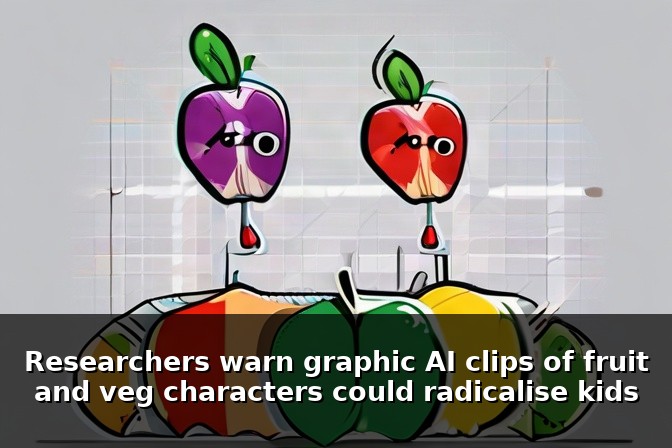
Researchers warn graphic AI clips of fruit and veg characters could radicalise kids

Posted by CEO Thomas Prendergast on August 16, 2026 - 6:15am


Researchers warn graphic AI clips of fruit and veg characters could radicalise kids

Gory AI Clips of Fruit and Veg Characters: What Parents and Platforms Should Know

Generative AI has unlocked a new era of video creation, letting anyone produce vivid, lifelike scenes with familiar characters in a matter of minutes. Recently, a worrying subset of these AI-made clips features cheerful fruit and vegetable mascots enacting graphic violence. Experts warn that such content could desensitize young viewers, blur lines between fiction and reality, and even push vulnerable minds toward extremist or violent ideologies. Here's a clear-eyed look at the risks, why these clips proliferate, and practical steps families, educators, and platforms can take to keep kids safe.

Why these clips are so persuasive—and risky

Two forces collide in these AI productions. First, the characters—bright, friendly produce with big eyes and playful personalities—naturally attract children. Second, AI’s capacity to produce realistic violence at a low cost means shocking, attention-grabbing content can spread rapidly. When fiction crosses into graphic territory, it challenges the brain’s ability to distinguish fantasy from real-world harm, especially for younger viewers who are still learning media literacy. The combination of familiarity and sensational visuals can make extreme ideas seem normal or exciting, a dynamic researchers caution could contribute to radicalization or the normalization of violence over time.

Key risk factors to watch for

  • Repeated exposure to graphic violence can dull emotional responses and lower resistance to aggressive ideas.
  • If violent acts are portrayed casually or humorously, suspicious ideologies can seem trivial or appealing.
  • Platforms’ recommendation systems may push sensational AI clips to keep engagement high, widening exposure beyond intended audiences.
  • Hyper-real visuals can mislead kids into thinking violence shown in videos reflects acceptable real-world behavior.
  • Children and early teens may lack the cognitive filters to critically assess the intent or origin of AI-made content.

Context: where this content comes from

The surge in AI-generated media is not inherently harmful. When used responsibly, AI can aid storytelling, satire, education, and brand creativity. The concern arises when the medium is used to seed harmful beliefs or to push graphic content toward audiences that aren’t prepared to process it. For families and educators, the challenge is not only identifying such clips but understanding how they might influence impressionable minds in our content-saturated world.

Practical steps for parents and educators

  • Use kid-safe streaming platforms with robust parental controls. Create watchlists and disable autoplay on uncertain content.
  • Have conversations with kids about what they see online, the difference between real life and animation, and the intent behind a video.
  • Establish time limits and content types appropriate for different ages. Encourage children to pause and ask questions before sharing or engaging with odd content.
  • Ask kids to describe what surprised them, what seemed real, and what didn’t add up in a clip.
  • Balance entertainment with age-appropriate educational content that models healthy, non-violent problem-solving.

What platforms and policymakers can do

  • Require clear markers for AI-generated or synthetic content, especially when violence is involved.
  • Implement tighter safeguards around violent AI clips and implement stricter age verification for content that features graphic violence.
  • Invest in AI-based detection tools that flag graphic or extremist content and streamline takedown processes.
  • Encourage or require visible watermarks and origin trails to help viewers understand who created a clip and why.
  • Support school and community programs that teach digital discernment and responsible AI use.

Closing thought

As AI tools become more accessible, the line between imaginative storytelling and harmful messaging can blur quickly. By combining cautious content creation with proactive education, families, educators, brands, and platforms can harness the creativity of AI while safeguarding young minds. The goal is a digital landscape where innovative storytelling thrives without normalizing violence or extremism.

Thomas Prendergast (clone)
By his direction