
x
Black Bar Banner 1
x

NEW: About Me Look — turn on a full-width dark About Me from your profile Configuration (Profile Page Upgrade). The Academy, profile feeds and Media Feed now read like the News Feed. See Subscriptions »

New: AI Blog Autopilot — free for the next 30 days. Switch it on by November 15th »

NEW: Smart Mail is live — free for every member. Send broadcasts, build lists and run autoresponders. Open Smart Mail »

New training: The Campaign Map. Watch it now »

A+ A−
Ads by Markethive - View All
The Blog Feed
The Blog Feed
» Blog Feed
Write a New Blog Post
Search Blog Status
Most Viewed
Most Recent
Most Shared
Alphabetical
Markethive Blog (default)
My Blog Posts
Friends' Blogs
Blog Categories
All
Advertising
Blockchain & Cryptocurrency
Business Development
Diet & Weight Loss
Environmental
Health and Wellness
History and Culture
Home and Garden
Marketing
Mentoring & Training
Money & Finance
Other
Political
Prayer & Religion
Programming & Technical
Real Estate
Search Engine Optimization
Social Media
Spirituality
Sports & Recreation
Transport
Travel & Events
Website Design
Blogging Tools & Assets
My Blog Info
Members Subscribed to You
Blogs You Are Subscribed To
Website Widget
Wordpress Plugin
Subscribe for Greater Services
Subscribe to one of many subscriptions, each one includes the previous ones.. Unlock powerful tools, advance features, to build a powerful reach.

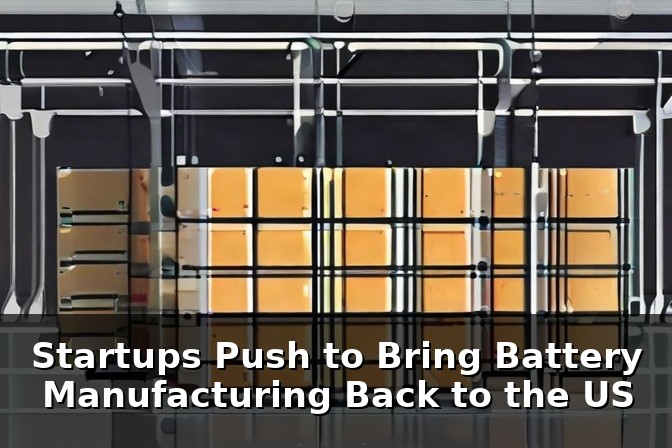
Startups Push to Bring Battery Manufacturing Back to the US

Posted by CEO Thomas Prendergast on October 02, 2026 - 6:15am


Startups Push to Bring Battery Manufacturing Back to the US

The start-ups hoping to return battery making to the US

Across the United States, a new wave of startups is betting that the future of energy storage can be built at home, using sodium-ion chemistry and materials sourced domestically. The idea is simple in premise but ambitious in execution: create reliable, safe batteries with abundant, locally available inputs, and reimagine how and where batteries are manufactured. If successful, this approach could reshape the U.S. energy and transport ecosystems by reducing dependence on far-flung supply chains.

Why sodium-ion—and why now?

  • Material abundance. Sodium is far more available than lithium and is commonly dissolved in seawater or found in salt deposits. This could translate to more stable, less geopolitically entangled supply chains for raw materials.
  • Domestic sourcing potential. With a focus on locally sourced sodium salts, iron, manganese, and phosphate-based chemistries, there’s a path to minimize import dependence and support U.S. mineral processing.
  • Cost considerations. While lithium-ion batteries often lead on energy density, sodium-ion chemistry trades some performance for potentially lower raw-material costs and a more resilient supply chain, especially in a volatile global market.
  • Manufacturing adaptability. Many of the production steps for sodium-ion cells resemble those used in lithium-ion manufacturing. This opens possibilities to retrofit or repurpose existing facilities and equipment with targeted process tweaks.

Building a domestic supply chain

U.S. startups are exploring a mix of strategies to bring sodium-ion batteries to life here at scale. Some focus on closed-loop supply chains that emphasize traceability from mining to cell assembly and eventual recycling. Others pursue partnerships with domestic materials suppliers and regional fabrication hubs to shorten logistics and reduce carbon footprints. A common thread is the aim to minimize reliance on overseas fabs and to leverage a comparatively abundant pool of regional resources.

Key levers include:

  • Developing cathode and anode chemistries that perform well at moderate temperatures and with readily available elements like iron, manganese, and sodium-based compounds.
  • Designing cell architectures and electrolytes that maximize safety and cycle life while keeping production costs in check.
  • Transforming existing battery lines—where feasible—by applying targeted equipment upgrades and process controls tailored to sodium-ion chemistry.
  • Investing in local supply chains for critical materials, with a focus on environmental stewardship and transparent sourcing.

Technical landscape: progress and hurdles

Sodium-ion technology is steadily maturing, but it faces meaningful challenges. Energy density remains a primary hurdle compared with state-of-the-art lithium-ion cells, which affects range for EVs and run-time for grid storage. Researchers are narrowing the gap through improved electrode materials, better electrolytes, and smarter cell designs. Durability, temperature tolerance, and safety are also active areas of development, as is assuring long-term performance across hundreds to thousands of charge-discharge cycles.

Despite the challenges, early pilots and small-scale production trials are progressing. Demonstrations often focus on stationary energy storage and commercial EV applications where the energy density penalty is less critical than reliability, cost stability, and regional supply security. As pilot programs mature, they are expected to reveal how well sodium-ion batteries can compete in price, performance, and lifecycle economics in the U.S. market.

Policy climate and market momentum

Public policy and funding environments are increasingly favorable for domestic battery manufacturing. Legislative measures aimed at accelerating local production, materials processing, and supply chain resilience provide a runway for startups to pilot new chemistries in the U.S. While incentives and subsidies can help offset higher initial costs, the true payoff lies in building scalable, repeatable processes that deliver affordable, reliable energy storage with a domestic footprint.

Recycling and circular economy considerations also play a role. Sodium-ion batteries could integrate with existing recycling streams, enabling the recovery of constituent materials and promoting a more sustainable lifecycle. This aligns with broader environmental goals and strengthens the case for U.S.-based fabrication that prioritizes end-of-life stewardship.

What this means for entrepreneurs and the Markethive community

For startups, the sodium-ion pathway opens opportunities in material science, manufacturing automation, and supply-chain innovation. Entrepreneurs can explore:

  • Modular, scalable production lines that can be deployed closer to demand centers.
  • Local-material sourcing strategies and partnerships with regional mining and processing initiatives.
  • Digital platforms for materials traceability, quality assurance, and end-of-life recycling programs.
  • Battery-as-a-service and long-term performance contracts that reward durability over peak energy density.

As the U.S. rebuilds its domestic battery manufacturing backbone, sodium-ion startups could become a cornerstone of a more resilient, locally rooted energy economy. The coming years will reveal how quickly laboratories convert to pilot plants, pilots to production, and production to a genuine domestic battery supply chain.

Thomas Prendergast (clone)
By his direction

Kevin Jacobson Excellent article highlighting how innovation and entrepreneurship can help restore America's leadership in battery manufacturing. The emergence of sodium-ion technology demonstrates how forward-thinking startups can challenge established industries, strengthen domestic supply chains, and create exciting economic opportunities. This pioneering spirit aligns perfectly with Markethive's mission of empowering entrepreneurs through innovation, independence, and opportunity. It's encouraging to see American ingenuity driving meaningful progress toward a more sustainable and self-reliant future!
October 11, 2026 at 11:20am