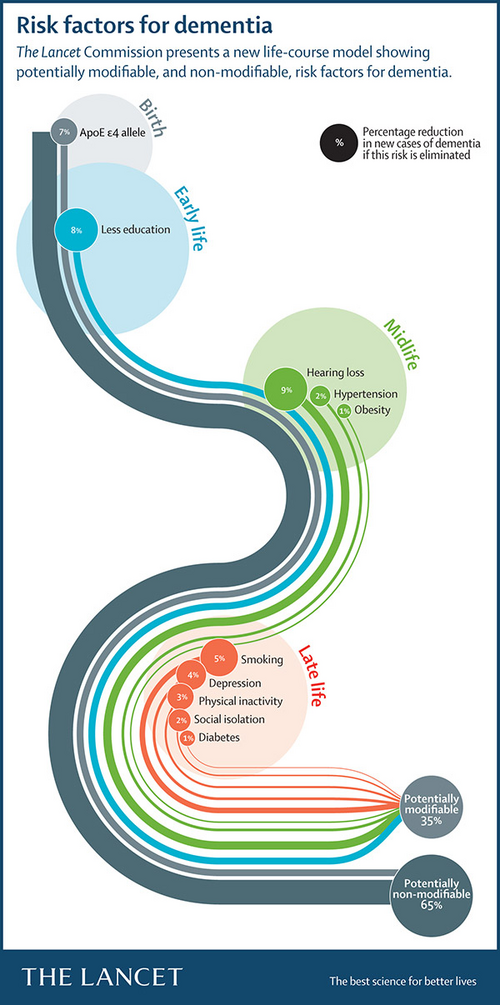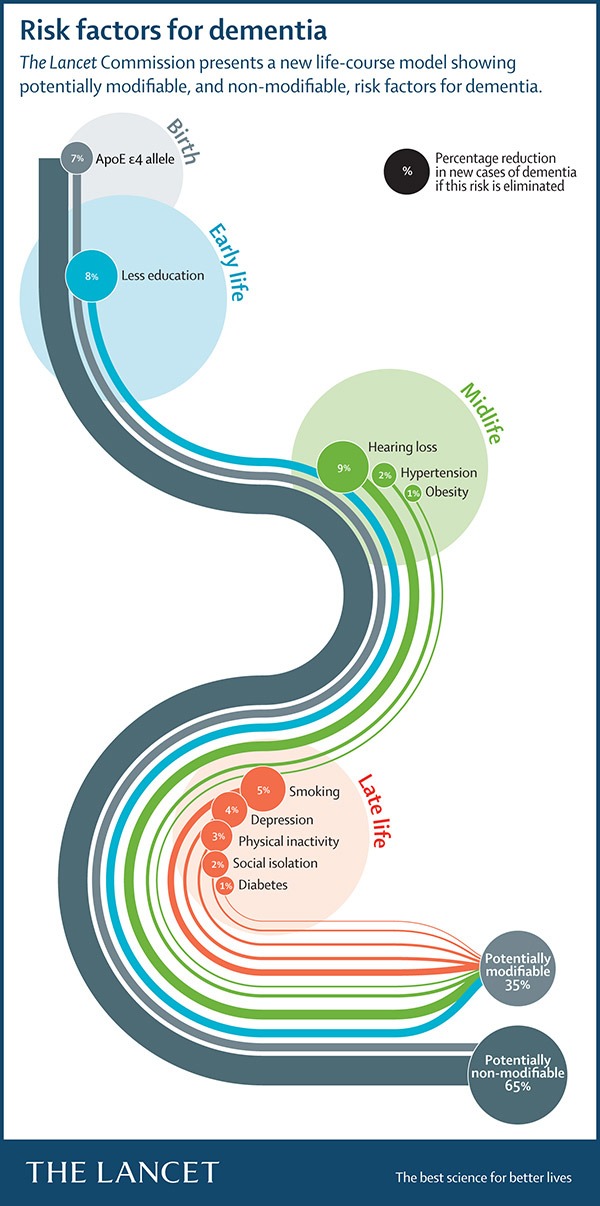
The Lancet Commission brings together 24 international experts to consolidate the huge strides that have been made in our knowledge and understanding of dementia risk factors, treatment and care, and the emerging knowledge as to what we should do to prevent and manage dementia. The Commission conducted a new review and meta-analysis; based on which they extended current models of risk by including hearing loss and social isolation. Incorporating potentially modifiable risk factors from across the life-span, they proposed a novel life-course model of risk, highlighting the opportunity for prevention.
Among their key recommendations are:
- Be ambitious about prevention. Interventions for established risk factors may have the potential to delay or prevent one third of dementias.
- Treat cognitive symptoms. To maximize cognition, people with Alzheimer’s dementia or dementia with Lewy bodies should be offered cholinesterase inhibitors at all stages, or memantine for severe dementia.
- Individualize dementia care. Good dementia care spans medical, social and supportive care; and should be tailored to unique individual and cultural needs, preferences, and priorities.
- Care for family carers. Family carers are at high risk of depression. Effective interventions reduce the risk and treat the symptoms, and should be made available.
- Plan for the future. People with dementia and their families value discussions about the future and important upcoming decisions.
- Manage neuropsychiatric symptoms. Management of the neuropsychiatric symptoms of dementia — including agitation, low mood or psychosis — is usually psychological, social, and environmental, with drug treatment reserved for more severe symptoms.
- Consider end of life. A third of older people die with dementia, so it is essential that professionals working in end-of-life care consider whether a patient has dementia as they may be unable to make decisions about their care or express their needs and wishes.
The Lancet Commission launched a novel life-span-based model of dementia risk, showing interventions that may maximize cognition, decrease distressing associated symptoms, reduce crises, and improve quality of life. The team estimate the contribution of each of the risk factors to the overall incidence of dementia, at the population level. The combined evidence to date shows that roughly 35 percent of all cases of dementia are attributable to nine potentially modifiable risk factors. Many of the risk factors occur at particular life stages but some, such as smoking and hypertension, are likely to make a difference at all life stages.
The nine modifiable risk factors include:
- Early life — Education to a maximum of age 15
- Mid-life — Hypertension; Obesity; Hearing loss
- Later life — Depression; Diabetes; Physical inactivity; Smoking; Low social contact
According to the Commission’s report, worldwide dementia prevalence could be reduced by more than 1 million cases with a 10 percent reduction in the prevalence of seven principal health and lifestyle factors. An intervention that delayed dementia by a year might decrease the number of people living with dementia globally by 9 million in 2050.
The Study
Dementia prevention, intervention, and care (The Lancet)
- Executive Summary: Dementia is the greatest global challenge for health and social care in the 21st century: around 50 million people worldwide have dementia and this number is predicted to triple by 2050. The Lancet Commission on dementia aims to review the best available evidence and produce recommendations on how to best manage, or even prevent, the dementia epidemic. Dementia is not an inevitable consequence of ageing and the Commission identifies nine potentially modifiable health and lifestyle factors from different phases of life that, if eliminated, might prevent dementia. Although therapies are currently not available to modify the underlying disease process, the Commission outlines pharmacological and social interventions that are able to help manage the manifestations of dementia.