x




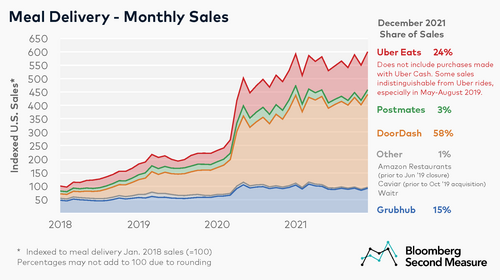
In addition to more consumers ordering from food delivery services, the average sales per customer has increased for these companies during the pandemic. DoorDash and Uber Eats have seen the most growth in average sales per customer over the past two years. At DoorDash, the average sales per customer in the fourth quarter of 2021 was 104 percent higher than in the fourth quarter of 2019. For Uber Eats, the average sales per customer rose 72 percent during the same time period.
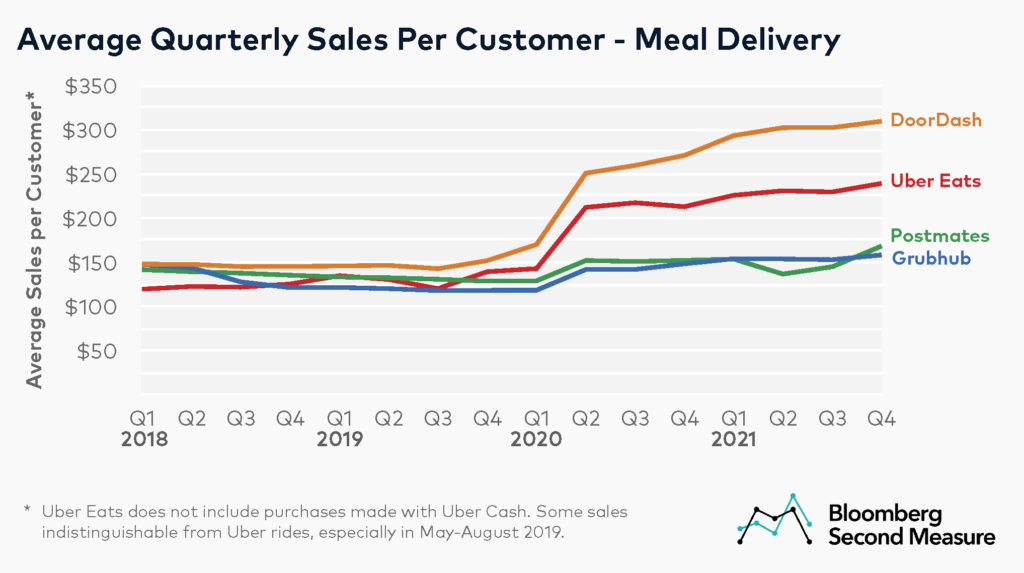
In the fourth quarter of 2021, DoorDash customers spent the most, with an average of $309 per customer. Uber Eats’ quarterly customer spend was the second highest with an average of $239, while customers at Postmates and Grubhub spent an average of $168 and $158, respectively.
As meal delivery services look for new ways to grow in cities big and small, one emerging answer is subscriptions. Last year, Grubhub announced its answer to Postmates Unlimited (launched in 2016) and DoorDash’s DashPass (launched in 2018). Notably, in December 2019, DoorDash partnered with Chase to give free DashPass memberships to millions of credit card holders. (These free memberships are not included in Bloomberg Second Measure’s data.) In December 2021, DashPass attracted 27 percent of DoorDash’s customers, not including the promotional memberships they offered Chase users. In November 2021, Uber also launched its new “Uber One” subscription plan, which offers benefits for both rides and delivery services.
Another very popular growth strategy for meal delivery companies has been forming partnerships with the nation’s top chain restaurants. (Though many services have also been in the news for listing restaurants that do not want partnerships.) In 2020, DoorDash officially teamed up with Little Caesars Pizza, a brand that has never previously offered delivery. DoorDash has other deals with Wendy’s, Chick-fil-A, and McDonald’s, the biggest fast food chain in the country, which also offers delivery with Uber Eats.
Starbucks has a contract with Uber Eats, Popeyes with Postmates, and Taco Bell and KFC with Grubhub. Yet, as Uber Eats and Grubhub public filings show, partnerships don’t always lead to revenue. Often, larger partners pay the delivery services lower fees, decreasing their take rates or even causing them to lose money. Conversely, some restaurants that are relying heavily on delivery amidst the COVID-19 pandemic have reported losing money on orders as meal delivery companies charge high service fees, prompting policy intervention in many cities. New York City has also recently passed legislation to improve conditions for food delivery workers.
However, the partnerships seem to be driving sales for some of the restaurants. The Cheesecake Factory and Chipotle have publicly credited DoorDash with boosting their revenue. In December 2021, DoorDash accounted for 10 percent of December sales at Buffalo Wild Wings and 11 percent at Chipotle (before subtracting DoorDash’s cut or the delivery tip).
Despite overall industry growth, the battle for customers is getting more intense because fewer of today’s diners are loyal to just one service. (Grubhub’s former CEO cited “promiscuous customers” as a hindrance to his company’s growth.) In the fourth quarter of 2019, 59 percent of Grubhub’s customers didn’t use other meal delivery services. Two years later, it’s fallen to 47 percent, as competing services woo customers with different restaurant offerings and promotional prices.
DoorDash saw 61 percent of customers use them exclusively in the fourth quarter of 2021, and for Uber Eats, it was 47 percent. Postmates has the lowest percentage of exclusive customers (32 percent). With the exception of DoorDash, the meal delivery services in our analysis have a lower percentage of exclusive customers than they did two years ago.
We Are Ready To Disrupt The Norm with #SnapDelivered