x




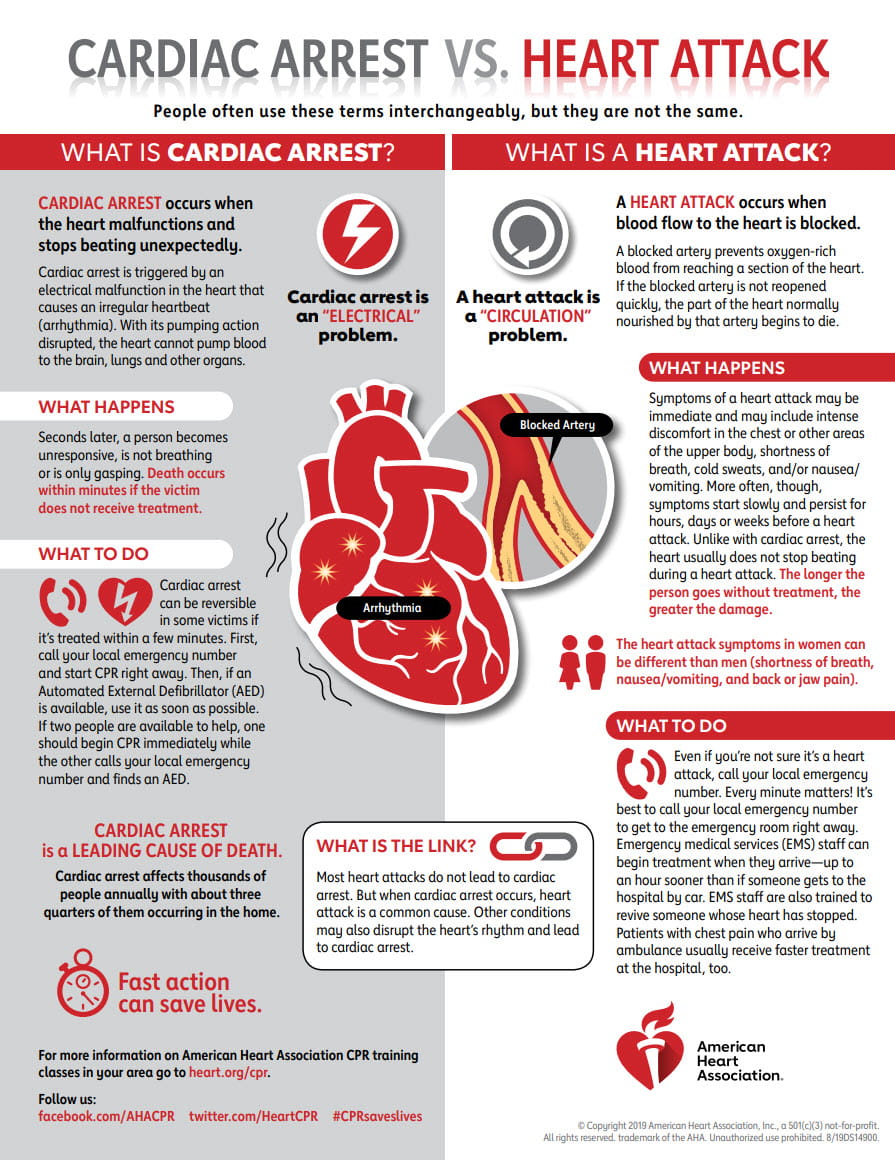
People often use these terms interchangeably, but they are not the same.
CARDIAC ARREST occurs when the heart malfunctions and stops beating unexpectedly.
Cardiac arrest is an “ELECTRICAL” problem.
Cardiac arrest is triggered by an electrical malfunction in the heart that causes an irregular heartbeat (arrhythmia). With its pumping action disrupted, the heart cannot pump blood to the brain, lungs and other organs.
Seconds later, a person becomes unresponsive, is not breathing or is only gasping. Death occurs within minutes if the victim does not receive treatment.
Cardiac arrest can be reversible in some victims if it's treated within a few minutes.
Cardiac arrest affects thousands of people annually with about three quarters of them occurring in the home.
A HEART ATTACK occurs when blood flow to the heart is blocked.
A heart attack is a “CIRCULATION” problem.
A blocked artery prevents oxygen-rich blood from reaching a section of the heart. If the blocked artery is not reopened quickly, the part of the heart normally nourished by that artery begins to die.
Symptoms of a heart attack may be immediate and may include intense discomfort in the chest or other areas of the upper body, shortness of breath, cold sweats, and/or nausea/vomiting. More often, though, symptoms start slowly and persist for hours, days or weeks before a heart attack. Unlike with cardiac arrest, the heart usually does not stop beating during a heart attack. The longer the person goes without treatment, the greater the damage.
The heart attack symptoms in women can be different than men (shortness of breath, nausea/vomiting, and back or jaw pain).
Even if you're not sure it's a heart attack, call your local emergency number. Every minute matters! It’s best to call your local emergency number to get to the emergency room right away. Emergency medical services (EMS) staff can begin treatment when they arrive — up to an hour sooner than if someone gets to the hospital by car. EMS staff are also trained to revive someone whose heart has stopped. Patients with chest pain who arrive by ambulance usually receive faster treatment at the hospital, too.
Most heart attacks do not lead to cardiac arrest. But when cardiac arrest occurs, heart attack is a common cause. Other conditions may also disrupt the heart’s rhythm and lead to cardiac arrest.