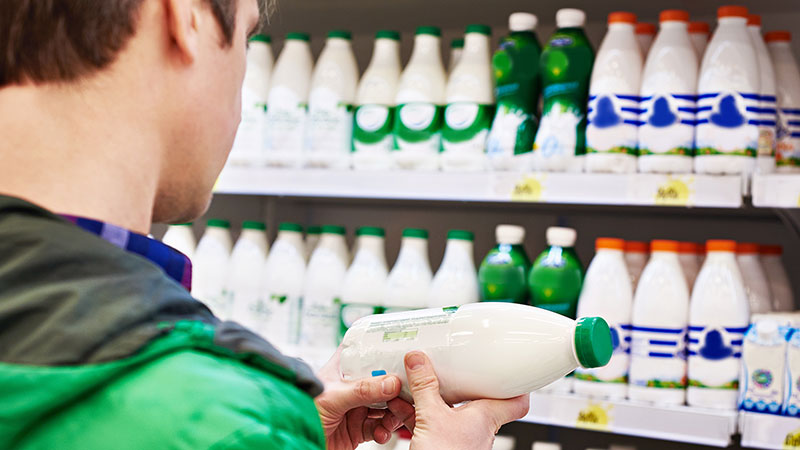
Milk Products
AHA Recommendation
- Choose 2–3 servings of fat-free or low-fat dairy products for adults. Children should have two or more servings, teenagers and older adults should have four.
- For dessert or snacks, choose ice milk, frozen or fruited low-fat or nonfat yogurt, sherbet, sorbet or low-fat puddings.
Choose from:
- Fat-free, zero-fat, no-fat or nonfat milk
- ½–1% low-fat or light milk
- Nonfat or low-fat dry milk powder
- Evaporated fat-free milk
- Buttermilk made from fat-free or 1% fat milk
- Fat-free or low-fat yogurt
- Frozen fat-free or low-fat yogurt
- Drinks made with fat-free or 1% fat milk and cocoa
(or other low-fat drink powders)
- Low-fat cheeses (dry-curd or low-fat, cottage cheese, low-fat natural cheeses or processed cheeses made with nonfat or low-fat milk with no more than 3 grams of fat per ounce and no more than 2 grams of saturated fat per ounce)
- Fat-free or low-fat ice cream (no more than 3 grams of fat per 1/2 cup serving)

Shopping and preparation tips
- Fat-free, ½% fat and 1% fat milk all provide slightly more nutrients than whole milk and 2% fat milk. But they're much lower in fat, saturated fat, cholesterol and calories.
- If you're used to whole-milk products (3.5% fat), you may find it easier to taper off slowly. Try 1% low-fat milk first, then change to ½% low-fat milk. Soon you'll be able to switch to fat-free milk with no trouble.
Note: The servings per day of milk products are higher to reflect revised recommendations for calcium intake — 1,000 milligrams for all adults until age 50; 1,200 milligrams at age 50 and older. For vitamin D, the revised recommendations are 400 I.U.s (International Units) for everyone age 51 and older; 600 I.U.s for age 71 and older.
Imitation Milk
AHA Recommendation
We recommend that adults and children age 2 and older use milk that's low in dairy fats. This includes fortified fat-free (skim or nonfat) milk, fortified nonfat milk powder, and 1/2 percent and 1 percent low-fat milk.
The label on the container should show that the milk has been fortified with vitamins A and D. We also recommend buttermilk made from skim milk and canned evaporated skim milk.
Avoid substitutes that contain coconut oil, palm oil or palm kernel oil. These oils are very high in saturated fats. Saturated fats tend to raise the level of cholesterol in the blood. High blood cholesterol is one of the six major risk factors for heart disease that can be changed, treated or modified. It can also lead to developing other heart and blood vessel diseases.