x




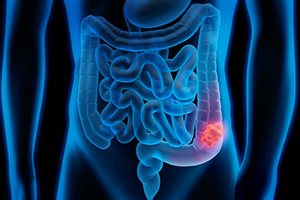
Colon cancer is not something that arrives out of the blue one morning. It starts off with a single damaged colon cell which passes its ‘defect’ on to certain of its fellow cells. But day after day, year after year, this cell accumulates new defects which cause increasing levels of dysfunction, until the final mutation leads to the irreparable development of an uncontrollable cancer cell.
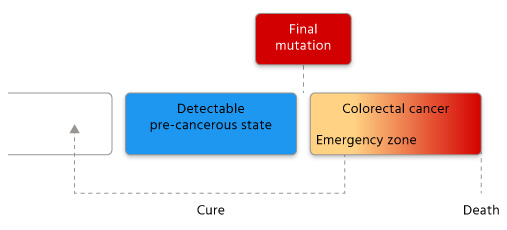
To illustrate the process more clearly, we can use a chronological arrow, with the initial mutation shown on the far left, and the final one resulting in the tumour, on the far right. It’s possible that 10, 20 or even 50 years might elapse between these two stages, but either way, these mutations tend to accumulate over time, moving us slowly towards the right of this axis.
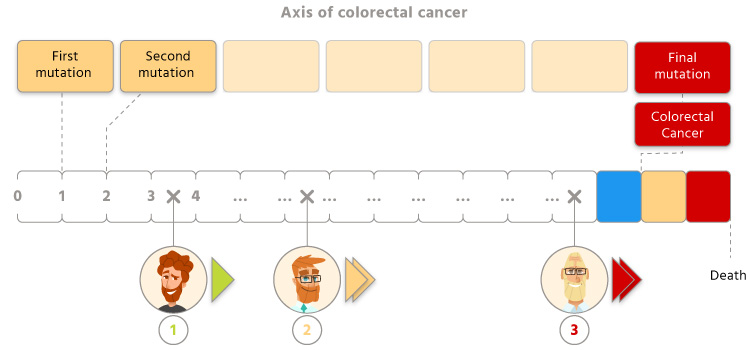
At this very moment, you will be somewhere on this axis. Perhaps, without knowing it, you are (like person no. 3) just one or two mutations away from the one that will trigger the disease. On the other hand, you might be in the same place as person no. 1 – some distance away from this fateful stage. But whatever your position, you will tend to move towards the fatal outcome: it’s just mathematics. Which is how each year, as a result of this apparently inexorable rightward progression, 43,000 people end up crossing the outer limit signalling the onset of colon cancer.
What happens next for them? It all depends on how quickly they react. If too much time passes before the cancer cells silently proliferating in their colon are detected, they will continue to move to the right of this line, getting ever closer to the point of no return: death. Each year, 18,000 people go down this fatal, one-way path.
If, however, the tumour is discovered while they are still at the initial development stage (within the ‘emergency zone’), they can still expect to escape the worst. Medical intervention will to some degree halt the disease’s progress, and if cured, they will return in the other direction, some distance away from colorectal cancer.
How quickly do we progress along this axis?
This is the first piece of good news: the speed with which we move towards colon cancer differs from one individual to another. The fastest may reach the other end in less than 40 years, while some people will never get there.
The rate at which we progress depends, to a small degree, on the genetic material we inherit from our parents: some people will unfortunately move rapidly along this line because of a genetic predisposition to mutations. But the second piece of good news is that this rate depends primarily on our diet. Scientists agree that between 70% and 90% of colorectal cancers could be avoided with preventive dietary interventions. This is hardly surprising given that this is a region of the body which is constantly exposed to the foods we ingest, as well to the breakdown products they produce and the bacterial populations they promote.
In other words, you can slow down or stop your rightward progression provided you prioritise foods, nutrients and micronutrients that are scientifically recognised as natural and effective protectors against colorectal cancer. The more you include these compounds in your diet, the more you will reduce your risk of one day falling victim to colorectal cancer. It doesn’t matter that you have previously had a terrible diet or that you are getting close to the limit, there is still time to prevent those final mutations!
So, what dietary changes do you need to make? There are currently at least four, each of which will help you reduce your relative risk of developing colorectal cancer, and these risk reductions obviously have a cumulative effect: the more you embrace these measures, the slower your progress along the axis of colorectal cancer.
.png)