x




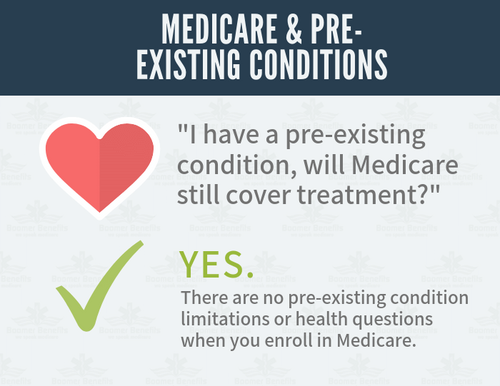
Many people are lucky enough to enter Medicare in good health. Others may already be dealing with chronic conditions and fear Medicare won’t cover them. This is an understandable fear, so let’s review Medicare and pre-existing conditions. (This post was updated in 2022)
Yes, Original Medicare covers all pre-existing conditions. When you enroll in Medicare, there are no pre-existing condition limitations or health questions. You can also enroll in Medigap coverage during your open enrollment window to ensure that your supplemental coverage will also cover pre-existing conditions.
Over the years, I’ve seen people with all sorts of chronic conditions enter Medicare and sign up for Medigap insurance. I once even enrolled someone who was so ill she could not leave her bed.
She had an IV in her arm and a certified nurse aide by her side. However, she was turning 65 and enrolling in Medicare for the first time.
I got to give her the good news that her health conditions would be covered right from the start. There are no Medicare pre-existing conditions restrictions for Parts A, B, or D.
Part A will cover any inpatient needs related to your pre-existing condition. Part B will cover any outpatient needs related to your pre-existing conditions. You can enroll in a Part D drug plan that covers the medications you are taking as well.
This rule about Medicare and pre-existing conditions is a federal law. Without it, there would be thousands of people every year who were afraid to retire.
Fortunately, everyone on Medicare gets an Initial Enrollment Period to sign up for Medicare without any health questions or pre-existing conditions. You’ll also have a limited period of time to get supplemental coverage without any exclusions or limits as well.
We also get lots of questions about pre-existing conditions and Medicare supplement insurance. Concerning Medicare supplements, when you enroll makes all the difference.
The answer is yes IF you enroll during your one-time open enrollment period or under guaranteed issue rules.
When choosing your Medicare supplemental coverage, your state of health is something to consider. While Medicare itself doesn’t ask you any health questions, Medicare supplement companies can accept or decline you if you miss your one-time Medicare Supplement open enrollment window.
However, beneficiaries can enroll in either a Medicare supplement or a Medicare Advantage plan.
All too often, we see people sign up for the cheapest coverage without analyzing their health needs. This can result in unnecessary out-of-pocket expenses down the road.
Let’s look at why.
When you first enroll in Medicare, you’ll usually be making a decision between two types of supplemental coverage: Medicare Supplements vs. Medicare Advantage plans.
Medicare supplements have higher premiums upfront and little to no back-end expenses. Medicare Advantage plans have much lower premiums up front but more back-end expenses.
It can be tempting to enroll in a Medicare Advantage plan that offers a low premium to enrollees. However, there is a trade-off here.
As a member, you’ll need to see providers who are in the network. You’ll also pay copays for your healthcare services as you go along. Some services might be no copay at all, but others could be as high as paying 20% of the cost of services.
Copays on Medicare Advantage plans can add up quickly for people with chronic conditions.
It’s important to try to estimate what copays you might incur regularly based on your current medical usage.
For example, if you have diabetes and see your endocrinologist twice a month to monitor your condition, you will incur two specialist copays per month.
If your plan charges $35 for a specialist visit, you will spend at least $70 for those two visits. Your pre-existing conditions will cause you some copay spending that you can estimate ahead of time.
On the other hand, let’s say that in your area, you can enroll in a Medigap Plan G for $120/month. Your visits to the specialist would have no copay due whatsoever, minus your Part B deductible. The same goes for lab testing, diagnostic imaging, surgeries, and more: nothing out of pocket at the time of service.
You’d also be able to get all your diabetes testing supplies covered at 100% from approved Medicare durable medical equipment vendors. A Medigap plan looks pretty attractive in this scenario.
Analyzing these costs will help you determine whether it makes sense to opt for the slightly more expensive but also more comprehensive Medigap coverage. It’s also important to realize that if you select a Medicare Advantage plan up front, you may not later be able to qualify for a Medigap plan again.
Sometimes people with an existing health condition want to change from a Medicare Advantage plan to a Medigap plan or from one Medigap plan to another. In most states, this will require you to answer some health questions and go through medical underwriting. Some applications do get declined.
If you think you have a health condition that may make it difficult to get a Medigap plan later, then you want to be very careful to choose the best coverage for your long-term needs upfront.
Each insurance company has its own rules and underwriting questions. That’s why it’s important to work with a Medicare insurance broker with various Medigap companies to choose from. A qualified broker specializing in Medicare will have the experience to help you evaluate your choices.
Do Medicare supplement plans cover pre-existing conditions?
Yes, they do when you enroll during your one-time Medicare supplement open enrollment window or during a guaranteed issue window. After that point, when you apply for a Medigap plan, they can implement a waiting period for pre-existing conditions, or they can just decline you for coverage altogether.
Do Medicare Advantage plans cover pre-existing conditions?
Yes, Medicare Advantage plans cover pre-existing conditions. You will pay copays and coinsurance for services related to your health conditions as you go along.
Can you be denied Medicare coverage?
Not if you are eligible for Medicare by aging in at 65 or by qualifying for Medicare after 24 months of Social Security disability income benefits. However, you must enroll in Medicare during a valid enrollment period.