x




If you’re overweight or have developed a paunch, you’re probably suffering from chronic inflammation of your adipose tissue. This is a silent pathological process which sooner or later will become a ticking time bomb, so it makes sense to read up on the latest findings published in the journal Metabolism1 and take action fast.
What happens when you put on weight?
Gaining weight is an entirely natural process – it’s the means by which energy which is surplus to immediate requirements is stored for future use. In this way, there is never any waste and the body is able to survive periods of food scarcity without difficulty. Unfortunately, what was a blessing for our ancestors has turned into a veritable curse in today’s affluent societies. Decreased levels of physical activity, an abundance of foodstuffs and the calorific nature of that food have all interfered with this mechanism and led to an epidemic of excess weight.
When a person becomes overweight, it’s because their calorie intake has exceeded their energy output for a certain period of time: the surplus energy has therefore been stored in specialised cells called adipocytes. It is these cells which primarily make up adipose tissue, the soft tissue responsible for unsightly bulges. Energy reserves are stored in the form of lipids: they penetrate the adipocytes which inflate like balloons as the fats accumulate.
If the calorie/energy imbalance persists, the adipose tissue continues to expand, forcing the body to recruit yet more fat cells and to reconfigure blood flow pathways in order to feed them properly. But if the adipocytes grow too large, they end up becoming oxygen-deficient and they suffocate: the blood vessels are no longer able to reach them and the oxygen diffusion distance may be exceeded2-3.
This lack of oxygen, or hypoxia, creates chaos in adipose tissue.
The process is a vicious circle: the decrease in blood flow to fatty tissue affected by fibrosis can lead to necrosis of fat cells which attracts other macrophages and further increases inflammation levels9 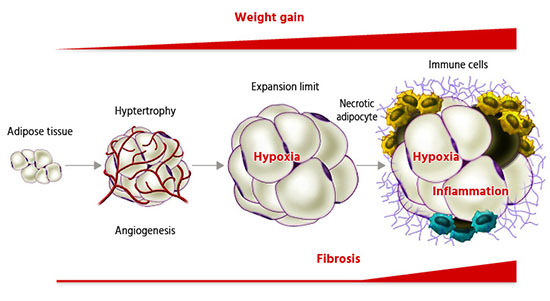
How can you tell if your adipose tissue is normal?
According to scientists, fibrosis of fatty tissue does not just occur in obese individuals. It can also develop in slim people with very little fat under the skin, but who have a ‘potbelly’ or are ‘apple-shaped’. In such individuals, fat is deposited in the abdominal area, in the innermost layers of the stomach around the internal organs. This particular pattern of fat accumulation is especially dangerous to health.
Fat is deposited at several main sites in the body: subcutaneous tissue, visceral tissue, around the hips and around organs such as the heart and kidneys. Each of these types of fat deposit has a specific hormonal profile, ie, they do not all secrete the same messengers and do not, therefore, lead to the same consequences if the deposits get bigger or become problematic. For example, fat deposited in subcutaneous tissue does not appear to be linked to obesity, whereas that deposited in visceral tissue seems to be particularly vulnerable to fibrosis10.
How do you know if you should be worried about your abdominal fatty tissue? To be certain, you’d need to measure your inflammation levels and identify whether or not fibrosis has taken place. A simpler guide is whether or not you feel too fat in the abdominal area, although this is not necessarily indicative, since slim people can be affected while obese individuals remain ‘metabolically healthy’11. How you feel, what your body’s telling you, whether you’re suffering from inflammation problems or fatigue and if you’re finding it difficult to lose weight (even if you’re not significantly overweight) are all vital clues.
What happens if you do nothing?
It should be stressed that fatty tissue is not simply a facility for storing fat: it’s an organ which secretes numerous chemical messengers (in particular, leptin and adiponectin) which have a direct effect on the body as a whole - the immune response, blood pressure, haemostasis, regulation of bone mass, food intake, functions controlled by the thyroid and even reproduction. In other words, if your fatty tissue has been affected by fibrosis, it’s your whole body that suffers.
It therefore requires urgent action in order to prevent the threat of type 2 diabetes or atherosclerosis. The longer you wait, the more likely it is that fibrosis will develop and cause overall degeneration of tissue. Following are five steps to consider right now if you want to reduce your fatty tissue and inflammation levels:
Don’t forget: allowing yourself to gain weight means maintaining a state of inflammation which will inevitably lead to health problems and will sooner or later become irreversible.
.png)