x




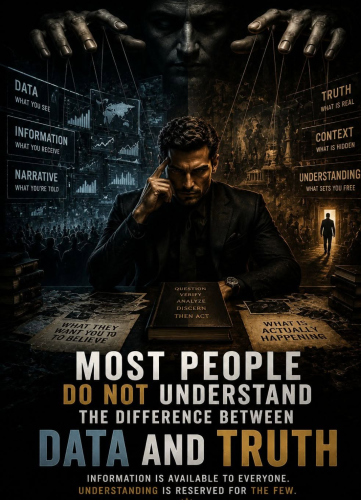
MOST PEOPLE DO NOT UNDERSTAND THE DIFFERENCE BETWEEN DATA AND TRUTH
Information by itself is meaningless. Raw data does not automatically produce intelligence. Facts do not interpret themselves. Numbers do not explain motives. And visibility does not guarantee understanding.
This is why two people can observe the same event and arrive at completely different conclusions. Because human beings do not merely receive information. They filter it through fear, desire, ideology, insecurity, loyalty, ego, and expectation.
Perception alters interpretation long before logic enters the room.
This is also why intelligent people are still manipulated constantly. They assume access to information protects them from deception, when in reality, most deception works by controlling interpretation rather than hiding facts completely.
The modern world rarely lies directly.
It overwhelms.
Distracts.
Frames.
Selects.
Amplifies.
Suppresses.
Recontextualizes.
And emotionally reactive people become easy to govern because they interpret information through impulse instead of verification.
This is why strategic operators never base major decisions on isolated information.
One source is vulnerability.
One perspective is blindness.
One narrative is dependency.
Real intelligence requires comparison, contradiction, pattern recognition, and emotional detachment from preferred conclusions. Because the most dangerous lies are usually attached to things people already want to believe.
And enemies understand this well.
They feed false information selectively. They leak partial truths. They manufacture narratives capable of producing predictable emotional reactions. They understand that controlling perception is often easier than controlling reality itself.
Once emotion enters analysis, objectivity begins collapsing.
Fear exaggerates threats.
Hope ignores risks.
Hatred distorts judgment.
Pride rejects correction.
And the individual convinced they “already know” becomes the easiest person to manipulate.
This is why disciplined skepticism is a strategic advantage. Not paranoia. Not cynicism. Verification.
The ability to pause before reacting.
The ability to question emotionally satisfying conclusions.
The ability to distinguish evidence from interpretation.
Because information is abundant now. Accurate interpretation is rare.
Most people consume data passively.
Strategic people interrogate it aggressively.
And that difference alone determines who becomes manipulated — and who understands the machinery manipulating everyone else.