x




What causes the Northern Lights? As nature’s most spectacular light show, the aurora borealis is an unforgettable sight that’s shrouded in mystery. Colossal sheets of vividly colored light shimmy and dance across the night sky in locations near or within the Arctic Circle, from Siberia all the way to Iceland. How and why are they even there?
“A greenish-white light spread over half of the sky, and, even as I watched, it started billowing and pulsing in great curtains, in constant motion, as if we were enjoying a cosmic fireworks display,” says Historian Victoria Salem, as she recalls a sighting from Silver Cloud – one of Silversea’s expedition cruise ships – while lecturing on a voyage to Greenland. “It’s amazing how much the shape, composition and even color of the lights shift over time. One night it was predominantly pale green, with just a hint of purple at the edges.” On a Northern Lights cruise, ships’ Captains will often dim the lights to enhance the spectacle’s effect. Aurora spotters are advised to bring a camera, as the phenomenon appears more vivid in pictures than to the naked eye. Plus, your Northern Lights photography is documented proof that you saw nature’s fireworks.


The aurora borealis from the expedition cruise ship, Silver Cloud, off Greenland/Lacey Dawson
It’s easy to understand how legends have emerged in far-north countries, as attempts to explain this seemingly mystical phenomenon become creative. Despite their magical allure, there’s a scientific explanation behind the northern lights: Solar electrical particles collide with gas particles in the earth’s atmosphere, creating the visually breathtaking phenomenon.
When magnetic fields on the sun get twisted together, they create sunspots, and particles escaping from these sunspot regions create something called solar wind. After traveling 93 million miles to our planet, the solar wind is lured by the magnetic North and South Poles. The varying colors are caused by different gases in the earth’s atmosphere, says Dr. Don Hampton, Research Associate Professor of Space Physics at the Geophysical Institute of the University of Alaska at Fairbanks.
A shade of greenish-yellow, the most common color visible during one of these light shows, is caused by solar particles colliding with oxygen in lower altitudes—up to 150 miles above the earth. A collision with oxygen at very high altitudes, over 180 miles above the earth, produces much rarer shades of red. A pinkish-red at the lower edges of the sheets of light is common, created by collisions with nitrogen particles. According to Hampton, a purplish glow is also seen when solar particles get charged by nitrogen at sunset.
The name aurora borealis, which was conceived by astronomer Galileo Galilei in 1616 after the Roman goddess of the dawn and the Greek word for the north wind, refers, strictly speaking, only to the lights in the Northern Hemisphere. In the extreme Southern Hemisphere, which is far less inhabited, it’s called the aurora australis. The best places to see the Northern Lights are in remote locations—far from cities and their light pollution— on cloudless and moonless winter nights. While the aurora borealis is often visible from Northern Europe cruises, sightings are never guaranteed, as visibility is dependent on the weather and solar conditions.
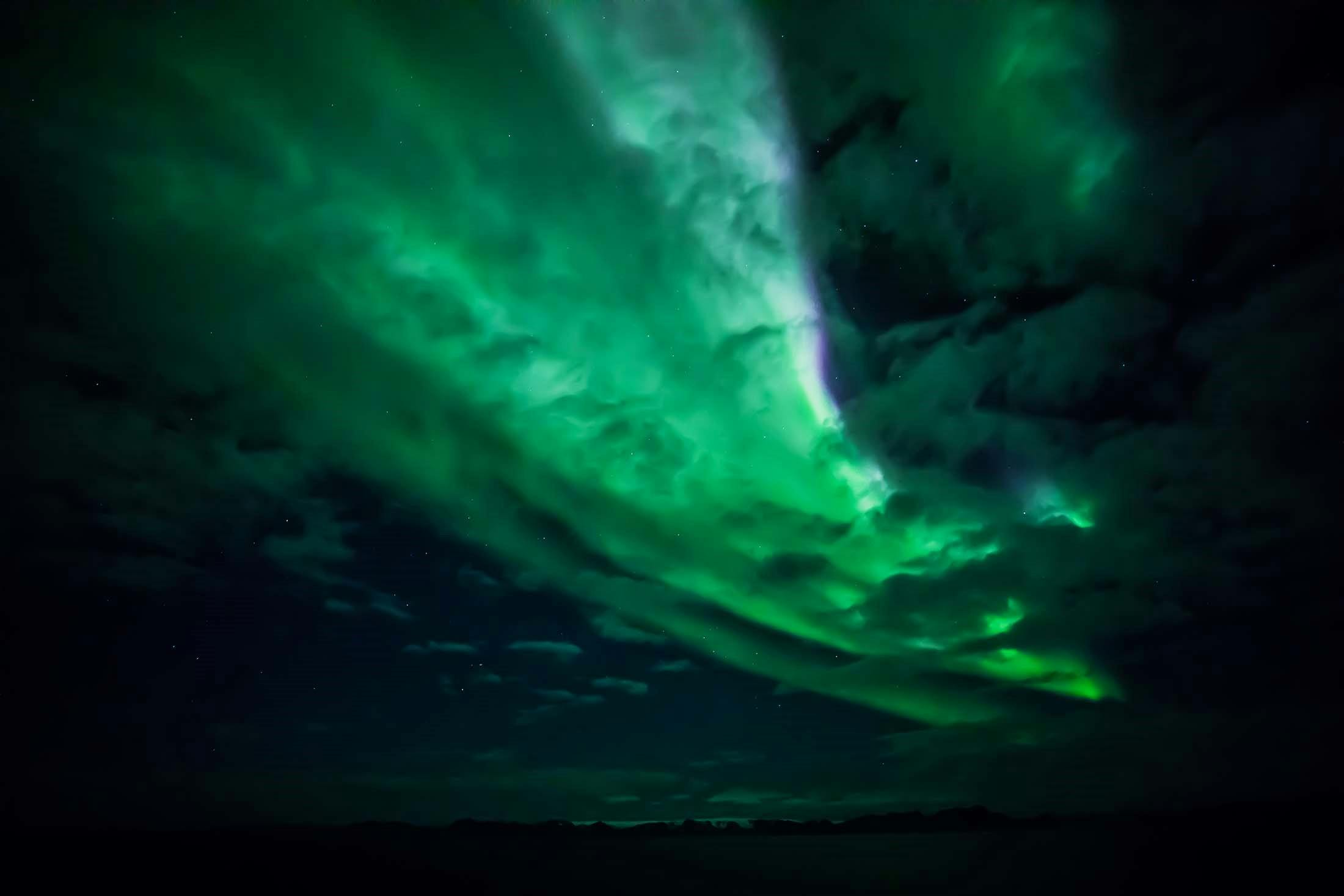
The lights appear to ‘dance’ due to solar flares. “When solar flares are active, the magnetic fields get pushed out and disturbed, making ripples like waves in water,” says Dr. Kristina Lynch, who studies the Northern Lights as a Professor of Physics and Astronomy at Dartmouth College in Hanover, New Hampshire.

Dr. Lynch and her team have launched NASA rockets into auroras to take electromagnetic readings from multiple observation points at Poker Flat Research Range, operated by the University of Alaska at Fairbanks.“If you understand how auroras work, it tells you about that planet,” adds Lynch, noting that Jupiter, Saturn and Uranus also experience the phenomenon. “If there is an orderly aurora, like the Earth has with halos around the poles, it can tell you where the magnetic field is and something about its strength, as well as its interaction with the solar wind.”
Near Fairbanks in Alaska, auroras are visible about two nights out of three in February. But, when solar flares are especially powerful, auroras can be seen much farther south, even in Texas. Auroral activity peaks in strength every 11 years; the last peak occurred in 2013, says Lynch.
Victoria Salem recalls that auroral activity occurred on a total of seven nights of Silver Cloud’s cruise itinerary in Greenland. As we edge ever closer to a peak in the strength of this phenomenon, there could be more frequent sightings and brighter flares on the way. So don’t forget to look to the skies!
Cruising The World