x




To stay mentally fit, you need to stay physically fit.
But for those suffering from dementia, aerobic exercise and strength training may be beyond them. Fortunately, an easy exercise program is now available that fits the bill for just about any health situation.
This new exercise program is not only transforming the physical lives of many dementia patients, it’s improving their cognitive function in amazing ways.
Best of all, you can perform these exercises while you sit on your sofa.
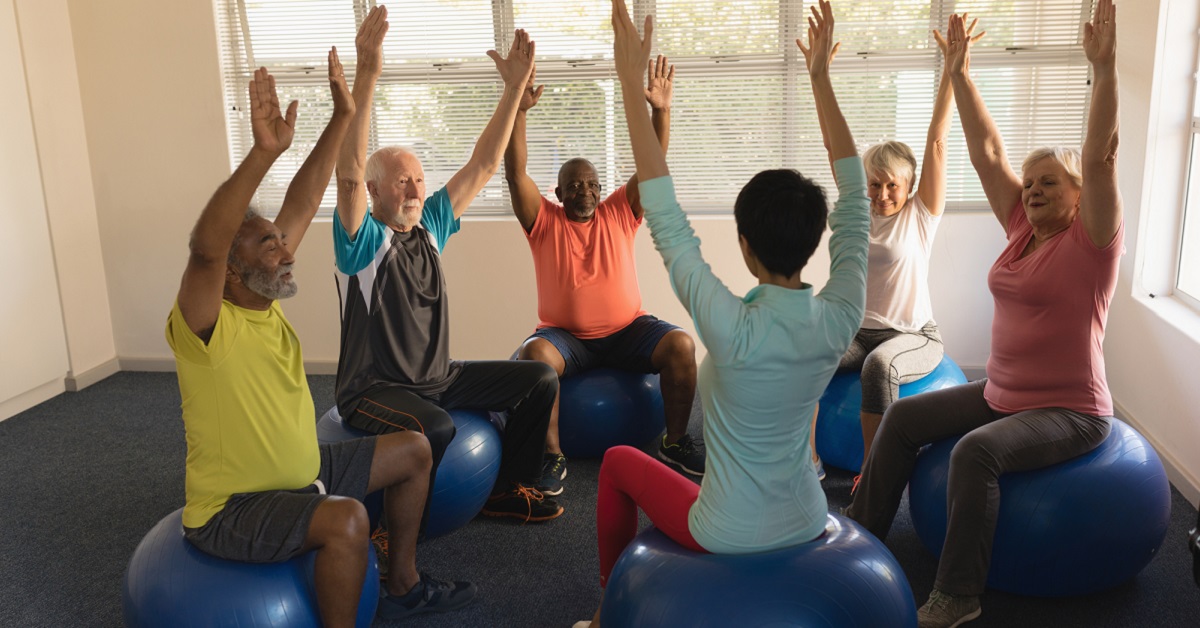
When Patrick Bonner, head of the British Gymnastics Foundation, visited Japan four years ago, he witnessed a chair-based exercise program that was changing peoples’ lives. The results were so remarkable he felt compelled to introduce it to the West.
“It isn’t just exercise,” he explained, “it’s unique.”
There are a number of key components to the program, called Love to Move, but the unique aspect of it, and one of the main reasons it’s thought to work so well, is that it uses “bilaterally asymmetrical movement patterns.”
That’s a mouthful, but it just means body movements on the left side do not mirror body movements on the right side. For instance, one of the exercises is called “drawing sticks and circles” where the left arm moves up and down while the right arm moves in a circle.
Mr. Bonner explains why these types of exercise are important: “They do something quite amazing in the brain for all adults, whether they have dementia or not.
“The science that lies behind the specially designed brain-training exercises has a transformational effect… as new pathways are created by the brain.”
Mr. Bonner goes on to say, “They require both sides of the brain to work independently and individually. Without you realizing it, your brain has to work much harder and the effect of that is to increase cognitive reserve.”
To my longtime readers who have a really good memory, the principle behind Love to Move is not entirely new. Years ago I reported that a righthanded person could improve cognition by forcing himself to do things with his left hand. Lefthanded people can achieve the same result by just doing the reverse.
This builds cognitive reserve, which makes the brain more resilient, utilizes more neurons, and enables everyday tasks to be processed more easily. Building cognitive reserve is believed to reduce the risk of dementia.
There are many other ways to build it – cognitive reserve is believed to be the reason people who are more educated or “use their heads more” have a much lower incidence of dementia.
But if you didn’t go to college, or you’re not a chess or bridge champion, fear not: Love to Move can cause your brain to spark up.
The simple Love to Move exercises have a profound effect on people with dementia.
Kim Hall, the lead coach, remarked that she “thought the program would, at best, just be able to slow down the rate of dementia progression. But we have found some participants are regaining functions thought to have been lost.”
For example, a wheelchair user who needed to be pushed started wheeling himself after beginning the Love to Move program.
Then there’s Hazel, age 97, who was reclusive, couldn’t concentrate, stopped talking and struggled to feed herself. Now she chats away, reads better, can pick up a hot cup of tea safely and is able to knit.
“When I went into the care home I was gone,” Hazel said, “there was nothing left inside me. Then I started doing Love to Move. I can feed myself. I can knit. I feel like I am a person again.”
Another participant had lived with dementia for two years. She was no longer able to use a coffee machine. After just two weeks of performing the exercises for 20 minutes a day, and with no other changes in her life, she was able to recall the complex sequence of actions needed to operate the machine and make herself a fresh cup.
Meanwhile, Ricky, a 77-year-old dementia patient, was confused, depressed and anxious with no confidence. His daughter describes what happened next.
“We tried the class on the premise that he would be able to sit and do a few exercises that weren’t that complex on the face of it.
“Slowly, it stimulated him in so many ways. His cognitive function improved, so did his appetite to be with other people. And then, as he got more comfortable, he would help to make the teas and coffees, and put the chairs out. It gave him a sense of purpose.”
.png)