x




From Sinatra to Katy Perry, celebrities have long sung about the power of a smile—how it picks you up, changes your outlook, and generally makes you feel better. But is it all smoke and mirrors, or is there a scientific backing to the claim?
Groundbreaking research from the University of South Australia confirms that the act of smiling can trick your mind into being more positive, simply by moving your facial muscles.
With the world in crisis amid COVID-19, and alarming rises of anxiety and depression in Australia and around the world, the findings could not be more timely.
The study, published in Experimental Psychology, evaluated the impact of a covert smile on perception of face and body expressions. In both scenarios, a smile was induced by participants holding a pen between their teeth, forcing their facial muscles to replicate the movement of a smile.
The research found that facial muscular activity not only alters the recognition of facial expressions but also body expressions, with both generating more positive emotions.
Lead researcher and human and artificial cognition expert, UniSA’s Dr. Fernando Marmolejo-Ramos says the finding has important insights for mental health.
“When your muscles say you’re happy, you’re more likely to see the world around you in a positive way,” Dr. Marmolejo-Ramos says.
“In our research we found that when you forcefully practice smiling, it stimulates the amygdala—the emotional center of the brain—which releases neurotransmitters to encourage an emotionally positive state. For mental health, this has interesting implications. If we can trick the brain into perceiving stimuli as ‘happy’, then we can potentially use this mechanism to help boost mental health.”
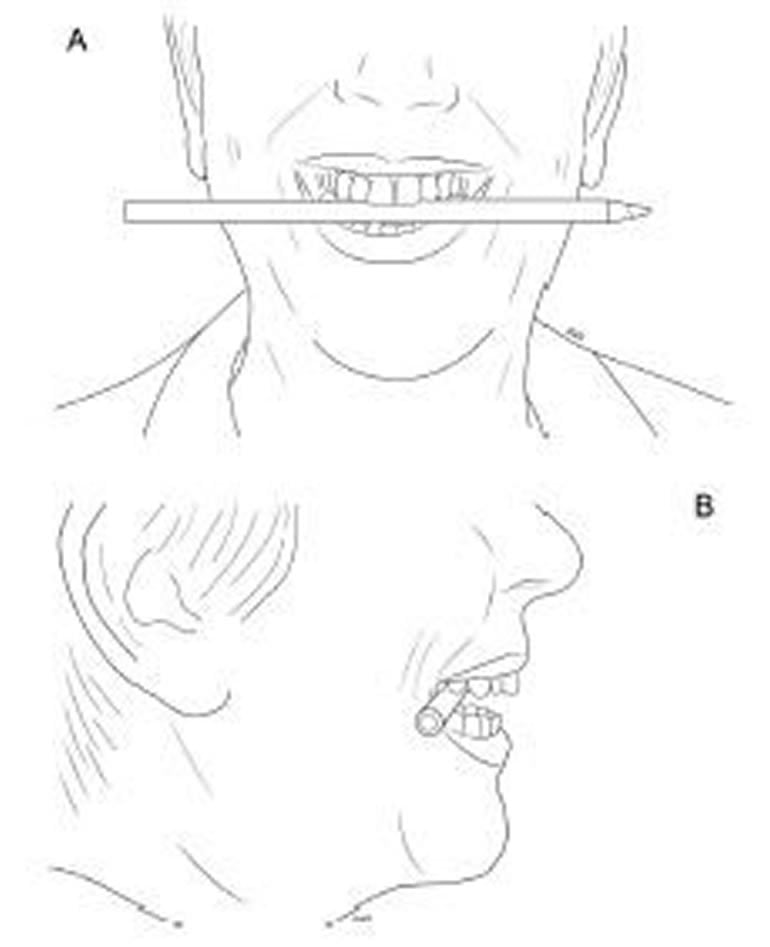
Illustration of the way a pen is held between the teeth in order to induce a covert smile: (A) a frontal view and (B) a profile view. Image is credited to Daniela A´ lvarez.
The study replicated findings from the “covert” smile experiment by evaluating how people interpret a range of facial expressions (spanning frowns to smiles) using the pen-in-teeth mechanism; it then extended this using point-light motion images (spanning sad walking videos to happy walking videos) as the visual stimuli.
r. Marmolejo-Ramos says there is a strong link between action and perception.
“In a nutshell, perceptual and motor systems are intertwined when we emotionally process stimuli,” Dr. Marmolejo-Ramos says.
“A ‘fake it ’til you make it’ approach could have more credit than we expect.”
Abstract
Your face and moves seem happier when I smile. Facial action influences the perception of emotional faces and biological motion stimuli
In this research, we replicated the effect of muscle engagement on perception such that the recognition of another’s facial expressions was biased by the observer’s facial muscular activity (Blaesi & Wilson, 2010). We extended this replication to show that such a modulatory effect is also observed for the recognition of dynamic bodily expressions. Via a multi-lab and within-subjects approach, we investigated the emotion recognition of point-light biological walkers, along with that of morphed face stimuli, while subjects were or were not holding a pen in their teeth. Under the ‘pen-in-the-teeth’ condition, participants tended to lower their threshold of perception of ‘happy’ expressions in facial stimuli compared to the ‘no-pen’ condition; thus replicating the experiment by Blaesi and Wilson (2010). A similar effect was found for the biological motion stimuli such that participants lowered their threshold to perceive ‘happy’ walkers in the ‘pen-in-the-teeth’ compared to the ‘no-pen’ condition. This pattern of results was also found in a second experiment in which the ‘no-pen’ condition was replaced by a situation in which participants held a pen in their lips (‘pen-in-lips’ condition). These results suggested that facial muscular activity not only alters the recognition of facial expressions but also bodily expression.