x




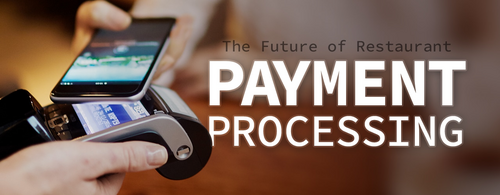
Long gone are the days of exchanging cash for services. It’s 2018, and there are a variety of entirely digital ways to pay for everything from haircuts to dinner and drinks. It can be hard to navigate the quickly evolving world of restaurant payment processing, but restaurateurs have to keep up in order to keep their business current. For restaurant owners who are looking to have a thumb on the pulse of where the future of restaurant payment processing might be headed, your best bet is to stay on top of the elements covered here: credit cards, app-based payment processing, the role of cryptocurrency, and automation.
You know those little chips that started showing up on credit cards a couple of years ago? They’re not a passing fad—they’re here to stay for the foreseeable future.
Credit card chips are called EMV chips, which stands for Europay, MasterCard, and Visa because these are the three companies that got together to launch the transition to chips in the first place.
No, your business is not required by law to accept credit card chip payment. There were a couple of compliance dates set which told merchants when they were supposed to be able to accept EMV payment, but it is a common misconception that those dates are tied to law. They aren’t. Europay, Mastercard, and Visa set compliance dates in order to penalize their non-compliant merchants after a certain time.
While there is nothing set in stone to say that it’s the EMV way or the highway, chances are that chip-based credit card payments will eventually be the only option—it’s just not clear when that day will be.
The thing that stays the same regardless of whether you’re swiping magnetic strips or dipping chips is the fact that you’ll be paying to process credit cards. About 81% of all of the money spent at full-service restaurants in the U.S. comes through cards and other digital means. Figuring out what that’s going to cost you as a restaurant owner can be a hassle since restaurant credit card processing fees are different for every card and payment method you accept.
Speaking of other digital means of payment, another element to keep your eye on when dissecting what the future of restaurant payment processing might look like are contactless payment methods.
Contactless payment methods are mobile payment apps like Android Pay, Apple Pay, Google Wallet, and more. These kinds of payments are called near-field communications, or NFC for short, because they transfer data between two machines that don’t actually touch. Instead, customers do something like wave their cell phone over a pad designed to read it.
In 2017, the research firm Forrester predicted that NFC payments would reach $142 billion by 2019, but the expectation has now shifted to $2.85 trillion by 2020.
Cryptocurrency is one of the most cutting-edge payment methods today. This being said, most cryptocurrencies are not designed for point-of-sale, so it remains unclear if they will play a role in the future of restaurant payment processing.
Cryptocurrency is the complicated digital exchange process that basically boils down to the generation and management of digital currencies, AKA money. It’s by no means everywhere yet, but there are already dozens of restaurants across the U.S. that accept Bitcoin—one particular type of cryptocurrency—as payment.
The central argument in favor of restaurants and other providers accepting cryptocurrency as payment is that it allows them to still accept digital payments without all of the high credit card processing fees that are associated with all other methods of digital payment. Another argument is that cryptocurrency exchanges keep the customer’s information safe because transactions are ultimately secure and anonymous thanks to the distributed ledger network that handles them.
On the other hand, cryptocurrency payment requires several stages of authorization. While this entire process can take days for credit cards and only a few minutes to a few hours for cryptocurrency, credit card customers don’t have to wait out that entire process.
That said, there are a few companies working to sort that waiting period out right now. Through their online wallet, payment option, and merchant payment services, SpectroCoin is working to help businesses receive Bitcoin-based payments from their customers through the use of a simple QR code.
A major component to consider about the future of payment processing is the level of automation. No matter what kind of payment is being processed, there’s a chance that your restaurant might have a machine rather than a human doing it for you.
Touchscreens and tablets have already become standard ways for customers to order food and drinks in places like airports as well as commonly used methods for servers to quickly take table-side orders and a few pioneering restaurant chains have already begun to pave the way. While we’re still in the early stages of the transition to automated ordering here in the US, it is already popular in places like Japan.
There are certain philosophical considerations to make when replacing a human’s job with a machine. Further, kiosks don’t mean that your restaurant can go staff free—machines are great at taking and processing orders, but not so great at explaining menu items and offering recommendations. Yet, technology like facial recognition software could prove to be the solution to problems like these.
The most important thing to remember when deciding how you might adapt your restaurant to the changing payment processing landscape is this: no one knows your restaurant better than you. Have a clear idea of what you want to achieve and how you want to get there and the answers to payment processing questions will reveal themselves.
.jpg)