x




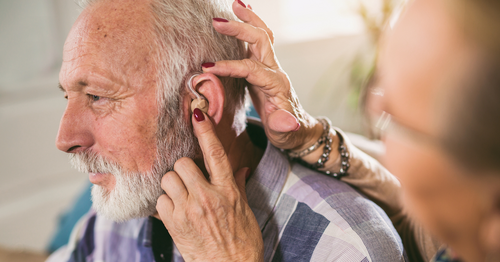
One out of every eight adults suffers from hearing loss, and the older you get, the more likely you are to lose your hearing.
Treatment is as simple as getting a hearing aid, yet millions avoid it. If that sounds like you or someone you love, keep reading. Researchers now point to hearing loss as a strong predictor of dementia and they report that saying “no” to hearing help is gambling with your memory.
Hearing aids are life-changing. Just ask those who wear them and report improvements in their physical, emotional, mental and social well-being. Despite these tangible benefits, hearing aids aren’t popular.
When researchers surveyed those aged 50 and older with hearing loss, only one in seven reported using a hearing aid. This number dropped to fewer than one in 20 when researchers isolated the responses of those in their 50’s with hearing problems.
One reason, researchers say, could be the stigma that surrounds hearing aids. For example, they can be uncomfortable at first, and can make you feel “old.” But researchers say another reason for ignoring a hearing problem is the affordability of these tiny, high-tech devices. Whatever your reason for putting it off, memory researchers want you to know that your memory depends on good hearing.
I’m as vain as the next person, probably more so, but I do not understand the concept of risking your mind, your health and your connection with your nearest and dearest because the treatment makes you look or feel old. And in a country where a “cheap” new car costs $30,000, and people willingly pony up the dough, surely most of us can somehow come up with the money for a hearing aid.
A large review carried out by an international research group found that in mid-life, hearing loss posed a greater risk for accelerated cognitive decline and dementia than obesity or high blood pressure.
What’s more, researchers found that out of all of the modifiable risk factors for dementia, hearing loss management came out as the most effective, successfully preventing nine percent of dementia cases.
Let me underscore that: Nearly one out of every ten cases of dementia could be prevented by hearing aids.
How hearing loss causes damage to the brain isn’t known but there are a number of theories.
For one thing, scientists speculate that higher level cognitive processes involving memory might be compromised by poor hearing because of the need to redirect mental activity towards auditory sensory stimuli and away from storing information.
Another theory is that hearing loss affects processes that are common to both hearing and neurodegeneration in the aging brain. The brain-damaging effect of social isolation caused by hearing loss has also been put forward as a theory behind the link between hearing problems and dementia.
Whatever the reasons, the harm caused to the brain by hearing loss has been reported for some years. And yet, in all this time, no study has ever examined whether the use of hearing aids would slow the conversion of mild cognitive impairment (MCI) to dementia.
This is important to know because people with MCI – who have minor memory and thinking issues – are more likely to develop Alzheimer’s or other dementias. So, a research group from Ulster University in Northern Ireland decided to fill this research gap.
Ulster University researchers looked at data on 2,114 hearing impaired people over the age of 50, some of whom wore hearing aids while others didn’t. The study included people diagnosed with MCI and others diagnosed with dementia at the start of the study.
Lead researcher Dr. Magda Bucholc called the findings “robust”, saying, “We measured the time for progression from MCI to dementia in individuals using hearing aids and those with uncorrected hearing impairment. [We] found that use of hearing aids was associated with a two-year slower conversion to dementia.”
In fact, Dr. Bucholc went on to say, “The percentage of participants who had not developed dementia five years after the baseline MCI diagnosis was 19 percent for non-users of hearing aids and 33 percent for those using hearing aids.”
The results, she said, are a key “first step in triggering policy changes to encourage people with hearing loss who are at risk of dementia to wear hearing aids.”
Ralph Holme, executive director of the Royal National Institute for Deaf People in the United Kingdom, explained, “It is well established that hearing loss is associated with an increased risk of dementia.
“This new research supports the growing view that the use of hearing aids may help slow its onset. Further research is needed to definitively show this, but clearly taking early action to address your hearing loss can only be a good thing.”
.jpg)