x




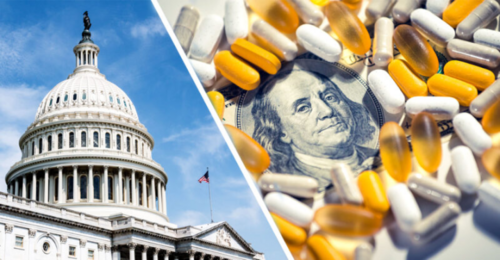
With their long, sordid history, pharmaceutical companies incentivize doctors to prescribe their products through financial rewards. Thanks to their astronomical profit margins, the pharmaceuticals and health products industry is able to spend more on lobbying than any other industry in America.
After graduating from Columbia University with a chemical engineering degree, my grandfather went on to work for Pfizer for almost two decades, culminating his career as the company’s Global Director of New Products.
I was rather proud of this fact growing up — it felt as if this father figure, who raised me for several years during my childhood, had somehow played a role in saving lives. But in recent years, my perspective on Pfizer — and other companies in its class — has shifted.
Blame it on the insidious big pharma corruption laid bare by whistleblowers in recent years. Blame it on the endless string of big pharma lawsuits revealing fraud, deception and cover-ups. Blame it on the fact that I witnessed some of their most profitable drugs ruin the lives of those I love most. All I know is, that pride I once felt has been overshadowed by a sticky skepticism I just can’t seem to shake.
In 1973, my grandpa and his colleagues celebrated as Pfizer crossed a milestone: the $1 billion sales mark. These days, Pfizer rakes in $81 billion a year, making it the 28th most valuable company in the world. Johnson & Johnson ranks 15th, with $93.77 billion.
To put things into perspective, that makes said companies wealthier than most countries in the world. And thanks to those astronomical profit margins, the pharmaceuticals and health products industry is able to spend more on lobbying than any other industry in America.
While big pharma lobbying can take several different forms, these companies tend to target their contributions to senior legislators in Congress — you know, the ones they need to keep in their corner because they have the power to draft healthcare laws.
Pfizer has outspent its peers in six of the last eight election cycles, coughing up almost $9.7 million. During the 2016 election, pharmaceutical companies gave more than $7 million to 97 senators at an average of $75,000 per member. They also contributed $6.3 million to president Joe Biden’s 2020 campaign. The question is: what did big pharma get in return?
ALEC’s off-the-record sway
To truly grasp big pharma’s power, you need to understand how The American Legislative Exchange Council (ALEC) works. ALEC, which was founded in 1973 by conservative activists working on Ronald Reagan’s campaign, is a super secretive pay-to-play operation where corporate lobbyists — including in the pharma sector — hold confidential meetings about “model” bills. A large portion of these bills is eventually approved and become law.
A rundown of ALEC’s greatest hits will tell you everything you need to know about the council’s motives and priorities. In 1995, ALEC promoted a bill that restricts consumers’ rights to sue for damages resulting from taking a particular medication. They also endorsed the Statute of Limitation Reduction Act, which put a time limit on when someone could sue after a medication-induced injury or death.
Over the years, ALEC has promoted many other pharma-friendly bills that would: weaken the U.S. Food and Drug Administration (FDA) oversight of new drugs and therapies, limit FDA authority over drug advertising, and oppose regulations on financial incentives for doctors to prescribe specific drugs. But what makes these ALEC collaborations feel particularly problematic is that there’s little transparency — all of this happens behind closed doors.
Congressional leaders and other committee members involved in ALEC aren’t required to publish any records of their meetings and other communications with pharma lobbyists, and the roster of ALEC members is completely confidential. All we know is that in 2020, more than two-thirds of Congress — 72 senators and 302 House of Representatives members — cashed a campaign check from a pharma company.
Big pharma funding research
The public typically relies on an endorsement from government agencies to help them decide whether or not a new drug, vaccine or medical device is safe and effective. And those agencies, like the FDA, count on clinical research. As already established, big pharma is notorious for getting its hooks into influential government officials.
Here’s another sobering truth: The majority of scientific research is paid for by the pharmaceutical companies.
When the New England Journal of Medicine (NEJM) published 73 studies of new drugs over the course of a single year, they found that a staggering 82% of them had been funded by the pharmaceutical company selling the product, 68% had authors who were employees of that company and 50% had lead researchers who accepted money from a drug company.
According to 2013 research conducted at the University of Arizona College of Law, even when pharma companies aren’t directly funding the research, company stockholders, consultants, directors and officers are almost always involved in conducting them.
A 2017 report by the peer-reviewed journal The BMJ also showed that about half of medical journal editors receive payments from drug companies, with the average payment per editor hovering around $28,000. But these statistics are only accurate if researchers and editors are transparent about payments from pharma.
And a 2022 investigative analysis of two of the most influential medical journals found that 81% of study authors failed to disclose millions in payments from drug companies, as they’re required to do.
Unfortunately, this trend shows no sign of slowing down. The number of clinical trials funded by the pharmaceutical industry has been climbing every year since 2006, according to a John Hopkins University report, while independent studies have been harder to find. And there are some serious consequences to these conflicts of interest.
Take Avandia, for instance, a diabetes drug produced by GlaxoSmithKline (GSK). Avandia was eventually linked to a dramatically increased risk of heart attacks and heart failure. And a BMJ report revealed that almost 90% of scientists who initially wrote glowing articles about Avandia had financial ties to GSK.
But here’s the unnerving part: if the pharmaceutical industry is successfully biasing the science, then that means the physicians who rely on the science are biased in their prescribing decisions.
Where the lines get really blurry is with “ghostwriting.” Big pharma execs know citizens are way more likely to trust a report written by a board-certified doctor than one of their representatives. That’s why they pay physicians to list their names as authors — even though the M.D.’s had little to no involvement in the research, and the report was actually written by the drug company.
This practice started in the ’50s and ’60s when tobacco execs were clamoring to prove that cigarettes didn’t cause cancer (spoiler alert: they do!), so they commissioned doctors to slap their names on papers undermining the risks of smoking.
It’s still a pretty common tactic today: more than one in 10 articles published in the NEJM was co-written by a ghostwriter. While a very small percentage of medical journals have clear policies against ghostwriting, it’s still technically legal —despite the fact that the consequences can be deadly.
Case in point: in the late ’90s and early 2000s, Merck paid for 73 ghostwritten articles to play up the benefits of its arthritis drug Vioxx. It was later revealed that Merck failed to report all of the heart attacks experienced by trial participants.
In fact, a study published in the NEJM revealed that an estimated 160,000 Americans experienced heart attacks or strokes from taking Vioxx. That research was conducted by Dr. David Graham, associate director of the FDA’s Office of Drug Safety, who understandably concluded the drug was not safe. But the FDA’s Office of New Drugs, which not only was responsible for initially approving Vioxx but also regulating it, tried to sweep his findings under the rug.
“I was pressured to change my conclusions and recommendations, and basically threatened that if I did not change them, I would not be permitted to present the paper at the conference,” he wrote in his 2004 U.S. Senate testimony on Vioxx.
“One Drug Safety manager recommended that I should be barred from presenting the poster at the meeting.”
Eventually, the FDA issued a public health advisory about Vioxx and Merck withdrew this product. But it was a little late for repercussions — 38,000 of those Vioxx-takers who suffered heart attacks had already died. Graham called this a “profound regulatory failure,” adding that scientific standards the FDA applies to drug safety “guarantee that unsafe and deadly drugs will remain on the U.S. market.”
This should come as no surprise, but research has also repeatedly shown that a paper written by a pharmaceutical company is more likely to emphasize the benefits of a drug, vaccine or device while downplaying the dangers. (If you want to understand more about this practice, a former ghostwriter outlines all the ethical reasons why she quit this job in a PLOS Medicine report.)
While adverse drug effects appear in 95% of clinical research, only 46% of published reports disclose them. Of course, all of this often ends up misleading doctors into thinking a drug is safer than it actually is.
When it comes to the news, you can seek out independent, nonprofit outlets, which are less likely to be biased due to pharma funding. And most importantly, when it appears an organization is making concerted efforts to conceal information from you — like the FDA recently did with the COVID vaccine — it’s time to ask yourself: why? What are they trying to hide?
In the 2019 film “Dark Waters” — which is based on the true story of one of the greatest corporate cover-ups in American history — Mark Ruffalo as attorney Rob Bilott says: “The system is rigged. They want us to think it’ll protect us, but that’s a lie. We protect us. We do. Nobody else. Not the companies. Not the scientists. Not the government. Us.”
Words to live by.
.jpg)