x




It’s easy to confuse Medicare and Medicaid since they have similar names, and both programs help pay for health care costs. Here’s what you need to know about the difference between Medicare and Medicaid and how you might qualify for each program.
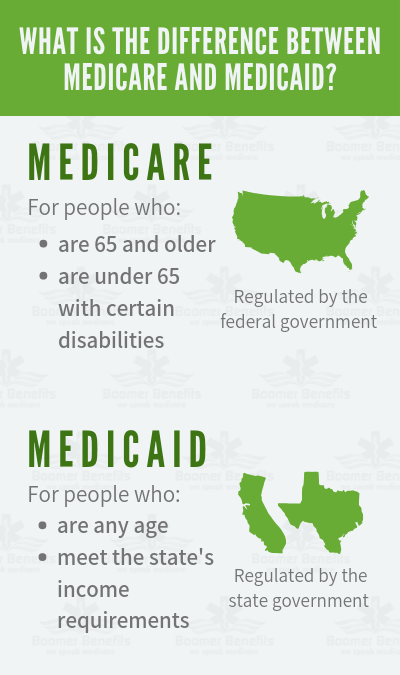
The difference between Medicare and Medicaid is that the programs serve two different groups of people. Medicare is a healthcare program intended for people aged 65 and older and people under 65 with certain disabilities. Medicaid is intended for people of any age with low incomes.
Medicare is a national health insurance program established and administered by the federal government. It operates under the same rules no matter where you live.
You generally become eligible for Medicare once you reach age 65. If you have the required work history – 40 quarters – then you won’t pay for your Medicare hospital benefits. During your working years, you made FICA contributions toward your future Medicare benefits. FICA (Federal Insurance Contributions Act) taxes help pay for Medicare and Social Security benefits.
You may qualify for Medicare before age 65 if you get Social Security disability benefits or your doctor diagnoses you with end-stage renal disease or Lou Gehrig’s disease.
There are no income requirements for Medicare enrollment. As long as you are a U.S. citizen or permanent legal resident and meet the age and work requirements, you qualify for Medicare benefits.
One difference between Medicare and Medicaid is that Medicare is not free. Both Part A and Part B have monthly premiums, although most people do qualify for premium-free Part A, as mentioned above.
The federal government sets the Part B premium each year. About 95% of people pay this standard premium. However, certain high-income enrollees may pay a surcharge in addition to the standard premium.
There are four parts to the Medicare program: Part A (hospital insurance), Part B (medical insurance), Part C (Medicare Advantage), and Part D (prescription drug insurance). The federal government oversees all four parts.
However, insurance companies themselves offer Part C and Part D plans. These private insurance carriers contract with Medicare to offer the plans to the public. When Medicare beneficiaries like you enroll, Medicare pays the plan to deliver your Medicare benefits.
The government provides guidelines though. This is so you’ll know that no matter which parts you enroll in, there are basic benefits.
What is Medicaid?
Medicaid is a program to provide health care services to low-income individuals, primarily children.
In 2015, just under half of all Medicaid dollars were spent on minor children. It also provides benefits for older adults, people with disabilities, pregnant women, and caretakers of children.
Medicaid is a voluntary program administered at the state level, although it is jointly funded with both state and federal tax dollars. Because Medicaid is voluntary, states can offer Medicaid benefits to residents but do not have to. If a state does participate, it must meet certain guidelines in order to obtain funding from the federal government.
Currently, all states do participate in Medicaid. Each state sets its own income and eligibility requirements within the federal parameters. Most states base their eligibility requirements on income, disability, pregnancy, age, household size, and household role.
Although Medicaid covers some of the same services that Medicare typically covers, such as hospital care and doctor visits, it also offers certain benefits that Medicare doesn’t.
Examples would be long-term custodial care, and vision and dental care.
There are no federal premium requirements for Medicaid because it is coverage designed for people with already low incomes. However, since states administer this program, some states may collect premiums and other cost-sharing payments from beneficiaries.
There are usually no monthly premiums for Medicaid, but beneficiaries may incur low out-of-pocket costs like copays.
Medicaid covers most major medical costs, but the healthcare services and medication coverage does vary by state. In order to get funding from the federal government, states must provide:
It is possible for people to qualify for and enroll in, both Medicare and Medicaid at the same time. When someone qualifies for both programs, they become “dual eligible,” and they receive their care through certain Medicare Savings programs.
At the highest level, a person is considered a Qualified Medicare beneficiary, which means they will get financial assistance with Medicare premiums, deductibles, copays, and coinsurance.
This can be particularly helpful if the individual needs help with things Medicare doesn’t cover, such as long-term care.

Medicare and Medicaid are different programs administered by different government entities. However, people on Medicare can also have Medicaid as their secondary coverage.
If you are age 65 and over or meet the disability requirements for Medicare, and you also meet the income requirements for Medicaid in your state, you are considered dual-eligible. This means you qualify for both programs.
The Centers for Medicare and Medicaid Services (CMS) has an office that is tasked with coordinating benefits between Medicare and Medicaid. This makes it easier for dual-eligible individuals to get health care coverage.
If you have Medicare and think you may be dual-eligible, contact your state health services department for more information about how to apply.
There are different levels of Medicaid qualification. People with the lowest incomes can qualify as QMB, which means Qualified Medicare Beneficiary. The QMB program provides the highest level of coverage at almost no out-of-pocket cost.
If you have Original Medicare Parts A and B and you also qualify for the Medicaid QMB program, your Medicaid can function as supplemental insurance. Keep in mind that this will likely require you to only treat with doctors that accept both programs.
People who wish to enroll in a Medicare Advantage plan should specifically seek out Medicare Special Needs Plans for people with dual eligibility. You can do this by registering at MyMedicare.gov and using your personal portal to review the plans offered in your state.
As we mentioned, the Medicaid programs for people who have Medicare are called Medicare Savings programs.
Most of these programs will at least help you to pay for some or all of your Part B premiums. They also all will automatically lower the amount you pay for your Medicare Part D.
Because the words are so similar, we get lots of questions about Medicare vs. Medicaid. Here are some common Medicare vs. Medicaid questions:
No, they are two separate programs designed for different groups of people. Medicaid, which is for low-income people, covers some services that Medicare doesn’t, such as long-term care and food stamps. Medicare is for people over age 65 or people with certain disabilities.
The ACA legislation created the ability for states to expand Medicaid so it would cover more low-income Americans under 65.
Most government programs utilize an asset test to help you see if you qualify. You can visit the healthcare exchange website to use their tools in helping you determine eligibility for Medicaid.
To qualify for Medicaid help with assisted living or nursing home care, you may have to spend down your assets first. One exemption from that is your home. However, the state can attempt to recoup some of its spendings on your care from your assets after you pass away.
So, as you can see, there is a big difference between Medicare and Medicaid. Medicare helps our nation’s elders and people with disabilities, and Medicaid helps people with low incomes.
Qualifying for both is possible. However, the coordination of the two programs can cause some hiccups in billing or provider access. Contact the state Medicaid office where you live or your local Area Agency on Aging for help in discovering your local options.