x




Healthy Living
Health Topics
Professionals
Get Involved
Ways to Give
About Us
CPR
In Your Community
Healthy for Good Topics
or
Search Condition
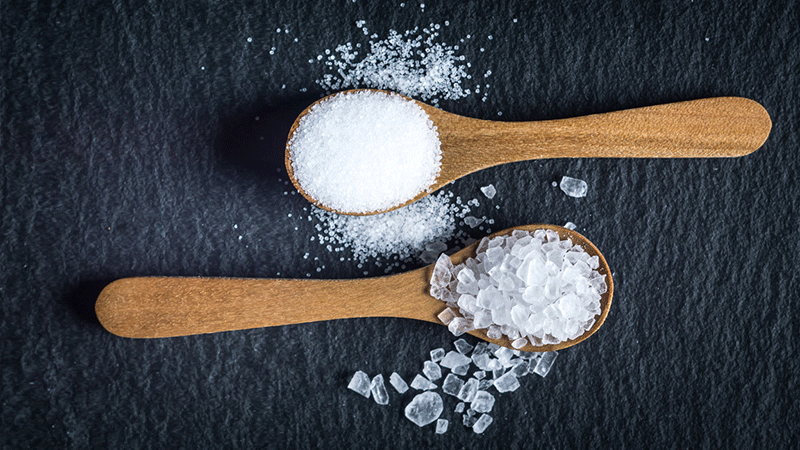
Sea salt has boomed in popularity in restaurants and supermarket aisles. Some chefs prefer it over table salt for its coarse, crunchy texture and stronger flavor. Manufacturers are using it in potato chips and other snacks because it’s “all natural,” and some health-conscious consumers choose it because it contains minerals like magnesium.
But in one very important respect there’s usually little difference between the two: sodium content.
In a survey conducted by the American Heart Association, 61 percent of respondents incorrectly agreed that sea salt is a lower-sodium alternative to table salt. Table salt and most sea salts all contain about 40 percent sodium by weight.
Kosher salt and some sea salts may have larger crystal sizes than table salt, so they may have less sodium by volume (e.g., by teaspoon or tablespoon). A teaspoon of table salt has about 2,300 mg of sodium, but a teaspoon of sea salt or kosher salt may have less sodium simply because fewer crystals fit on the spoon.
Some varieties of sea salt claim to have less sodium than table salt. You can check the Nutrition Facts label to compare how a given sea salt compares to table salt, which has about 575 mg sodium per ¼ teaspoon.
Sea salt is obtained directly through the evaporation of seawater. It is usually not processed, or undergoes minimal processing, and therefore retains trace levels of minerals like magnesium, potassium, calcium and other nutrients.
Table salt, on the other hand, is mined from salt deposits and then processed to give it a fine texture so it’s easier to mix and use in recipes. This processing strips table salt of any minerals, and additives may be used to prevent clumping.
Most sea salts don’t offer any real health advantages.
The minute amounts of trace minerals found in sea salt are easily obtained from other healthy foods. Sea salt also generally contains less iodine (added to prevent goiter) than table salt.
You can usually let your taste buds choose between kosher salt, sea salt and table salt. They all contain about the same amount of sodium.