x




Most people do not understand risk.
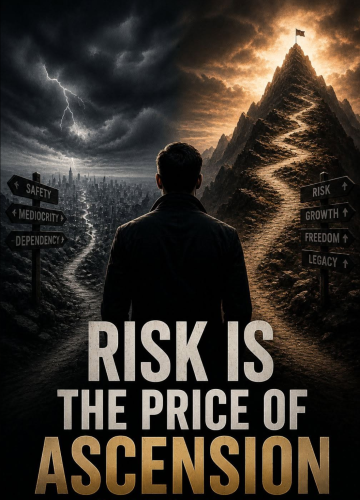
They speak about “playing it safe” as though safety is a permanent condition rather than a temporary illusion. But a life without risk has never existed. Risk cannot be eliminated. It can only be transferred, reduced, delayed, disguised, or recalculated.
The employee avoiding entrepreneurial risk accepts dependency risk.
The man avoiding loneliness accepts relationship risk.
The citizen avoiding instability accepts institutional risk.
Every path extracts payment.
The real question is not whether you will suffer risk. It is which form of risk you are willing to tolerate.
This is where intelligent people separate opportunities into categories.
There are Smart Bets.
High upside. Low downside. Asymmetric reward.
These are the rarest opportunities in life. The few moments where potential gain vastly exceeds probable loss. A strategic alliance with the right person. An emerging market before saturation. A calculated career move with limited downside and disproportionate leverage.
Smart Bets should be seized aggressively.
Then there are Stupid Bets.
Low upside. Catastrophic downside.
These are everywhere.
Momentary pleasure that destroys reputation.
Emotional impulsiveness that ruins positioning.
Short-term validation that creates long-term weakness.
Life offers endless opportunities to lose foolishly.
Far more than it offers opportunities to win intelligently.
Then come the Ambivalent Bets.
The uncertain territory where reward and danger are difficult to measure clearly. High risk-high reward paths. Low risk-low reward paths. Situations where probability becomes blurred by incomplete information.
This is where strategic judgment matters most. Because life rarely gives mathematical certainty. "Life is a game of calculated risk taking."
And the ability to calculate risk quickly is one of the highest forms of practical intelligence.
In the real world, opportunities do not wait patiently for perfect analysis. Decisions are often made under incomplete information, emotional pressure, limited time, and uncertain outcomes.
You will rarely know exact probabilities.
But you can rank dangers relative to each other.
You may not know the exact chance that starting a business makes you wealthy. But you can certainly recognize that entrepreneurship carries greater upside and greater danger than remaining a salaried employee inside a stable hierarchy.
Strategic people think comparatively, not absolutely.
This is why your current position matters enormously.
A man with much to lose should behave differently from a man with little to lose.
If your life is stable, your reputation strong, your income secure, your positioning favorable — recklessness becomes irrational. Preservation becomes intelligent. Risk aversion is no longer cowardice. It is asset protection.
But if your trajectory leads toward stagnation, irrelevance, dependency, or quiet failure, then excessive caution becomes self-destruction disguised as prudence.
As Niccolò Machiavelli wrote: “All courses of action are risky, so prudence is not in avoiding danger (it is impossible), but in calculating risk and acting decisively.”
A man already drifting toward defeat cannot afford timid strategy. When the downside is slow decay regardless, escalation becomes rational.
This is the brutal psychological threshold most people never cross.
Fear continues controlling them long after fear has lost strategic usefulness. And so they remain trapped in low-risk, low-reward existence while secretly hoping for extraordinary outcomes.
But extraordinary outcomes almost always require asymmetrical exposure.
This is why death itself alters psychology. As Robert Greene wrote in The 33 Strategies of War: “Life has more meaning in the face of death.”
The closer a person moves toward absolute loss, the less conventional fear restrains them. Men with nothing to lose become capable of actions psychologically unavailable to ordinary people protected by comfort, routine, and future expectation.
This is why desperation can produce both collapse and greatness. It strips hesitation away. But wisdom requires calibration.
Fools romanticize reckless aggression.
Cowards romanticize permanent caution.
Both misunderstand strategy.
Some men destroy themselves through unnecessary high-risk behavior while possessing enormous future potential. Others rot inside safe mediocrity while their lives deteriorate slowly beneath the surface.
Wisdom lies in knowing when to preserve and when to gamble. And once the decision is made, hesitation becomes fatal.
As Robert Greene wrote in The 48 Laws of Power: “If you are unsure of a course of action, do not attempt it; your doubts and hesitations will infect your execution.”
Half-hearted execution destroys more people than failure itself.
This is why analysis belongs before commitment — not during it.
Question thoroughly beforehand.
Doubt thoroughly beforehand.
Calculate thoroughly beforehand.
But once action begins, hesitation must disappear. Because boldness carries psychological force while uncertainty infects outcomes instantly.
And this leads to the final principle: Not every battle should be fought.
Modern culture glorifies “trying” indiscriminately. But when stakes become existential, failure is not always noble. Some risks permanently destroy reputation, freedom, leverage, finances, health, or future opportunity.
At high stakes, disciplined restraint is often superior to reckless courage.
Strategic people understand this instinctively.
Fight when the probabilities justify conflict.
Withdraw when preservation creates superior long-term positioning.
Escalate only when the upside exceeds the danger.
Because power is not built through random aggression.
Power is built through calculated exposure to risk while avoiding irreversible loss.
That is the real psychology of strategic ascent.