x




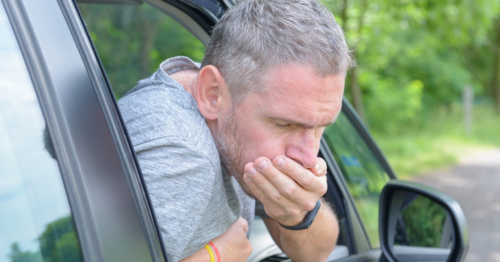
Car sickness and other forms of motion sickness are surprisingly common, with up to one in three people highly susceptible to the condition.
Being a driver rather than a passenger is protective. But with driverless cars coming to our roads in the near future, drivers will become passengers, and many will want to use their time away from the wheel productively.
This expectation has sparked the interest of scientists who are now looking for a solution to motion sickness. One research group in the United Kingdom thinks they’ve found one.
The main symptoms suffered by people with motion sickness are nausea and vomiting, but there can be many others such as dizziness, drowsiness, sweating and headaches.
Motion sickness can occur when using any form of transportation and even during leisure activities such as skiing, amusement park rides, or using virtual reality headsets and simulators.
The reason for motion sickness isn’t known for certain. Researchers believe there is a genetic component, but it’s mainly thought to be due to a “sensory mismatch.”
The brain receives movement signals from the eyes, inner ears, muscles and joints. In a car, for instance, the eyes see the body as being still, but the other parts of the body tell a different story. These conflicting ‘moving yet not moving’ messages trigger the symptoms of motion sickness.
Drivers are protected because they can anticipate directional and motion changes and prepare for them. This helps the brain to resolve the sensory conflict because it feels as if it’s in control of the movement.
Passengers cannot anticipate these changes, especially when sitting in the back seat because their field of view is restricted, and this limits the brain’s ability to resolve the sensory conflict.
In spite of motion sickness being common, research in this area has been remarkably thin. But with the driverless car revolution upon us, researchers from the Warwick Manufacturing Group at the University of Warwick, England, set about testing a possible solution to this problem.
The research team enrolled 42 volunteers and split them into two groups. One used a driving simulator while the other took part in an on-road journey as back seat passengers. Researchers supplied both groups with questionnaires to obtain real-time feedback on the severity of symptoms.
The second part of the trial tested visuospatial ability. This is the kind of brain activity we use to draw, button a shirt, make a bed, construct models or assemble furniture.
After testing their current abilities, participants were given 15-minute visuospatial tasks to complete each day for two weeks. The tasks improved their abilities by 40 percent.
Then, they repeated the first part of the trial that involved a road trip or a driving simulator.
Researchers found that the increase in visuospatial ability was directly responsible for a 51 percent reduction in motion sickness in the driving simulator, and a 58 percent reduction in the on-road trial.
A member of the project team, Dr. Joseph Smyth, explained, “Being able to reduce an individual’s personal susceptibility to motion-sickness using simple ‘brain training style’ tasks training is a massive step-forward in the development of future transport systems, including autonomous vehicles.
“I hope that in the future we can optimize the training into a short, highly impactful method.”
While we wait for the brain training style system to be perfected, there are a number of methods for relief from motion sickness that we can employ right now.
In addition to medication, John Golding, a car sickness expert from the University of Westminster, suggests the following:
.png)