x



Gold Price News: Gold Ticks Lower to Pare Week-on-Week Gains
Gold prices edged lower on Friday, reversing some of Thursday’s gains to end the week with a 0.7% gain.
Prices rose to a three-week high of $2,666 an ounce on Friday morning, but fell back through the session to trade at around $2,640 an ounce later in the day. Intraday trading ranges have been compressed since mid-December, reflecting a subdued market over the seasonal holiday period.
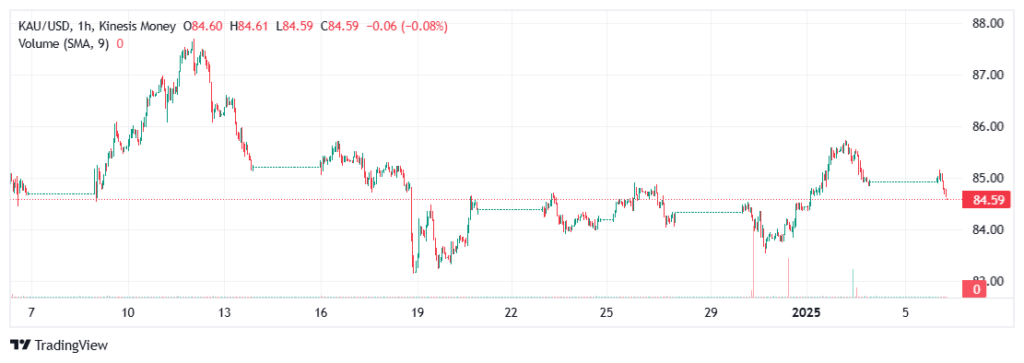
Gold (KAU) price – $/g – on Kinesis Pro exchange
The US dollar made a strong start to the new year, rising against other major currencies on Thursday, and this appeared to put gold prices under modest pressure by the end of the week.
In addition, the US Manufacturing PMI rose to 49.3 in December, above market expectations of 48.4, according to data released on Friday. The figures showed that US manufacturing activity contracted by the smallest amount for nine months in December, highlighting an improving trend. This may help to reduce the pressure for further interest rate cuts by the US Fed – a notionally bearish element for gold prices.
Market positioning:
Investor interest in gold saw a drop in the final days of December, with physically-backed gold ETFs showing net outflows of 0.2 tonnes in the week ending December 27th. That compared with net inflows of 18 tonnes the previous week, according to World Gold Council figures: Gold ETF: Stock, Holdings and Flows. Meanwhile, net long positioning on gold futures contracts on the US Comex was unchanged at 757 tonnes in the week ending December 31st. Read More
Silver Price News: Silver Nudges Higher for 0.8% Weekly Gain
Silver prices edged slightly higher on Friday to cap the week with a modest rise of 0.8%, continuing range-bound trading that has persisted for the last three weeks.
Prices rose as high as $30.14 an ounce on Friday, although the gains failed to hold and prices pulled back to around $29.64 an ounce later in the session.
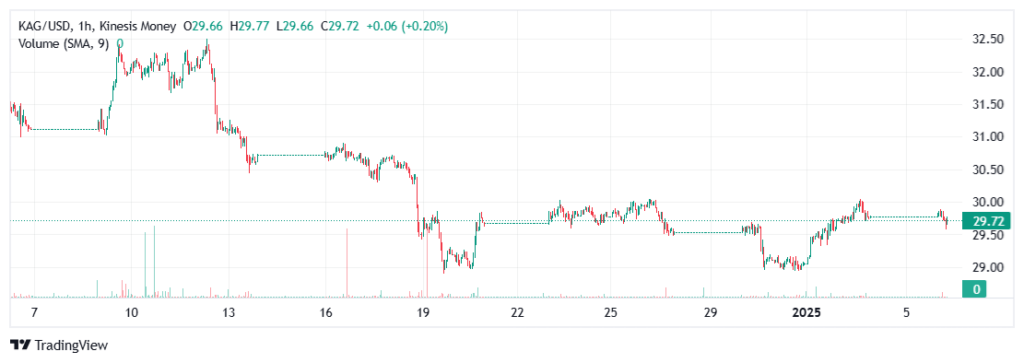
Silver (KAG) price – $/oz – on the Kinesis Pro exchange
Friday’s modest increase helped lift silver further off its mid-week lows of $28.81 an ounce, although this does not represent fresh momentum in either direction. The market has been mostly range bound between $29.00 and $30.00 an ounce since December 19th and hovering at four-month lows.
Industrial demand seen up 7% in 2024:
Industrial demand for silver was forecast to rise by 7% in 2024 to top 700 million ounces for the first time, industry group the Silver Institute said in a report on January 2nd: Silver News December 2024.
However, total global demand for silver was expected to be up only 1% in 2024 from 2023 levels, while total supply was expected to rise by 2% year-on-year, it said. The silver market was expected to see a physical supply deficit of 182 million ounces in 2024 overall. The figure rises to 282 million ounces if the net investment of 100 million ounces in exchange-traded products is included in the calculation, which were on track for their first annual inflows in three years, it said. Read More
Gold prices begin 2025 with positive momentum, what is next?
Gold has started 2025 on the front foot after recording stellar gains in 2024. The precious metal, known for its status as a safe-haven asset, has benefitted from a combination of economic uncertainties, geopolitical tensions, and shifting monetary policies. There is no doubt that towards the end of 2024, there was profit-taking that happened, which pulled the prices away from their all-time high. However, as we begin the first trading day of 2025, traders are recalibrating their views and their trading strategies, and that is helping the shining metal’s price. Read More
Rolex raises prices after gold sees strongest annual gains in 14 years
Gold was one of the top-performing assets of 2025, ending the year with a nearly 30% gain to finish solidly above $2,600 an ounce.
However, the precious metal's stellar performance comes at a cost for consumers. Rolex SA, the largest luxury Swiss watch brand, has raised prices on some of its most popular models.
The watchmaker typically increases its prices on January 1. According to media reports, Rolex has raised prices this year by as much as 11% on certain gold watches, while prices for its steel models increased by only 3%.
By comparison, the company raised prices by 4% last year.
Rolex’s Daytona, one of its most sought-after watches, has seen its price jump nearly 14%. The white gold version with the OysterFlex bracelet now carries a suggested price of $38,100, up from $35,000 last year.
Similarly, the Rolex Deepsea now costs $58,000 — an increase of more than 11% from last year’s price of $52,100.
Despite these higher prices, some experts do not expect sales to suffer. Read More
U.S. dollar starting 2025 on a high note, but momentum won’t last and gold will shine
The U.S. dollar has started the new year on very strong footing, with the U.S. Dollar Index pushing above 109 points to its highest level since November 2022.
Looking ahead, many analysts expect further gains for the greenback as a robust economy forces the Federal Reserve to navigate a shallower easing cycle through 2025.
“Simply put, the strong U.S. fundamental story continues to favor higher UST yields and a higher dollar,” said currency strategists at Brown Brothers Harriman in a recent note. “We expect these trends to continue in 2025. Strong data should carry over into Q1, meaning the dollar, U.S. yields, and U.S. equities are likely to march higher.”
Jonas Goltermann, Deputy Chief Markets Economist at Capital Economics, also expects American exceptionalism to play a major role in the U.S. dollar’s strength in the new year. He added that perceptions of America’s resilient economy are built on a solid foundation.
“The U.S. economy has weathered the shocks of the past few years considerably better than its peers, and the FOMC is consequently in a position to keep policy rates higher than elsewhere. Additionally, we expect the AI-driven surge in the S&P 500 to outpace other major equity markets by some margin,” he said. Read More
Gold ETFs rode massive swings from US, EU investors in 2024 while Asia ramped up holdings, but global funds saw net outflows for fourth straight year
While gold prices enjoyed a strong and steady climb in 2024, physical gold demand, as reflected in ETF flows, was much more uneven, as investors sought to get ahead of big price moves during some periods, and took advantage of record-high prices to liquidate holdings at other times.
Among the major regions, data from the World Gold Council (WGC) showed ETF demand from Asian investors was the most steady, with the overwhelming majority of weekly flows reports showing net gains in the region as China's faltering currency and collapsing property market combined to drive strong safe-haven appeal for the yellow metal. By contrast, European and North American ETF demand reflected a more arbitrary and opportunistic attitude as OECD investors were happy to jump on and off the gold price roller coaster depending on how interest rates, equities, and precious metals prices were performing on a week-to-week basis. Read More
Gold and USD can rally together if US labor market weakens
After achieving its best annual gains in 14 years, gold has started 2025 on a quieter note, consolidating in elevated territory solidly above $2,600 an ounce.
Gold has managed to trade within a tight range during the two-week holiday period. However, as markets return to full activity on Monday, analysts note that the precious metal still faces some significant headwinds.
Solid economic data is supporting the U.S. dollar, which is trading at a 25-month high against a basket of currencies.
In a note on Friday, David Morrison, Senior Market Analyst at Trade Nation, said that bullish momentum is starting to build for gold and silver. However, he continues to monitor the impact of the U.S. dollar on next week’s price action.
“It will be interesting to see if [gold and silver] can make upside progress from here, even with the dollar at two-year highs,” he said. Read More
An Important Week Ahead For Gold Traders
This week holds significant importance for gold traders, as they will closely monitor crucial economic data. There is no doubt that the gold price has been trading in a tight range due to the holiday season, but this is about to change, and gold traders are worried that the big bull run that we saw in 2024 may not happen this year.
Short But Volatile Week Ahead:
While the shortened week, Memorial Day for former U.S. President Jimmy Carter on Thursday, might initially suggest subdued activity, the reality is that traders are gearing up for a busy period with crucial economic data.
Investors believe that trading volume is likely to see a return to normal as the anticipation builds for the release of critical data points. Specifically, the U.S. NFP report due on Friday will capture most of the market’s attention. Investors will be closely watching the data to assess two important aspects: the overall health of the U.S. labour market and the trends in U.S. wages, particularly the average hourly earnings. Read More
Gold SWOT: Central bank gold inflows totaled 2,575 tons over the past five years Strengths
The best-performing precious metal for the year was gold, dazzling the world with a 21.41% premium afforded in 2024. Central banks, led by a gold-hungry China and joined by India and Turkey, unleashed a buying spree, adding over 1,000 tonnes to their reserves—a historic move to shield against inflation, currency risks and global turmoil. India’s cultural reverence for gold, paired with booming GDP growth, turbocharged demand, while investors flocked to gold amid Federal Reserve rate cuts and escalating geopolitical tensions.
According to Bank of America, central bank gold inflows totaled 2,575 tons over the past five years, with the largest buyers being China (+412 tons, a 22% increase in holdings), Türkiye (+359 tons or +141%), Poland (+299 tons, or +232%), India (+280 tons, or +47%) and Russia (+223 tons, or +11%).
Silver is living up to its promise as the Fed interest rate-cutting narrative gains greater traction. The cheaper precious metal is outperforming gold by a comfortable margin. Right now, it is on pace to close out another quarterly climb in what would be the longest winning run since 2011, according to Bloomberg. Read More
Strong majority of retail traders expect gold to trade above $3,000/oz in 2025, experts see gains in H2 after early consolidation
The Kitco News Annual Gold Survey showed strong belief in the yellow metal’s bullish potential on the part of retail traders, while the big banks and industry experts mostly expect continued strength from gold prices in 2025.
457 retail investors participated in the Kitco News Annual Gold Survey, with a strong majority of Main Street predicting the yellow metal will set a new all-time high as it trades above three thousand dollars per ounce in 2025.
266 retail traders, fully 58%, expect gold to trade above $3,000 per ounce level next year, with the current all-time high of $2,788.54 set on October 30, 2024. Another 22%, or 103 Main Street investors, predicted gold prices will trade between $2,800 and $3,000 in 2025, while only 7%, or 30 participants, expect gold to top out somewhere between $2,600 and $2,800. The remaining 58 retail traders, representing 13% of the total, think gold prices will drop back into the $2,400 to $2,600 per ounce range seen in late summer and early fall of 2024. Read More
November gold purchases point to another strong year of central bank demand – World Gold Council
The world’s central banks continued to drive demand for gold in November, with the lion’s share of purchases once again being made by emerging markets, according to Krishan Gopaul, Senior Analyst, EMEA at the World Gold Council.
“November represented another solid month of gold buying as central banks collectively added a net 53t to global official holdings based on available reported data,” Gopaul said. “This extends the broader trend observed throughout this year where central banks – mostly those from emerging markets – have remained keen buyers of gold, driven by the need for a stable and secure asset amid global economic uncertainties.”
“The gold price dip in November, following the US election, may have provided some central banks with added impetus to accumulate,” he said, adding that much of the buying came from countries who had been active in recent months. Read More
Gold modestly down, pressured by rising U.S. Treasury yields
Gold prices are a bit weaker but well up from earlier sharp losses in midday U.S. trading Monday. Silver prices are solidly up and hit a three-week high. Rising U.S. Treasury yields that are at their highest levels since last May are a bearish outside-market element for the two metals to start the trading week. February gold was last down $3.40 at $2,651.50 and March silver was up $0.595 at $30.67.
The U.S. dollar index is sharply down today on worries about the bulging U.S. government debt load. Bloomberg reported the uptick in bond yields only adds further pressure to U.S. government debt. There are concerns the incoming Trump administration will reignite inflation. There’s $119 billion of U.S. government debt issuance this week, amid growing concern Republican-controlled Congress will push up spending and increase the U.S. budget deficit. The USDX quickly but only briefly shot up from its daily low on news President-elect Trump denied that he will go easier on new trade tariffs. Trump refuted a Washington Post story that quoted Trump aides as saying the new president may be more selective on new tariffs.
In other news, Bloomberg reports Goldman Sachs no longer sees gold reaching $3,000 an ounce by the end of 2025, pushing its forecast for that level to mid-2026 on expectations the Fed will make fewer U.S. interest-rate cuts. Gold prices gained 27% in 2024.
Technically, February gold futures bulls have the overall near-term technical advantage. Bulls’ next upside price objective is to produce a close above solid resistance at $2,700.00. Bears' next near-term downside price objective is pushing futures prices below solid technical support at the November low of $2,565.00. First resistance is seen at today’s high of $2,663.80 and then at last week’s high of $2,681.00. First support is seen at the overnight low of $2,624.60 and then at $2,608.40. Wyckoff's Market Rating: 6.0.

Image Source: Kitco News
March silver futures bears have the slight overall near-term technical advantage. However, a nine-week-old downtrend on the daily bar chart has been negated. Silver bulls' next upside price objective is closing prices above solid technical resistance at $32.00. The next downside price objective for the bears is closing prices below solid support at the December low of $29.145. First resistance is seen at $31.00 and then at $31.50. Next support is seen at $30.50 and then at $30.00. Wyckoff's Market Rating: 4.5. Read More

Image Source: Kitco News
Goldman Sachs now sees $3,000/oz gold only next year as fewer Fed rate cuts slow 2025 price growth
Gold’s record-breaking rally will slow down this year, with the yellow metal taking longer to reach the $3,000 level, but steady central bank demand remains a key long-term price driver, according to a leading investment bank.
Goldman Sachs Group Inc. announced on Sunday that it no longer expects the gold price to reach $3,000 per ounce by the end of 2025, with the Federal Reserve’s shallower rate cut path pushing the forecast to mid-2026.
Goldman analysts, including Lina Thomas and Daan Struyven, wrote in the update that slower monetary easing will likely depress demand for gold-backed exchange-traded funds (ETF) in 2025. They now project the spot price to top out at $2,910 per ounce by the fourth quarter. The analysts added that weaker-than-expected ETF flows in December driven by easing uncertainty after the US election also resulted in a lower starting point for gold prices into the new year.
“Opposing forces — lower speculative demand and structurally higher central bank buying — have effectively offset each other, keeping gold prices range-bound over the past few months,” the analysts wrote, but added that demand from central banks will remain a key driver for prices over the longer-term. “Looking ahead, we forecast monthly purchases to average 38 tons through mid-2026.” Read More
Disclaimer: These articles are provided for informational purposes only. They are not offered or intended to be used as legal, tax, investment, financial, or any other advice.
Featured Image - Source: Unsplash















