x





Gold Price News: Gold Tests High on Safe Haven Bid
Having rallied strongly at the end of last week, gold now appears poised for another push higher. However, economic drivers are little changed; while US rate markets have marginally eased, this has been offset by some firming of the US dollar. According to CME FedWatch the market is pricing in c. 0.5% of Fed rate cuts by the end of 2024 and a total of 1.25% by the middle of 2025. Nevertheless, gold starts Wednesday trading at $2676/toz.
Geopolitics however continues to be a key support for gold, with ongoing conflict in the Middle East and uncertainty around US Elections on 6 November. In Europe, Ukrainian President Zelenskyy has now accused North Korea of sending troops to support the Russian offensive, implicating further Chinese involvement in the process. The ‘safe haven bid’ for gold remains strong and appears to be compensating for the lack of clear economic support.
Looking at the gold chart, despite some volatility last week, and the broader picture of consolidating price action at elevated levels in October, gold seems poised to challenge key technical levels once again. This morning it appears to have breached the upper bound of the 26 June/ 17 July/ 25 July ascending channel at $2667/toz and is currently negotiating major horizontal resistance at $2673/toz. Read More
Silver Price News: Silver Sidles Higher on Better European Data
Silver has traded with a mild positive bias this week despite the absence of significant market catalysts.
At the margin, fundamental support has improved somewhat, with both August Eurozone Industrial Production and the October Eurozone ZEW Economic Sentiment Index proving better than expected yesterday.
Looking forward, while a rate cut from the European Central Bank on Thursday is very much discounted in the market, the subsequent press conference may give further guidance on future, silver-supportive, rate cuts. In the meantime, silver starts Wednesday trading around $31.7/toz.
However, a resolution of China’s reflation strategy remains a significant gap in the global reflation story, and support for silver industrial demand. It seems clear from the recent performance of the domestic stock market that investors are losing patience, though Friday’s China Q3 GDP data release might prompt much-needed clarity on policy going forward. Read More
China’s gold market mixed in September, Q4 could see jewelry demand increase, investment demand fall – World Gold Council
China’s gold market was a mixed bag in September with prices increasing, and gold ETF flows turning positive while imports and futures volumes declined, according to Ray Jia, Research Head, China at the World Gold Council (WGC).
Jia noted that lower Treasury yields, a weakening dollar from the Fed’s larger-than-expected rate cut, and rising geopolitical tensions in the Middle East lifted gold prices to another record high in September. “But due to a rapid appreciation in the RMB, driven by dollar weakness and an improved Chinese economic outlook, the SHAUPM in RMB saw limited gains relative to its USD peer,” he said.
“Having risen for three months in a row, the RMB gold price ended Q3 with a sizable gain of 8%, pushing its y-t-d increase to 24%, leading other major assets,” Jia said. “Expectations of lower rates, spikes in geopolitical risks and continued central bank purchases have driven gold notably higher so far in 2024.” Read More
Global public debt even ‘worse than it looks,’ could reach 115% of GDP in 3 years – IMF
Public debt levels around the world are even worse than current projections, and the measures being undertaken by governments won't be enough, according to economists at the International Monetary Fund (IMF).
“Global public debt is very high,” wrote Era Dabla-Norris, Davide Furceri, Raphael Lam, and Jeta Menkulasi in an Oct. 15 blog post. “It is expected to exceed $100 trillion, or about 93 percent of global gross domestic product by the end of this year and will approach 100 percent of GDP by 2030. They pointed out that this is 10 percentage points of GDP above the 2019 level, “that is, before the pandemic.”
“While the picture is not homogeneous—public debt is expected to stabilize or decline for two thirds of countries—the October 2024 Fiscal Monitor shows that future debt levels could be even higher than projected, and much larger fiscal adjustments than currently projected are required to stabilize or reduce it with a high probability,” they said. “The report argues that countries should confront debt risks now with carefully designed fiscal policies that protect growth and vulnerable households, while taking advantage of the monetary policy easing cycle.”
The IMF economists give three reasons why the fiscal outlook of many countries could be even worse than the already dire projections: “[L]arge spending pressures, optimism bias of debt projections, and sizable unidentified debt.” Read More
To predict silver price performance in a recession, look to copper – StoneX’s Rhona O’Connell
The question of how precious metals like silver will perform during a recession is becoming increasingly pertinent amid surging debt levels and depreciating fiat currencies, and according to one analyst, the best predictor of how the gray metal will perform during a recession is its base metal counterpart: copper.
“Once it was coinage, now it’s an industrial component – but memories are long,” wrote Rhona O’Connell, Head of Market Analysis for the EMEA and Asia Regions at StoneX Financial. “Silver’s relationship with gold goes back hundreds of years, when both metals were currencies. In the 16th and 17th centuries, silver was the primary coinage in Britain, Europe and farther east, while gold was more contained to intra-national transactions.”
While this, combined with silver’s physical attractiveness and use in jewelry, “arguably justified its classification as a precious metal,” O’Connell noted that silver’s role as a monetary metal declined for several reasons, including the fact that “silver coins can wear and be tampered with (plus Henry VIII of England deliberately had the size of coins reduced more than once), and gold coins started to be introduced towards the end of the 17th century.”
“For logistical reasons, it didn’t take long before gold took over, almost by default,” she said. “Silver retained its role as a currency in a number of countries until much later, and it is only relatively recently that central bank holdings in Russia, China, and India have been worked off.” Read More
LBMA delegates do not see $3,000 gold by this time next year; silver will be the metal to watch
Gold prices are expected to continue their record run over the next 12 months, but silver remains the asset to watch in 2025, according to sentiment at the 2024 London Bullion Market Association (LBMA) Precious Metals Conference.
According to the LBMA’s annual delegate survey, 45% of attendees expect silver to outperform in the precious metals space. Meanwhile, 37% believe gold will be the top asset in the sector, with platinum in third place, as 16% of delegates foresee it shining the brightest over the next year. Only 2% of participants expect palladium to outperform.
On average, delegates anticipate gold prices rising to $2,941.40 an ounce by this time next year. The LBMA forecast reflects a 10.5% increase from current levels. Spot gold last traded around $2,661.90 an ounce, up 0.50% on the day.
The bullish outlook follows a significant underestimation of gold’s potential by LBMA delegates last year. In October 2023, the LBMA survey forecast prices around $1,990 an ounce. Paul Fisher, Chair of the LBMA, noted that prices are up by one-third from last year’s conference in Barcelona, Spain. He added that gold’s rally has come as the U.S. economy remains relatively healthy, with inflation elevated and the labor market showing resilient strength. Read More
Hong Kong aims to become international gold hub – Chief Executive
Hong Kong intends to leverage its strong position in the global gold trade to become a leading hub for the full range of services related to the yellow metal, the government said on Wednesday.
In his third policy address, John Lee, chief executive of the Hong Kong Special Administrative Region (HKSAR), announced his administration’s intention to build Hong Kong into an international gold trading center.
Lee noted that Hong Kong is already among the world's largest import and export markets for gold by volume, and said that Hong Kong's security and stability within the complex geopolitical environment makes it an attractive location for investors for gold storage, which in turn supports related activities such as gold trading, settlement, and delivery.
“This will spur development of the related industry chain, ranging from investment transactions, derivatives, insurance, storage, to trading and logistic services,” he said.
Under the plan, Lee said the Hong Kong government will promote the development of world-class gold storage facilities to streamline the storage and delivery of spot gold within Hong Kong, which will drive demand for related services such as collateral and loan businesses, which will grow new areas of the financial sector. Read More
New STKD Bitcoin & Gold ETF offers dual exposure to safe-haven assets
The launch of spot Bitcoin (BTC) exchange-traded funds (ETFs) in the U.S. heralded a new age of legitimacy for digital assets, and with central banks around the world debasing their currencies en masse in a bid to stave off recession, it was only a matter of time before BTC was paired with gold to offer protection against the ongoing loss of purchasing power.
Quantify Funds has announced the launch of the STKD Bitcoin & Gold (BTGD), a new ETF that offers exposure to both BTC and gold in one investment product.
“Through the combination of a digital currency (Bitcoin) and a physical currency (gold) in a single vehicle – the STKD Bitcoin & Gold ETF (BTGD), launching today – investors now have the opportunity to invest in two scarcity assets that may protect against future inflation and currency debasement,” Quantify Funds said in a press release.
While other products on the market offer exposure to both assets, the firm noted that “BTGD is unique in that for every $1 invested, the Fund seeks to provide 100% of exposure to its Bitcoin strategy and 100% of exposure to its gold strategy.” Read More
Gold, silver up a bit but off daily highs
Gold and silver prices are modestly higher in midday U.S. trading Wednesday, with gold pushing to just below its record highs before backing off. Some profit taking from the futures traders pulled both metals down from their daily highs. The precious metals are still seeing support from safe-haven demand amid heightened geopolitical tensions and on chart-based buying amid bullish technicals. December gold was last up $6.50 at $2,685.70 and December silver was up $0.114 at $31.87.
Tensions are still running high in the Middle East as Israel pounded Hezbollah installations in Lebanon overnight. The marketplace remains anxious regarding how Israel will respond, militarily, to Iran’s missile barrage against Israel a couple of weeks ago.
Technically, December gold bulls have the strong overall near-term technical advantage. Bulls’ next upside price objective is to produce a close above solid resistance at the contract high of $2,708.70. Bears' next near-term downside price objective is pushing futures prices below solid technical support at the October low of $2,648.90. First resistance is seen at $2,700.00 and then at $2,708.70. First support is seen at today’s low of $2,674.90 and then at this week’s low of $2,654.40. Wyckoff's Market Rating: 9.0.
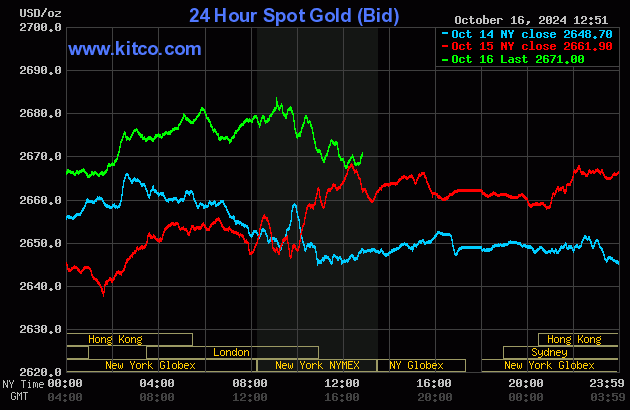
Image Source: Kitco News
December silver futures bulls have the firm overall near-term technical advantage. Prices are in a nine-week-old uptrend on the daily bar chart. Silver bulls' next upside price objective is closing prices above solid technical resistance at the May high of $33.50. The next downside price objective for the bears is closing prices below solid support at the October low of $30.345. First resistance is seen at today’s high of $32.385 and then at $33.00. Next support is seen at the overnight low of $31.60 and then at $31.00. Wyckoff's Market Rating: 7.0. Read More
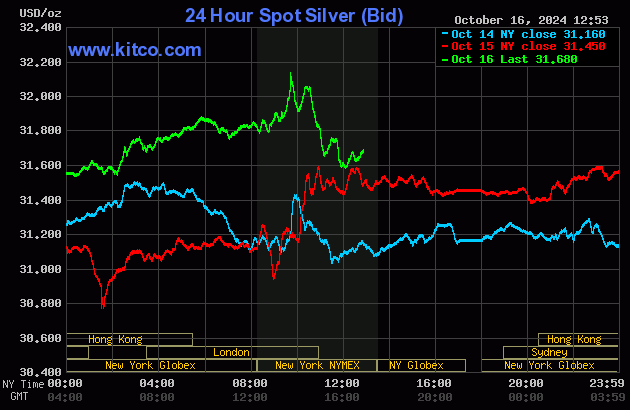
Image Source: Kitco News
The rally isn’t over: Five reasons why gold prices will keep rising, and will hit $4,800 by 2030 – Incrementum’s Stoeferle
While the sideways trading pattern of recent weeks may have gold bulls a little nervous, gold’s rally still has plenty of support and prices are not yet close to peaking, according to Ronnie Stoeferle, Managing Partner at Incrementum.
“+28.1%, +27.2%, +28.3% – this is the impressive performance of gold in the first 9 months of the year in US dollars, Euros and Swiss Francs, respectively,” Stoeferle wrote. “+42.3%, +35.0%, +31.1% – this is the even more impressive year-on-year performance as of the end of September.”
“Given these figures, the question automatically arises: has the gold price reached its ceiling, or is it even in a bubble, as it was in the early 1980s, and is a significant correction imminent?”
Stoeferle said that he doesn’t believe that’s the case, and there are compelling reasons why the gold price is not actually overvalued. First, even as the yellow metal trades above $2,675 per ounce in the spot market, when adjusted for inflation, gold still hasn’t reached its all-time high.
“Since December 2023 in US dollars and October 2023 in euros, the gold price has been chasing one all-time high after another,” he wrote. “It is hard to imagine now that the gold price failed several times to break through the USD 2,000 mark for almost four years, given that it subsequently rose by more than 30% to over USD 2,600 in less than six months. However, adjusted for inflation, the month-end gold price is still below its record level of USD 2,646 set in January 1980, albeit only slightly. Therefore, concerns that the air may already be thin in the current sphere are unfounded.”
Another positive indication that gold prices could rise further is that the current rally has been much more steady and sustained than the one seen in the late 1970s. Read More
Disclaimer: These articles are provided for informational purposes only. They are not offered or intended to be used as legal, tax, investment, financial, or any other advice.
Featured Image - Source: Unsplash















