x





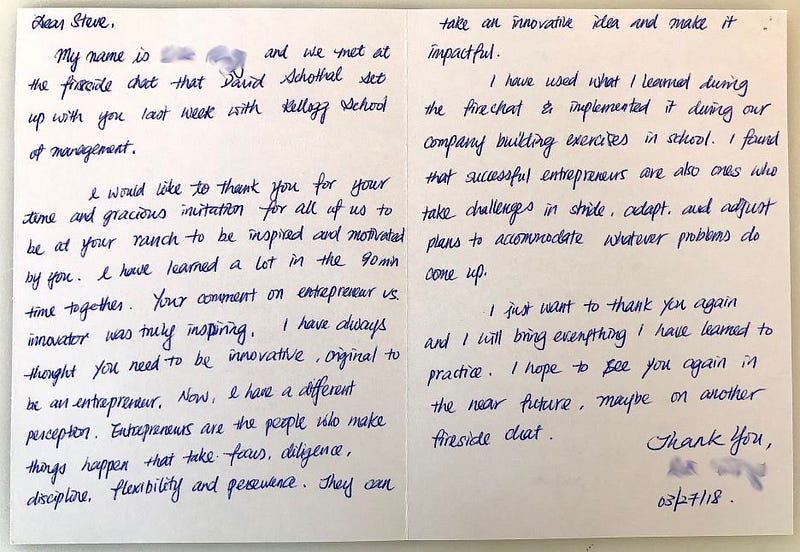
I just received a thank-you note from a student who attended a fireside chat I held at the ranch. Something I said seemed to inspire her:
“I always thought you needed to be innovative, original to be an entrepreneur. Now I have a different perception. Entrepreneurs are the ones that make things happen. (That) takes focus, diligence, discipline, flexibility and perseverance. They can take an innovative idea and make it impactful. … successful entrepreneurs are also ones who take challenges in stride, adapt and adjust plans to accommodate whatever problems do come up.”
Over the last decade I’ve watched hundreds of my engineering students as well as ~1,500 of the country’s best scientists in the National Science Foundation Innovation Corps, cycle through the latest trends in startups:
social media
new materials
big data
medical devices
diagnostics
digital health
therapeutics
drones
robotics
bitcoin
machine learning
etc.
Some of these world-class innovators get recruited by large companies like professional athletes, with paychecks to match. Others join startups to strike out on their own.
What I’ve noticed is that it’s rare that the smartest technical innovator is the most successful entrepreneur.
Being a domain expert in a technology field rarely makes you competent in commerce. Building a company takes very different skills than building a neural net in Python or decentralized blockchain apps in Ethereum.
Nothing makes me happier than to see my students getting great grades (and as they can tell you, I make them work very hard for them). But I remind them that customers don’t ask for your transcript.
Until we start giving grades for resiliency, curiosity, agility, resourcefulness, pattern recognition, tenacity, and having a passion for products and customers great grades and successful entrepreneurs have at best a zero correlation (and anecdotal evidence suggests that the correlation may actually be negative.)
Most great technology startups — Oracle, Microsoft, Apple, Amazon, Tesla — were built by a team led by an entrepreneur.
It doesn’t mean that if you have technical skills you can’t build a successful company. It does mean that success in building a company that scales depends on finding product/market fit, enough customers, enough financing, enough great employees, distribution channels, etc. These are entrepreneurial skills you need to rapidly acquire or find a co-founder who already has them.
Lessons Learned
Entrepreneurship is a calling, not a job.
A calling is something you feel you need to follow, it gives you direction and purpose but no guarantee of a paycheck.
It’s what allows you to create a missionary zeal to recruit others, get customers to buy into a vision and gets VC’s to finance a set of slides.
It’s what makes you get up and do it again when customers say no, when investors laugh at your idea or when your rocket fails to make it to space.
Steve Blank
The Father of Modern Entrepreneurship