x




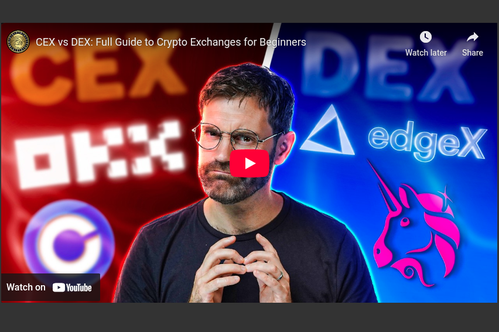
"There are two ways to buy, sell, and trade crypto: centralised exchanges and decentralised exchanges. Each has different trade-offs, and understanding them matters if you want to maximise your crypto gains.
In this video, we break down everything you need to know about CEXs and DEXs and why you might need both. Plus, we reveal which exchanges we use the most, why and how we use them."
~ Coin Bureau
The video provides a comprehensive guide comparing Centralized Exchanges (CEXs) and Decentralized Exchanges (DEXs) for buying, selling, and trading crypto. CEXs function like traditional brokerages, where the exchange acts as a custodian, holding your assets on your behalf and providing a convenient bridge between fiat currency and crypto. They are straightforward, offer familiar interfaces, handle regulatory compliance and tax documentation, and support automated trading strategies. However, CEXs come with significant risks, including counterparty risk—the exchange could be hacked, collapse (like FTX), or freeze your account—and higher, often hidden, fees from trading, withdrawals, and spread costs. Asset selection is also limited, as CEXs typically list tokens after the 100x growth opportunity has passed.
In contrast, DEXs, which are essentially lines of code like Uniswap or Edex, operate without a middleman, enforcing self-custody where you, and only you, control your crypto via your private keys, thus eliminating counterparty risk. DEXs offer significantly lower fees and provide complete access to the entire crypto asset landscape, allowing traders to find newly launched or niche tokens before they list on major CEXs. The trade-off is higher friction: you can't deposit fiat directly, you need a wallet and existing crypto for gas fees, and any mistake is permanent with no customer support to recover lost funds. The optimal strategy, according to the video, is to use CEXs (like OKX) strategically for fast and easy fiat-to-crypto and crypto-to-fiat conversion, and to use DEXs (like Edex) for the majority of trading, asset exploration, and holding, leveraging their lower fees and robust asset access.
0:00 Intro
0:55 What You’re Actually Choosing Between
4:18 Why People Use CEXs (And Why They Stop)
6:48 The Case Against
12:13 Why People Use DEXs (And Why They Hesitate)
13:58 The Case For
17:04 What We Actually Use
20:37 Our Favourite DEX
Source - Coin Bureau YouTube: https://www.youtube.com/watch?v=ZtSi1BRA7LA
Disclaimer: This video is provided for informational purposes only, and not offered or intended to be used as legal, tax, investment, financial, or any other advice.