x




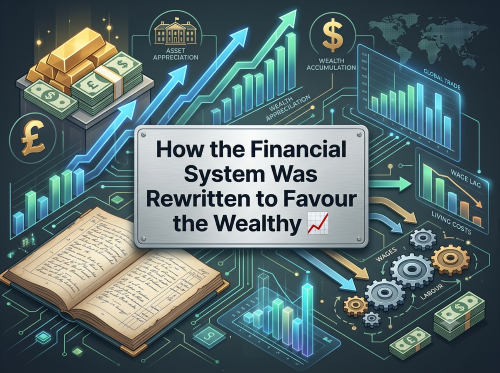
Have you ever wondered why the stock market frequently breaks record highs while everyday working families face an uphill battle against rising living costs? It often feels as though the modern economy operates on two entirely different sets of rules: one engineered to build compound wealth for asset owners, and another that leaves ordinary earners carrying the tax and inflation burden.
This growing divide is no accident. Over the past four decades, a series of quietly enacted regulatory changes, central bank monetary policies, and tax code provisions have systematically transformed financial markets into a mechanism for wealth concentration.
Here is a breakdown of how the rules were rewritten—and why these changes directly impact your pension, wages, and personal finances.
Prior to November 1982, if a publicly traded corporation bought back its own shares on the open market, it faced serious risk of federal prosecution. Under Sections 9 and 10 of the US Securities Exchange Act, corporate share repurchases were legally treated as market manipulation. The reasoning was straightforward: using corporate cash to artificially inflate a company’s own stock price distorted true market values.
Everything changed when the US Securities and Exchange Commission (SEC) adopted Rule 10b-18.
This rule established what is known as a safe harbour—a legal shield that protects companies from manipulation charges provided they follow four basic conditions regarding daily purchase volumes, trade timing, pricing, and broker selection. Once legal risks were eliminated, corporate share repurchases exploded:
While buybacks are officially defended as returning surplus cash to investors, the rewards are overwhelmingly concentrated at the top. The wealthiest 10% of households hold roughly 93% of all stocks. A comprehensive study by Oxfam and PolicyLink revealed that between 1996 and 2025, white households captured $9 trillion (91%) of total buyback gains, while black households captured just $14 billion. By legalising buybacks, regulators essentially created a massive price-pumping engine for existing asset holders.
To understand how share prices remain perpetually supported, one must look at central bank policy—specifically Quantitative Easing (QE).
When central banks engage in QE, they create digital currency to purchase government bonds and financial assets from commercial banks. This newly created money does not reach everyone simultaneously. Instead, it enters through the financial system first—a dynamic known as the Cantillon Effect, named after the 18th-century economist Richard Cantillon.
The Cantillon Effect explained: Whoever receives newly created money first gets to spend and invest it at existing prices before inflation sets in. As financial institutions funnel this capital into equities, real estate, and corporate debt, asset prices surge. By the time this expanded money supply trickles down to wage earners, the cost of goods, services, and housing has already risen, eroding everyday purchasing power.
Central banks have explicitly acknowledged this outcome. A study by the Bank of England into its own QE initiatives revealed that 40% of all financial gains from boosted asset prices went directly to the top 5% wealthiest households. As balance sheets expanded dramatically over recent years, existing asset owners saw their net worth soar while wage growth struggled to keep pace with real-world inflation.
For high-net-worth investors, holding massive stock portfolios presents a dilemma: selling appreciating assets to fund daily living triggers substantial capital gains tax. To bypass this, the ultra-wealthy utilise a legal tax-minimisation framework known as "Buy, Borrow, Die":
If an investor buys $1 million in stock that grows to $50 million, borrowing against it for life and passing it on at death means the $49 million in gain is legally never taxed. According to the Joint Committee on Taxation, this single provision costs the US Treasury an estimated $72.5 billion every single year—amounting to roughly $379 billion over five years. This missing revenue must ultimately be made up by everyday workers who are taxed directly on every pay cheque.
While ordinary investors navigate market fluctuations, lawmakers who write financial laws frequently trade the very companies affected by their policies.
A study by Common Cause found that members of the US Congress, their spouses, and dependents made 13,324 trades valued at roughly $635 million in 2025 alone. Of the 311 congressional portfolios tracked, approximately 100 comfortably outperformed the S&P 500 index.
To address public outcry, the STOCK Act was passed in 2012 to mandate timely trade disclosures. However, enforcement mechanisms remain virtually toothless:
Despite national surveys showing that 86% of the public across all political parties supports a complete ban on congressional stock trading, systemic reform remains stalled in the institutions that benefit from it.
An executive order directed financial regulators to open up private markets—such as private equity and private credit—to retirement accounts like workplace 401(k)s. Historically, these illiquid funds were restricted to accredited institutional investors. Wall Street has marketed this move as "democratising finance," framing it as an opportunity for ordinary savers to access higher returns.
However, industry data suggests institutional investors may have an alternative motive:
Consumer advocacy groups warn that retail pension holders risk becoming exit liquidity—the buyers of last resort who take on high fees and locked-up assets so institutional players can exit ageing investments.
The widening financial divide is the direct result of deliberate legal and regulatory choices. Rule 10b-18 enabled massive corporate buybacks, quantitative easing inflated asset values at the expense of currency purchasing power, tax provisions like stepped-up basis allowed capital gains to bypass taxation, and expanding private equity access risks transferring illiquidity down to pension savers.
Recognising how these financial mechanisms operate is the essential first step toward navigating your own investments, protecting your pension, and advocating for a fairer economic playing field.
Finance Bureau - How The Wealthy Rigged Financial Markets
"A Federal Reserve digital dollar is officially dead—quietly killed by a clause buried in a massive US housing bill. Find out how this happened with no presidential signature, who stood to gain from the ban, and what America just gave up by walking away from a CBDC while rivals like China accelerate their digital currency push.
We break down the political chess game, the quiet lobbying from powerful banks, and what this means for the future of money, privacy, and the US position in the coming digital currency showdown."
~ TIMESTAMPS ~
00:00 – How Stock Buybacks Went From a Federal Crime to a Trillion-Dollar Habit
02:45 – The Disturbed Truth Behind Who Actually Benefits From Rising Share Prices
04:01 – The 300-Year-Old Money Trick Central Banks Use to Make the Rich Richer
05:56 – Buy, Borrow, Die: The 3-Step Tax Strategy Used to Legally Erase Millions in Gains
07:39 – The Stock Act Failure: Why Members of Congress Comfortably Beat the Market
09:36 – The "Exit Liquidity" Trap: Why Wall Street is Suddenly Inviting You to Private Markets
Source 👉 https://www.youtube.com/watch?v=PXbR_BQKGaU
Disclaimer: This article is provided for informational purposes only, mistakes may be made, and it's not offered or intended to be used as legal, tax, investment, financial, or any other advice.