x






Image Source: Pixabay
OpenSea CEO: FTX Fallout Is ‘Opportunity’ to Refocus on Trust
The NFT marketplace head points to the benefits of decentralization and talks about creator royalties in the Solana NFT market.
OpenSea CEO Devin Finzer discussed the recent FTX collapse and the Solana NFT market with Decrypt.
The top NFT marketplace recently announced that it will continue to enforce NFT creator royalties, despite counter moves from some rival platforms.
The recent collapse of cryptocurrency exchange FTX has spawned a contagion that’s spreading throughout the industry. Beyond individual users, numerous companies have revealed their exposure to FTX—including crypto lending firm BlockFi, which filed for Chapter 11 bankruptcy protection on Monday after halting customer withdrawals.
Devin Finzer, CEO and co-founder of leading NFT marketplace OpenSea, described the FTX downfall as a “tragic event” in a recent interview with Decrypt. “We're still feeling the collateral damage across the space,” he said. “There's no doubt that it's a setback for crypto.”
OpenSea had no exposure to FTX or its associated Alameda Research trading firm, a company spokesperson confirmed to Decrypt. Amid the compounding wreckage, Finzer described what he sees as an “opportunity” for the industry to rebuild with a focus on trust while further embracing decentralization.
“I think for the broader crypto ecosystem, and for NFTs in particular,” Finzer said, “this is really an opportunity to invest in strong, continual trust with users.” Read More
Telegram Announces Plans to Build Decentralized Crypto Exchange Following FTX Failure
Founder and CEO Pavel Durov wants to steer crypto back towards trustless models.
As the collapse of the crypto exchange FTX shakes faith in the industry’s centralized players, Telegram is stepping in to build trustless and decentralized alternatives.
In his Telegram channel on Wednesday, Pavel Durov—the messaging platform’s founder and CEO—announced that the company would begin building “non-custodial wallets” and “decentralized exchanges” that would let millions of users safely trade their crypto.
“This way we can fix the wrongs caused by the excessive centralization, which let down hundreds of thousands of cryptocurrency users,” said Durov.
The executive argued that the project should be more than feasible: the development of Fragment, Telegram’s decentralized auction platform, “took only 5 weeks and 5 people, including myself,” according to Durov.
The marketplace, which launched last month, has already raked in $50 million worth of Toncoin by selling tokenized usernames on the blockchain. It operates over The Open Network (TON)—the spiritual successor of Telegram’s former blockchain ambitions that were squashed by the SEC years ago.
Rallying the developer community, Durov called for steering the industry back towards decentralized applications and away from having to trust third parties. Reliance on centralized entities, he said, caused many to lose their money in FTX’s bankruptcy at “the hands of a few who began to abuse their power.” Read More
No, Wrapped Ethereum Isn't In Trouble. Here's Why
A recent FUD campaign engineered by crypto community members raised doubts about the safety of wETH tokens—but it's all an elaborate joke.
Crypto Twitter has been sharing jokes about wETH being exploited or losing its peg.
At least one media publication—Bloomberg—took the jokes at face value.
Wrapped Ethereum does not have a sole custodian and does not pose a systemic threat to the Ethereum ecosystem.
Over the weekend, fears circulated in the crypto community stemming from claims that Wrapped Ethereum tokens could be at risk of losing their 1:1 value against ETH. However, the claims are no more than elaborate jokes about recent contagion fears. Read More
NFT Trading Goes Live On Uniswap
Uniswap Lab’s NFT aggregator platform went live earlier today with a $5 million USDC airdrop to Genie users.
Uniswap Announces Aggregator Tool:
Uniswap finally launched its NFT aggregator platform, where users will be able to conduct NFT trading from across multiple marketplaces. The team announced the launch of its aggregator on Twitter, saying,
“NFTs are officially live on Uniswap!! Starting today, you can trade NFTs across major marketplaces to find more listings and better prices. We're also airdropping ~$5M USDC to historical Genie users & offering gas rebates to the first 22,000 buyers.”
The company had recently successfully conducted its Series B funding round for new offerings, including the NFT aggregator tool.
The aggregator tool will allow Uniswap users to trade digital collectables across leading NFT marketplaces like OpenSea, X2Y2, LooksRare, Sudoswap, Larva Labs, Foundation, and NFT20. The team has claimed that users will be able to access the widest range of NFTs at the best prices as the Uniswap platform has 35% more listings than any other marketplace.
In addition, the platform has claimed that gas fees will be 15% lower than other NFT aggregators thanks to its new open-sourced Universal Router contract. Furthermore, the first 22,000 users of the aggregator will also receive discounts on gas fees. The team has also stated that all the front-end code has been open-sourced, making it the first NFT platform to do so. Read More
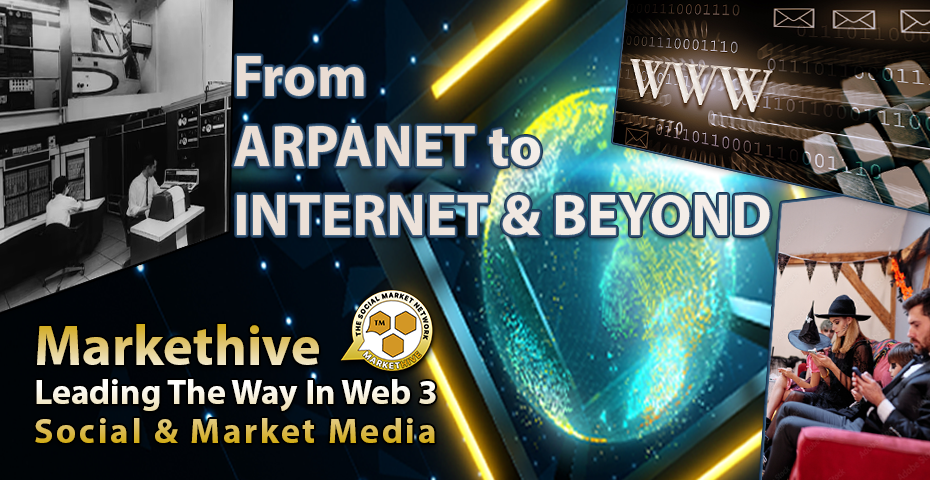
Markethive Leading The Way In Web 3 Social & Market Media
Web 3.0 is the next generation of the internet which people envision will be more decentralized and permissionless. One that's built on decentralized protocols, where users help with content creation and the governance of the web itself. They also have the ability to own a part of the network, so you can think of it as a Read-Write-Own Internet.
There are already several technologies that could serve as the backbone for a Web 3 world. Most point to blockchains like Elrond, Cardano, or Ethereum, for example, but other distributed technologies like IPFS can also be used to decentralize networks.
Thousands of dApps (decentralized applications) are already being built in the Web 3 environment. These often include native tokens to add value to the application to those who hold the tokens. These native crypto assets allow those who participate in the network to share in the value generated from it.
Web 3 promises a decentralized alternative where we are all users, owners, and developers. This quote from Fabric Ventures sums it up beautifully,
“Web 3.0 enables a future where distributed users and machines are able to interact with data, value, and other counterparties via a substrate of peer-to-peer networks without the need for third parties—the result: a composable human-centric & privacy-preserving computing fabric for the next wave of the web.” Read More

Solana-based market maker integrates Stripe for fiat-to-crypto transactions
The Solana-based automated market maker Orca has opened up fiat purchases and fiat-to-crypto transactions through a new integration with Stripe.
As the Solana ecosystem comes back from the aftershocks of the FTX liquidity earthquake, one of its leading automated market makers (AMM), Orca, has announced a new integration.
The AMM revealed an integration with Stripe that will power its new fiat-to-crypto on-ramp, making decentralized finance (DeFi) more accessible to users both in and out of the existing ecosystem. This new integration now enables fiat purchases along with fiat-to-crypto transactions.
Users can now purchase the blockchain’s standard native SPL tokens, including USD Coin, with fiat currencies.
According to Ori Kawn, the co-founder of Orca, the new integration helps create wider access to economic tools:
“With this new integration, we hope to make participating in the DeFi ecosystem even more accessible to the entire Solana community."
The Orca integration marks one of the first blockchain-based integration from Stripe as it continues to venture into the crypto space. Read More
Magic Eden follows OpenSea with NFT royalty enforcement tool
The open-source Open Creator Protocol of the NFT marketplace will enforce NFT creator royalties for new collections that opt-in to the tool.
Magic Eden, a Solana-based nonfungible token (NFT) marketplace, has become the latest platform to release a tool allowing creators to enforce royalties on their collections.
It follows the announcement of a similar tool from rival NFT marketplace OpenSea in early November.
According to a Dec. 1 statement, the open-source royalty enforcement tool is built on top of Solana’s SPL token standard and is called the Open Creator Protocol (OCP). This will allow royalty enforcement for new collections that opt-in to the standard starting Dec. 2.
Lu previously floated the idea of NFTs designed to enforce royalties at Solana’s Breakpoint 2022 conference on Nov. 5, citing the need for NFT creators to have a “sustained revenue model.”
Creators who use OCP will also be able to ban marketplaces that have not enforced royalties on their collections. Magic Eden will still maintain optional royalties on its platform for collections that do not adopt OCP. Read More
Sber Bank's blockchain technology uses Metamask
By linking its blockchain platform with the Ethereum blockchain, the biggest bank in Russia is expanding its operations into the decentralized finance and web 3 industries.
Sber, the bank that was once known as Sberbank and is now Russia's biggest financial institution, is continuing to improve its blockchain platform by merging it with the Ethereum blockchain.
On November 30, Sber made an official announcement on the new potential for its proprietary blockchain technology. One of these chances is interoperability with apps and smart contracts that run on the Ethereum network.
According to the bank, this would make it possible for programmers to transfer smart contracts and whole projects between Sber's blockchain and public blockchain networks.
The most recent updates to Sber include an interaction with a significant software cryptocurrency wallet known as MetaMask. This wallet is used for interacting with the Ethereum network.
According to the release, the connection enables users to do activities using tokens and smart contracts that have been deposited on the blockchain network operated by Sber. Read More
New Cardano algorithmic stablecoin evokes old fears for the community
“I thought we already figured this out, algorithmic stablecoins, not the best option,” a community member wrote on Twitter.
With the new announcement that Cardano is on its way to release an algorithmic stablecoin in 2023, various community members expressed concerns, comparing the project to TerraUSD (UST), which caused great losses within the crypto space in 2022.
According to its developers, the stablecoin project Djed will be pegged to the United States dollar and backed by Cardano. Apart from this, it will be using another token as its reserve coin. The project highlighted that it will be overcollateralized and will have on-chain proof-of-reserves.
Despite the assurances given by the team, various community members expressed concerns, with some bringing the recently collapsed UST to the conversation.
One community member was seemingly confused as to why another algorithmic stablecoin has come out despite Terra showing that they could go wrong. “I thought we already figured this out, algorithmic stablecoins, not the best option,” they wrote. Meanwhile, another Twitter user mentioned that they would rather keep using Tether. According to the community member, algorithmic stablecoins already proved that they are not stable.
In a statement, the Djed team said that though DJED and UST are both algorithmic stablecoins, they aren't the same. The team highlighted that DJED is overcollateralized and will be able to prevent a death spiral by blocking the burning and minting process of coins. They explained that:
“Djed is fully backed and overcollateralized with a significant reserve ratio, up to 8x. The Djed contract has enough money to buy back all the Djed stablecoins in circulation for 1 USD worth of the backing asset, thus maintaining the peg and would still have a lot of money left.” Read More
Disclaimer: These articles are provided for informational purposes only. They are not offered or intended to be used as legal, tax, investment, financial, or any other advice.















