x






Image Source: Pixabay
New paradigms for enterprise blockchain adoption
As blockchain gets ready for enterprise adoption, companies and projects must adapt to the rhythm and motion of enterprises.
Blockchain technology has created a new avenue to reconfigure the vision for the future of the internet. Data on the internet generated by individuals, organizations and other users are controlled by centralized entities, with a significant concentration of economic power and influence held by a few key corporate players who have thrived on data aggregation economics. This phenomenon has alienated users, removing trust in what they see, find, use or assimilate.
However, despite all these advancements, the acceleration and use cases of blockchains in the real world and the adoption by enterprise or individual developers are still minimal. There is a myriad of complexities involved in the dApp development process with many developers still steeped in using traditional tools and models associated with Web2. Let us examine a few limitations and problems in this space today.
Lack of integration(s):
The data that needs to be trusted lives within legacy databases today (e.g., Oracle, SAP, MS Dynamics, etc.) for enterprises and Google Drive, One Drive, Box, Dropbox, etc., for individuals or consumers. There are limited tools providing integration between these centralized data storages or systems of record into a blockchain-ready solution, posing an impediment to proper decentralization. Read More
Credit cards can bridge Web2 to Web3, says music industry exec
As DeFi continues to become more mainstream, traditional financial tools can serve as a bridge from Web2 to Web3 for those who still remain sceptical.
Last year proved that the Web3 space is not just a phenomenon but rather the future of digital interactions. However, as pervasive as the space has become, many are still sceptical as to how it can and will be a part of their lives.
Many developers are seeking ways to bridge the gap between these two iterations of the web. Cointelegraph spoke with Bruno Guez, CEO of Revelator, to understand why he believes already existing Web2 financial tools such as credit cards can actually be bridges to usher new users into Web3.
Revelator, which works in the music industry to provide labels and distributors with the infrastructure to run their businesses, recently announced that it integrated Stripe to help fans seamlessly purchase digital collectables with their credit cards.
Guez said that making these new digital tools accessible via Web2 tools users are already familiar with, such as credit cards, creates a bridge between these two versions of the digital reality.
“The majority of the developed world uses credit cards for everyday purchases. If we want to usher new users onto Web3, we must provide these Web2 users with a familiar and ‘safe’ payment method.” Read More
Exploring the possibilities of a Web3 telecom: A look into the future
Access to the internet and mobile services is not as widespread as most think, and blockchain can serve as a remedy.
The Web3 space is rapidly taking over the crypto world, and it could soon become part of the traditional telecom industry as well. According to the latest DappRadar industry report, Web3 platforms and blockchain-based applications attracted more unique active wallets in 2022, which skyrocketed to 2.37 million from 1.58 million in 2021.
This rapid growth in popularity of blockchain-based platforms is also set to enter the telecom industry, with companies already working on innovative projects. So, what are the benefits of a Web3 telecom service?
Reaching new audiences:
One of the main challenges for telecom service providers is managing costs and reaching audiences in countries where the main population is underprivileged. Bringing communications services to these areas of the world is important but difficult to achieve.
This is where blockchain technology and an interconnected Web3 platform can bring meaningful solutions. Companies are already working on employing the decentralized network blockchain offers to provide new services to telecom customers. From reducing costs on mobile data services to facilitating mobile money transfers with cryptocurrency tokens, blockchain tech has the potential to reshape the product suite telecom companies can offer to users. Read More
Ordinals Launches NFTs on Bitcoin, Unsurprisingly Sparking Controversy
Digital assets on the Bitcoin blockchain are a perennial goal, but some of Bitcoin’s biggest backers don’t like the idea.
When it comes to digital collectables, most enthusiasts think of Ethereum, Solana, or Polygon—deservedly, as proof-of-stake blockchains have cornered the NFT marketplace. But digital collectables using the Bitcoin blockchain have existed since 2014, and several projects have made it their continuing mission to bring NFTs to the first and biggest cryptocurrency.
NFTs are digital assets that are provably unique and linked to digital (and sometimes physical) content like digital art, movies, and music that show proof of ownership or membership in an exclusive group.
Even though NFTs have been in the Bitcoin ecosystem for nearly a decade, however, some still don’t see the point.
One of these projects is Ordinals, and some Bitcoin maximalists are calling it an affront to Bitcoin principles.
Ordinals creator Casey Rodarmor takes the criticism in stride, saying the controversy helps his cause.
“I actually love the haters,” he said. “I mean, they do more to drive people to find out about the project than anybody else. I don’t know what they think when they have these massive audiences, and they go, ‘This is an attack on Bitcoin’—it seems like you don’t want to do that if you don’t want people to use the thing.” Read More
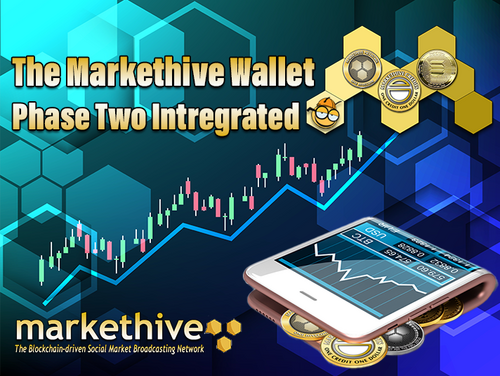
Phase Two of the Markethive internal wallet is complete, a considerable milestone for the company and the Markethive community. The impending release of the wallet is a pivot point for Markethive to secure its future as a completely decentralized social media broadcasting and marketing platform the world so desperately needs for these significant times.
The Markethive wallet is not just an ordinary wallet: It’s a transactional interface that services and keeps track of all your accounting and transactions, including your loans to Markethive and interest paid by Markethive to you via the ILP.
With Phase Two now in operation, you can access and set up your personal requirements and view your status in The Vault, Hive Rank, Staking, KYC Application, ILP Report, payments, and Markethive Credit threshold and balance. Plus, you can now transfer Markethive Credits to other members within Markethive.
Note that full access to all of the Markethive systems requires complete KYC documentation and an Entrepreneur One membership. The Markethive platform, with its general newsfeed, is free to use; however, the marketing systems and aspects thereof within Markethive will be limited, including Hivecoin transactional activity and micropayments of MHV.
Once the Markethive wallet is fully operational and launched, the Premium Upgrade will be introduced, which offers additional features and benefits to achieve a significant presence online for your marketing efforts and business growth, especially with the upcoming unique dashboard interface. It will be beyond anything else out there today. Read More

Coinbase Wallet Adds Safety Features Following High-Profile NFT Scams
Users will now be warned away from flagged apps and shown more detail about what certain actions will allow.
Coinbase says it is improving the safety and user experience of its Wallet app.
The crypto firm announced a number of new features on Monday aimed at improving blockchain transparency and security for Wallet users, adding transaction previews, token approval alerts, a blocklist of flagged dApps, and a spam token management feature that automatically hides maliciously airdropped assets.
Transaction previews will allow Wallet users to better understand how engaging with a smart contract will change their Wallet balances before they sign, Coinbase explained, while token approval alerts aim to clearly notify the user if a dApp is trying to take their NFTs or crypto.
Interacting with any “flagged” dApp will also warn Wallet users before they engage with potentially risky contracts—hopefully leading to fewer users losing their crypto in unwanted situations like phishing scams and wallet drainers. Read More
Binance Partners With Mastercard for Prepaid Crypto Cards in New Push for Adoption
Crypto giant Binance is teaming up with financial titan Mastercard to launch the “Binance Card” in Brazil.
In a new announcement, Binance, the world’s largest crypto exchange by trading volume, says it is committed to growing a relationship between traditional financial services and crypto.
“Binance Card is part of our ongoing efforts toward evolving the relationship between existing financial services and the growing crypto ecosystem. The card is in its beta launch phase in Brazil, and will be widely available in the coming weeks.”
Binance says Brazil is one of the exchange’s top 10 markets. Brazil will be the second Latin American company to receive the Binance Card after it was launched last year in Argentina.
According to the announcement, any Brazilian Binance user with a valid national ID will be able to use the card and manage it through the Binance app. Read More
Secret Network Validator Smart Stake to Shut Down Nodes
One of the most important validators for the privacy smart contract layer-1 blockchain. The Secret Network has declared that it would no longer provide the network with nodes or assistance after making this announcement.
On the 29th of January, the main validator Smart Stake made the announcement that it will turn down its Secret Network validator nodes on the 21st of February.
As justification for the discontinuation of its services, Smart Stake claimed "complicated and stressful validator operations, the expense and effort of validator operations, and recent events."
Staking and validator services are provided by Smart Stake, which is a provider that works with many networks, including Crypto.com, Polygon, and Cosmos, as well as Secret Network up until very recently.
The decision was made in the wake of discoveries about the Secret Foundation's lack of financial openness made by the founder of Secret Labs, Guy Zyskind. Read More
Cardano coins new name for its ADA-backed stablecoin Djed
After its successful security audit, the new overcollateralized stablecoin, Djed, from DeFi service provider COTI, deployed on the Cardano mainnet.
Since the fall of the TerraUSD (UST) algorithmic stablecoin in May 2022, many users in the crypto space have developed a weariness toward that particular asset class. The market for algorithmic stablecoins has declined 10x from its all-time high before the Terra collapse.
However, this has not stopped Cardano network developers from pushing forward with the launch of the ecosystem’s overcollateralized stablecoin—a name Cardano prefers to avoid confusion with algo stablecoins— on Jan.31. Launched on the Cardano mainnet, Djed (DJED) is pegged to the U.S. dollar and backed by Cardano’s native cryptocurrency, ADA. It uses the Shen (SHEN) token as its reserve coin.
According to the announcement, the new token recently completed a successful security audit and was under development for over a year. DJED is a product of Coti, DAG layer 1 on the Cardano blockchain, as a means for new decentralized finance (DeFi) and payment opportunities.
Shahaf Bar-Geffen, the CEO of Coti told Cointelegraph that recent times in the market prove we need a "safe haven" from volatility.
Not only do we need a stablecoin, but we need one that is decentralized, and has on-chain proof of reserves. Read More
Disclaimer: These articles are provided for informational purposes only. They are not offered or intended to be used as legal, tax, investment, financial, or any other advice.















