x






What are quantum-resistant tokens, and why do they matter for crypto?
Quantum-resistant tokens use advanced cryptographic methods to protect against the powerful capabilities of quantum computers.
Quantum-resistant tokens are a new generation of cryptocurrencies built to address vulnerabilities posed by quantum computing. Traditional cryptocurrencies, such as Bitcoin and Ether, rely on elliptic curve cryptography (ECC), which is secure against classical computers but vulnerable to quantum algorithms like Shor’s Algorithm. However, the potential threat is a concern for the future.
ECC is based on complex math problems, like finding the private key from a public key (the discrete logarithm problem). Solving this would take an unreasonably long time on standard computers, so it’s considered secure.
Quantum computers, however, can use Shor’s Algorithm to solve this problem much faster. Essentially, they could figure out the private key from the public key in a fraction of the time, breaking the security of the system.
To counter this, quantum-resistant tokens implement post-quantum cryptographic algorithms, such as lattice-based cryptography and hash-based signature schemes. These methods rely on problems even quantum computers cannot solve efficiently, ensuring robust protection for private keys, digital signatures and network protocols. Read More
Illuvium partners with Virtuals, bringing autonomous AI NPCs to its games
Illuvium said the partnership with AI agent protocol Virtuals will allow its in-game NPCs to adapt quests, dialogue and challenges based on the player’s actions.
Blockchain-based gaming franchise Illuvium is set to upgrade its in-game non-playable characters (NPCs) through a partnership with Virtuals, the protocol behind a number of viral social AI agents on X, including AIXBT.
The collaboration will see Virtual’s G.A.M.E AI model framework power NPCs within Illuvium’s trio of games (still in beta), giving them the ability to dynamically change up dialogue, quests or challenges depending on a player’s actions.
“Imagine this: You walk into a bar. The bartender agent dreams of being the most devoted husband. In a traditional game, your options might be to buy a drink or play a song. In an agent-driven world, you could insult his wife, sparking his anger, leading him to attack you,” the team behind the Virtuals Protocol wrote in a Jan. 7 X post.
The player’s actions could also change their game experience depending on how they interact with the agents, which could include attacking agents to alter the dynamics of an area or treating them kindly, which could garner bespoke rewards or quests.
“Multiply this emergent complexity across every agent, in every scenario, and you get a gaming experience filled with infinite stories.” Read More
Decentralization is in danger — We can fix it
We can preserve Bitcoin’s core principles while enabling advanced functionality and interoperability.
One of the biggest challenges to Bitcoin’s rise to hegemony is complacency. The world’s first cryptocurrency is often portrayed as “perfect” from a technological and philosophical perspective, but this is a significant risk. While Bitcoin’s core remains essentially unaltered — and, without consensus, unalterable — the rise of layer-2 networks and new capabilities like “merged mining” threatens to undermine the security foundations of this transformational technology.
Merged mining, where miners simultaneously mine Bitcoin and additional cryptocurrencies, has quickly proven to be a highly effective way of reusing Bitcoin’s hashrate to secure external systems. Still, it has created an environment where some Bitcoin miners control network sequencing and attack the remote chain while continuing to mine the cryptocurrency normally.
Another potentially more widespread danger comes from using Bitcoin as a data availability (DA) layer in a way that directly creates maximal extractable value (MEV) on the Bitcoin base layer. That may incentivize Bitcoin miners to engage in “time bandit attacks” — where miners rewrite blockchain history to steal funds allocated by smart contracts in the past — and other ecosystem vulnerabilities that damage Bitcoin’s anti-censorship capabilities.
How can we solve the problems presented by new layer-2 functionalities without damaging the crucial capabilities they bring? The most compelling solution is the one that cleaves closest to Bitcoin’s founding philosophy: to realign incentives for network participants.
It’s not all doom and gloom. It is possible to inherit Bitcoin’s complete consensus security in a scalable manner without giving a subset of BTC miners undesirable control over the second layer. Bitcoin layer 2s can still leverage Bitcoin for DA without introducing MEV risks. Bitcoin layer 2s can contribute back to the layer 1 in a symbiotic manner by increasing the utility of Bitcoin-based assets and directly subsidizing the blockchain’s security budget in an incentive-aligned manner that strengthens the entire ecosystem.
With thoughtful design decisions and an open discussion around the nuances of different protocol architectures, we can ensure that layer 2s are part of the solution rather than potential sources of systemic risk. Read More
Phuket to Trial Crypto Payments to Capture $1 Trillion Opportunity
The move reflects the country's evolving approach to digital assets in an effort to stay competitive in global finance and tourism.
Thailand is set to launch a crypto payment pilot program in Phuket, according to reports from Thai media on Wednesday.
Finance Minister Pichai Chunhavajira announced the initiative at a Marketing Association of Thailand seminar, emphasizing the program would operate within existing legal frameworks and wouldn't require new legislation.
"We won't do anything that is illegal," Chunhavajira was quoted as saying, according to a report from The Nation Thailand.
The development signals how the country's approach to digital assets is changing as it seeks to maintain its competitive edge in global finance and tourism.
Chunhavajira reportedly highlighted how recent geopolitical conflicts have disrupted global economies, noting that for individuals fleeing political tensions and seeking to purchase property in Thailand, "paying with Bitcoin could be a much simpler process." Read More
Markethive Redefines "Investment" With The ILP and E1 Upgrade. Don’t Miss The Chance Of A Lifetime!
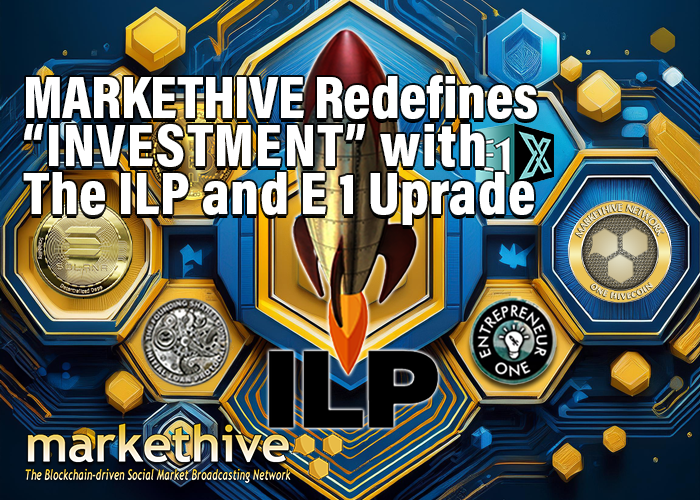
Markethive is redefining the investment realm. Markethive’s unique ecosystem combines a sophisticated inbound marketing suite replete with every innovative tool and system available to deliver successful marketing campaigns, a social networking interface, a state-of-the-art broadcasting system, and its fully functional crypto token, Hivecoin. (HVC) This unique combination sets Markethive apart, making it a complete ecosystem within the marketing and social network, digital broadcasting, and crypto industry.
As a result, the Markethive community can seamlessly accrue monetary value through micropayments for activity, content creation, rewards, incentives, and tipping. This is enhanced as the value of Hivecoin rises now that HVC is on its first crypto exchange. Given that Hivecoin is the apex of a utility token with many use cases in this prevalent industry, it stands to reason the only way the value of HVC can go is up.
The Entrepreneur One Upgrade is a gateway to a host of benefits. It allows you to acquire ILPs, become an equity holder, and participate in the platform’s future development. This unique investment approach, which bypasses the traditional finance route, positions Markethive as a compelling investment opportunity.
Markethive is heading into a future rooted in the principles of transparency and decentralization. It is a community-driven platform offering operational efficiency, freedom, and financial sovereignty not seen previously in conventional tech, aka Web 2.0, which has primarily been confined to the ethos of centralization. Read More
Starknet launches SN Stack, allowing developers to build custom chains
Zero-knowledge technology continues to be a popular method to scale cryptocurrencies while providing quantum-resistant security.
Starknet, a zero-knowledge (ZK) layer-2 scaling solution for Ethereum, announced the rollout of the Starknet Stack, allowing developers to create their own custom blockchains using Starknet’s zero-knowledge technology.
The software suite is available in three presets: StarkWare Sequencer, which most closely resembles the public Starknet stack; Madera, a fully customizable, open-source configuration; and Dojo, a mode optimized for gaming.
Following the announcement, Leo Sizaret, business development manager at StarkWare, said:
"We believe zero knowledge technologies are the future of blockchain. It gives you exceptional security and scalability while also being Quantum resistant and cost-efficient."
Starknet’s release of the SN Stack blockchain suite comes amid fears that quantum computers could break modern encryption standards used by blockchain networks and cryptocurrencies. Read More
Pyth partners with Revolut for real-time digital asset data
Pyth, a decentralized data infrastructure provider, has teamed up with fintech banking company Revolut to integrate digital banking data into decentralized finance (DeFi).
Revolut will publish its digital asset price data on Pyth Price Feeds, enabling DeFi developers to incorporate asset “quote and trade data,” according to a news release.
In return, Revolut will contribute its proprietary digital asset price data to Pyth Price Feeds to support the secure operation of Pyth’s decentralized applications (DApps).
In an exclusive interview with Cointelegraph, Mike Cahill, CEO of Douro Labs and core contributor to the Pyth network, said the partnership is “proof that the lines between traditional finance and Web3 are disappearing once and for all.”
Revolut’s integration with the Pyth network highlights the growing connection between traditional finance (TradFi) and DeFi, which Cahill said will “create the foundation for a truly global financial market.”
Through the partnership, DeFi developers gain access to over 500 real-time feeds across digital assets, foreign exchange, equities and commodities. These feeds support DApps, which reportedly handled over $1 trillion in total traded volume in 2024, according to data from Pyth. Read More
The Evolution of Crypto Lending – Risks, Rewards and the Path to Mainstream Adoption
In the constantly evolving world of finance, crypto lending has emerged as a revolutionary alternative to traditional banking systems.
Offering a blend of innovation and efficiency, it bridges the gap between DeFi (decentralized finance) and TradFi (traditional financial) systems.
While the promise is vast, navigating its complexities is crucial for understanding its role in the broader financial ecosystem.
The rise of crypto lending:
At its core, crypto lending allows borrowers to secure loans by providing cryptocurrency as collateral.
This process is governed by smart contracts – self-executing programs on the blockchain that eliminate the need for intermediaries.
Whether you’re an individual seeking a loan or an investor looking for returns, crypto lending offers a unique financial avenue.
What sets decentralized platforms apart is their openness – anyone with crypto assets can participate, making financial services more accessible than ever.
This trend is not just a fleeting moment in the evolution of blockchain. It represents a fundamental shift in how we perceive financial inclusivity and efficiency. Read More
How a mobile app is transforming decentralised AI data collection
Decentralised AI data collection is getting a significant boost with Ta-da, a mobile application that aims to solve one of artificial intelligence’s most pressing challenges: acquiring high-quality, diverse training data.
The platform, which emerged from the voice AI company Vivoka, has attracted around 85,000 users and the company currently works with 50 clients to generate millions of data points weekly.
Training robust AI models requires vast amounts of different yet high-quality data, particularly for speech recognition, image classification, and natural language processing. However, traditional data collection methods can often prove expensive, time-consuming, and prone to bias.
Ta-da’s approach to decentralised AI data collection addresses these challenges through a combination of mobile accessibility, blockchain technology, and user incentivisation. Read More
Disclaimer: These articles are provided for informational purposes only. They are not offered or intended to be used as legal, tax, investment, financial, or any other advice.
Featured Image Source: Pixabay















