x





Image Source: Pixabay
Orbs Releases Smart Contract for Validators in TON Blockchain
Orbs, a public blockchain infrastructure designed for mass usage applications, has announced the release of a new smart contract called the single nominator for validators in the Telegram Open Network (TON) blockchain. The contract provides an isolated cold wallet for validators to secure their validation process, enhancing their independence, security, and protection against gas-spending attacks.
In the TON blockchain network, validators participate in a proof-of-stake consensus algorithm by staking their cryptocurrency holdings to support the network's security and transaction processing. The nominator essentially nominates a validator to represent their stake in the network and earn rewards on their behalf. The validator, in turn, is responsible for validating transactions and adding new blocks to the blockchain.
The single-nominator smart contract provides an option for the core team's nominator pool smart contract. The alternative was developed in-house to provide security for validators who stake their funds. The contract provides an isolated cold wallet for validators to secure their validation process and prevent gas-spending attacks. The contract also offers the ability to recover stakes during emergencies, such as elector upgrades. Read More
Blockchain-Powered Satellite Contributes to Ethereum Scaling
The Ethereum KZG ceremony is receiving a contributor from outer space as Cryptosat, a blockchain-powered satellite orbiting Earth, has contributed entropy to the Ethereum scaling effort. The satellite's Verifiable Random Beacon service generated the entropy, which was signed by the satellite itself and can be verified using the public key of Crypto2.
The Ethereum Foundation requested that users from all over the world contribute randomness to the KZG ceremony to strengthen the security of the next version of Ethereum. The KZG ceremony aims to provide a cryptographic foundation for Ethereum scaling.
The contribution from Cryptosat's space satellite will be viewable in real-time via a dashboard monitoring the satellite's trajectory and latest status. According to the announcement from Cryptosat, the satellite orbits Earth every 90 minutes following a remote course 550 km above ground, which makes it difficult for outside actors to gain access during the KZG contribution.
Cryptosat has a Verifiable Random Beacon service, which generates entropy for its contribution. Beacons from this service are signed by the satellite itself and can be verified using the public key of Crypto2, which was also generated in space. The commitment of entropy from Cryptostat's space satellite will be valuable for strengthening the security of the next version of Ethereum. Read More
Hash rate and sustainability: How Bitcoin’s rising processing power is a net positive for the environment
Unveiling the potential environmental saviour hidden in Bitcoin's soaring hash rate, this report delves into the rapidly increasing processing power of the network and its unanticipated consequences.
At the end of February, the Bitcoin network’s computing power reached its all-time high of 320 EH/s.
The milestone sparked a cross-industry conversation about the implications of such a high hash rate, with many outside of the crypto space fearing its impact on the environment.
And while most Bitcoin critics tend to overuse the term “environmental impact” without giving much depth to what it encompasses, there has always been legitimate concern over Bitcoin’s energy usage.
Bitcoin mining is an energy-intensive process. Bitcoin mining is also a highly competitive and efficient industry, so miners will always seek the cheapest and most abundant energy sources. As the most affordable electricity comes from coal-powered plants, environmental activists are worried that an increase in Bitcoin’s hash rate comes with increased demand for the dirtiest energy sources. Read More
Unlocking mass adoption: The importance of user-friendly crypto wallets
Complicated infrastructure is the last barrier that must be overcome before achieving mainstream crypto adoption.
Cryptocurrencies have the potential to change how the world sees money, offering benefits like accessibility and decentralization. Due to their foundation in blockchain technology, people can buy and use cryptocurrencies without an intermediary, engaging directly with a buyer or seller on a digital ledger. For those unable to open a bank account due to a lack of documentation or for those in countries where the government has a history of freezing access to money stored in banks, accessibility and privacy have become much more crucial to achieving security and financial freedom.
What’s more, businesses are now also increasingly accepting cryptocurrencies as a form of payment, making it easier for people to use digital currency in daily transactions. As of November 2022, some of the major companies accepting cryptocurrencies included the online marketplace Etsy and the American internet retailer Overstock, in addition to several fast-food restaurants in Venezuela.
Early adopters’ successes in implementing digital currencies have brought continued business adoption and, more recently, government interest. Recognizing that people are paying for products and services with digital currency, it is only fitting that authorities are looking at ways to set and implement rules for safe usage. Although some critics are quick to poke at regulation as taking away from the benefits that digital currencies provide, such as freedom from intermediaries, the counterargument suggests that rules are crucial to further legitimizing cryptocurrencies and increasing global adoption on a wide scale. Read More
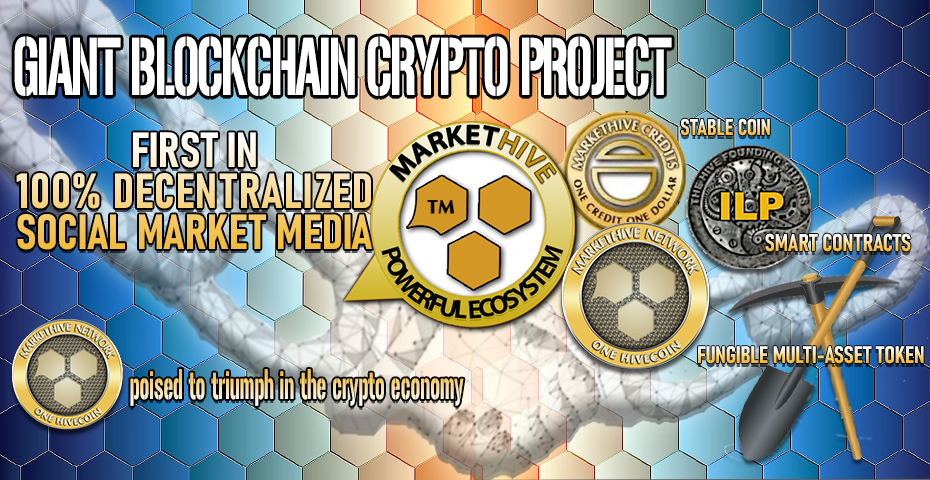
HVC is poised to triumph in the crypto economy.
Markethive is a monolithic blockchain project currently operating as a social network, an entire inbound marketing platform with email, blogging, and digital media capabilities that broadcast to the vast internet. It’s a complete Market Network and the first of its kind.
Markethive is predominantly a free system where users can access a platform that can cost more than $2,500 offered by other marketing platforms. There are, of course, upgrades that open up more tools and monetization opportunities, the first being the Entrepreneur One Loyalty Program, and coming soon is the Premium Upgrade.
The many domains Markethive has and its autonomous cloud systems that ensure its sovereignty and longevity make it untouchable and immune from the tech giants’ rule and biased agenda. But can still remotely infiltrate the social media platforms and reach the multitudes either locked in or looking for an alternative meritocratic medium.
In other words, wherever you go, Markethive is there, anywhere and everywhere, delivering its message via its community of entrepreneurs to a far-reaching audience. This next-generation social market media is poised in the wings, and when the time is right, it will emerge as a shining light to lift people up and bring financial sovereignty and hope in this gloomy and uncertain world.
The video platform, conference rooms, the unique four specific news feeds currently in development, and many other projects and incentives add to the credibility and need for an ecosystem in the social media and digital marketing space. Read More

Bitcoin Stamps Emerge as New Image-Storage Trend on the Bitcoin Blockchain, Over 8,000 Stamps Minted So Far
After the Ordinal inscription process gained significant traction on the Bitcoin blockchain with more than 800,000 inscriptions to date, a new trend of non-fungible token (NFT) technology has emerged called Bitcoin Stamps. The image-storing technique is a new way of storing images on Bitcoin, and so far, more than 8,000 stamps have been minted.
From Ordinals to Stamps: A New Way to Store Images on Bitcoin Materializes
Bitcoin enthusiasts have been introduced to a new method of storing images on the Bitcoin network that’s different from the Ordinal inscription process that has become a popular trend in recent months.
The new Bitcoin Stamp scheme was created by the Twitter user Mike in Space, and a summary of the project is hosted on Github. Basically, the technology provides a way to split an image into numerous unspent transaction outputs (UTXOs) by encoding it in Base64 text and leveraging the Counterparty protocol to broadcast it to Bitcoin. Read More
Hidden Treasure: Every Modern Copy of macOS Contains a Copy of Bitcoin's White Paper
On April 5, 2023, the independent blogger Andy Baio published a post on his Waxy Blog that explained every version of macOS from Mojave 10.14.0 to the current version hosts a copy of Satoshi Nakamoto’s seminal Bitcoin white paper. Mac users can type a simple command in the terminal, and all nine pages describing Nakamoto’s invention will appear in a PDF version in the built-in image viewer, Preview.
Blogger Discovers Bitcoin White Paper Hidden on Every macOS 10.15 or Later
While celebrating Satoshi Nakamoto’s alleged April 5th birthday, bitcoin supporters discovered that many Macintosh computers running the macOS operating system contain a complete version of the seminal Bitcoin white paper.
The initial discovery was revealed in a blog post called “The Bitcoin White Paper Is Hidden in Every Modern Copy of macOS” on Andy Baio’s Waxy Blog. The independent blogger found the hidden file while fixing his printer and confirmed his findings by consulting “over a dozen Mac-using friends to confirm.”
After typing the command in the terminal and using a Mac with macOS 10.15 or later, the Bitcoin PDF should open in Preview, according to Baio’s explanation. The blogger also provides instructions on how to access the file via the operating system’s library folder for those who are not familiar with the macOS terminal. Read More
Trust Wallet Partners with Ramp and MoonPay for Crypto-to-Fiat Withdrawals
Trust Wallet, the official cryptocurrency wallet of Binance, has announced a new partnership with Ramp and MoonPay. This partnership will introduce a new feature that enables Trust Wallet users to convert their cryptocurrency holdings to fiat currencies directly within the app.
The feature is a major development for Trust Wallet users as it eliminates the need for them to transfer their funds to a centralized wallet before they can convert their holdings to fiat. With this new functionality, users can enter and exit the cryptocurrency market entirely through their self-custody wallet, giving them complete control over their cryptocurrency funds.
Trust Wallet's head of product, Eric Chang, emphasized that the new feature will be a boon for customers, especially during a time when the market is turbulent and crypto platforms are under heavy scrutiny over managing customers' funds.
The partnership with Ramp and MoonPay comes as several centralized exchanges and even peer-to-peer platforms are shutting down. The latest to announce its closure is Paxful, a popular P2P global exchange that cited regulatory challenges and staff shortages as reasons for its closure.
Trust Wallet offers access to 65 different blockchains and boasts a customer base of 60 million users. In addition to crypto-to-fiat withdrawals, Trust Wallet also provides access to decentralized applications (DApps), enabling users to communicate with DApps on any supported blockchain. Its features include buying, staking, trading, and storing various cryptocurrencies. Read More
Solana reveals cost-cutting solution for on-chain storage
Known as state compression, the technology promises to drastically reduce the cost of on-chain storage.
Layer-1 blockchain Solana has released a new solution aiming to drastically reduce the cost of on-chain storage. Called state compression, the technology promises to bring down the cost of minting 1 million nonfungible tokens (NFTs) on the network to nearly $110.
“After numerous phases of development, adoption, and rollout, compressed NFTs are live on Solana’s mainnet-beta and powering the next wave of novel on-chain product experiences,” said Solana Foundation tech lead Jon Wong in a blog post on April 6. According to Wong, compressed NFTs “are 2,400-24,000x cheaper than uncompressed” peers with identical structures.
On Twitter, users classified the state compression solution as a “game changer” and a path “to make Solana a much more viable option for enterprise use cases.” Read More
Polygon becomes second-largest gaming blockchain after user activity surges in March
Polygon overtook Hive for the second spot last month, with the Hunters On-Chain RPG partly driving the growth in unique active wallets.
Surging user activity on Ethereum layer-2 scaling solution Polygon in March saw the network become the second-largest blockchain gaming network in terms of unique active wallets (UAWs).
According to the “Blockchain Games Report” published by decentralized application (DApp) analytics platform DappRadar, the number of UAWs engaging with games on Polygon hit 138,081 in March, marking an increase of 53% from February.
That figure places Polygon well ahead of third and fourth-ranked Hive and BNB Chain at 84,000 and 80,000 UAWs, respectively, while first-placed Wax is well ahead of the pack with 314,000 UAWs.
“Polygon, a blockchain previously known for DeFi DApps, overtook Hive this month and secured the second spot. This is a positive sign for Polygon, as it is now gaining recognition as a gaming blockchain,” the report reads. Read More
Disclaimer: These articles are provided for informational purposes only. They are not offered or intended to be used as legal, tax, investment, financial, or any other advice.















