x






Image Source: Pixabay
What the Kraken Crackdown Means for Ethereum Staking
Kraken’s settlement with the SEC over its staking-as-a-service product has put other exchanges on notice—but it may be a boon for decentralized alternatives.
On its face, it sounds like something that should have been bad for all crypto-staking services. But that’s not quite how the news landed. The governance tokens for Lido and Rocket Pool, two of the largest pooled staking services, soared as high as 11% in the past day, according to CoinGecko.
It’s a sign that the market thinks centralized exchanges acting as staking intermediaries, like Kraken and Coinbase, should worry, but not the rest of the industry. In the past day, Coinbase Wrapped Staked ETH (cbETH) selling volume has outpaced buying at a ratio of almost 3:1, according to GeckoTerminal.
Staked assets on proof-of-stake networks, like Ethereum, help keep networks running. They’re how validators, whose hardware stores data and processes new transactions, prove they have skin in the game. Validators receive rewards for participating on networks but can lose some of their staked assets for inactivity or other offences.
Becoming a standalone Ethereum validator, which is now the largest proof of stake network, isn’t easy for most retail-level investors. A user would need 32 ETH, worth roughly $48,000 at current prices, to do it. Instead, users with more modest amounts of ETH to stake turn to staking-as-a-service and pooled staking providers. Read More
Terra May Be at Risk Again—But This Time Is Different
Terra Classic, the network born of Terra's $60 billion collapse, may be at risk of takeover by a staking service wielding disproportionate power.
The $60 billion implosion of the Terra ecosystem last May exposed cracks in the foundations of the crypto industry and kickstarted a year of cascading financial crises that have yet to relent.
Now, in the ashes where Terra once stood, another controversy is bubbling—one offering potential warning signs for the broader crypto landscape.
The matter concerns Terra Classic (LUNC)—the Cosmos-based network born out of the collapsed Terra ecosystem—and Allnodes, a major staking platform currently integral to Terra Classic’s operation.
Terra Classic is often referred to as a “meme chain”—meaning it isn’t taken all that seriously by the wider crypto community. The network was resuscitated by Terra community members more out of a spirit of experimental novelty than an earnest ambition to re-establish the failed behemoth architected by current international fugitive Do Kwon. Read More
Blockchain tech still far from hitting the esport big leagues, says investor
Smaller-scale esports organizations have started using blockchain tech for distributing prize pools, but the tech is yet to be adopted by the big tournament organizers.
Small esports tournament organizers have started dabbling in blockchain tech to host tournaments and distribute prize pools. However, don’t expect to see it in the big leagues just yet, says an investor.
Esports, or electronic sports, is a form of organized competition via video games. Players sometimes referred to as esports athletes usually compete for prize money either individually or as a team.
Dave Harris, managing director of esports investment firm Guinevere Capital, told Cointelegraph that he has begun seeing blockchain being used in amateur gaming competitions.
In his opinion, however, it will take more time before the big titles and professional tournaments will consider adopting the tech.
“There are certainly a lot of places this technology can or is being used in esports, but it will take time for mass adoption into the mainstream titles and events, and as always the major game publishers are the kingmakers,” he said. Read More
Here’s how one company is solving DeFi’s issues through easy onboarding, and cross-chain staking
DeFi is growing fast, but it has to focus on making onboarding and earning yield easy to achieve mass adoption.
Decentralized finance (DeFi) was established to transform financial services so that anyone, no matter where they live or their status, can enjoy the benefits of financial sovereignty. However, before it can achieve its mission, it must first tackle the complexity, that deters millions of potential newcomers from using DeFi protocols.
One critical problem is the poor user experience and complicated interfaces that plague onboarding and make services inaccessible to a mainstream audience.
Onboarding and usability are key areas that hinder mass adoption. Even without the KYC (Know-Your-Customer) requirements, DeFi’s multi-step onboarding process puts services out of reach of most people. Wallet creation and the need to purchase crypto assets to load up these wallets make non-native users more hesitant to dive into valuable services such as lending, trading, and yield farming. Read More
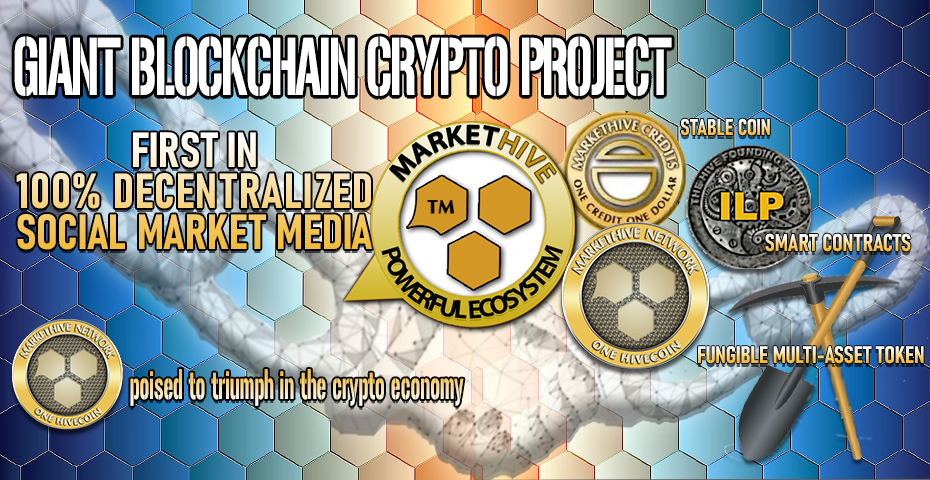
HVC is poised to triumph in the crypto economy.
Markethive is a monolithic blockchain project currently operating as a social network, an entire inbound marketing platform with email, blogging, and digital media capabilities that broadcast to the vast internet. It’s a complete Market Network and the first of its kind.
Markethive is predominantly a free system where users can access a platform that can cost more than $2,500 offered by other marketing platforms. There are, of course, upgrades that open up more tools and monetization opportunities, the first being the Entrepreneur One Loyalty Program, and coming soon is the Premium Upgrade.
The many domains Markethive has and its autonomous cloud systems that ensure its sovereignty and longevity make it untouchable and immune from the tech giants’ rule and biased agenda. But can still remotely infiltrate the social media platforms and reach the multitudes either locked in or looking for an alternative meritocratic medium.
In other words, wherever you go, Markethive is there, anywhere and everywhere, delivering its message via its community of entrepreneurs to a far-reaching audience. This next-generation social market media is poised in the wings, and when the time is right, it will emerge as a shining light to lift people up and bring financial sovereignty and hope in this gloomy and uncertain world.
The video platform, conference rooms, the unique four specific news feeds currently in development, and many other projects and incentives add to the credibility and need for an ecosystem in the social media and digital marketing space. Read More

Multichain DEXs are on the rise with new protocols enabling them
A new set of decentralized exchanges can enable multichain trading and margin trading for users.
Decentralized exchanges (DEXs) have become increasingly popular in recent years due to their ability to offer users a high degree of control over their assets and a more secure trading environment than centralized exchanges.
However, one major limitation of DEXs is their inability to support cross-chain and margin trading. There are multiple decentralized exchange protocols that aim to overcome this limitation by enabling DEXs to support cross-chain trading, margin trading and other features.
Injective Protocol is a decentralized exchange protocol built on Cosmos, a decentralized and interoperable blockchain ecosystem. Injective Protocol enables DEXs to support cross-chain trading and margin trading, allowing users to trade assets from different blockchain networks in a single platform.
AliumSwap is a decentralized exchange that supports multiple blockchain networks. In addition, it has a feature called Hybrid Liquidity that aims to simplify the trading process by consolidating it into one platform. Read More
Bitcoin hits record 44M non-zero addresses, thanks to Ordinals: Glassnode
Glassnode noted that this is the first time in Bitcoin history that the network has been used for purposes other than monetary.
The launch of Bitcoin nonfungible tokens (NFTs) — known as Ordinals — has tipped the number of non-zero Bitcoin addresses to a new all-time high of 44 million, according to crypto analytics platform Glassnode.
In a Feb. 13 report from Glassnode, the firm explained that for the first time in Bitcoin’s 14-year history, a portion of network activity is being used for purposes other than peer-to-peer monetary Bitcoin (BTC) transfers:
“This is a new and unique moment in Bitcoin history, where an innovation is generating network activity without a classical transfer of coin volume for monetary purposes.”
Glassnode explained that the Ordinals surge has contributed to a “short-term uptick in Bitcoin network usage of late” which has brought many “new active users” with a non-zero BTC balance to the network:
“The primary source of this activity is due to Ordinals, which instead of carrying a large payload of coin volume, is instead carrying a larger payload of data and new active users,” said Glassnode.
“This describes a growth in the user base [...] from usage beyond the typical investment and monetary transfer use cases,” it added. Read More
MetaMask Warns Investors Against Phishing Attempts by Scammers
MetaMask, a popular supplier of cryptocurrency wallets, issued a warning to investors about continuous phishing efforts. These phishing attempts are being carried out by fraudsters who are trying to contact consumers using Namecheap's third-party upstream system for emails.
The web hosting business Namecheap discovered that one of its third-party services had been abused in the evening of February 12 for the purpose of sending some unwanted emails, which were directed specifically against users of MetaMask. "email gateway problem" was how Namecheap referred to the situation in question.
In the proactive notice, MetaMask informed its million users that it does not collect Know Your Customer (KYC) information and would never contact users through email to discuss account details. This was done to ensure that users are aware that the company does not conduct KYC checks.
Phishing emails sent out by the hacker include a link that, when clicked, takes the recipient to a bogus MetaMask website that requests a confidential recovery phrase "to keep your wallet safe." Read More
What is NFT ticketing and how does it work?
NFT ticketing is a secure and unique solution that allows you to own your ticket as a one-of-a-kind digital asset verified on the blockchain.
NFT ticketing is revolutionizing event ticketing by providing a secure, transparent and efficient way of issuing and managing tickets. Nonfungible tokens (NFTs) are significantly harder to forge or duplicate than conventional tickets since they are stored on a blockchain. This lowers the risk of fraud and fake tickets by allowing event organizers to determine that only authentic tickets are used to enter an event.
NFT ticketing also enables greater customization and adaptability in terms of ticketing. For instance, event planners may issue NFTs for various event sections, such as VIP or general admission tickets. They can also provide details like seat numbers or access to premium content. This can streamline the ticketing process and save time and resources.
This article will discuss the concept of NFT ticketing, how NFT events work, the benefits and risks of NFT ticketing and how it is different from traditional ticketing. Read More
Disclaimer: These articles are provided for informational purposes only. They are not offered or intended to be used as legal, tax, investment, financial, or any other advice.















