x





Image Source: Pixabay
Blockchain Developer Activity Is Indeed a Measure of Crypto Success
The number of weekly active blockchain developers is down more than 26% over the past three months. However, many attempted to downplay the news. Perhaps most notably, many on claimed the loss of ‘tourist builders’ and ‘tourist investors,’ was no loss at all, as it will allow the industry to better focus on real projects.
However, the reality is that any smart contract platform is dependent on significant blockchain developer activity. Those without them wither away and die. It is disingenuous to say that the exodus of developers or investors is really a good thing. In fact, it is a major liability. This industry depends on innovation, and the more innovators, the greater the competition.
What some consider tourist builders and tourist investors are actually people who are often blockchain-agnostic – folks who aren’t necessarily blockchain enthusiasts but people who understand the industry and see the value in it. These are people who can take their talent and treasure to a number of different industries. These are people who the industry should want involved. Read More
Collaboration Between Social3 and Shardeum
The collaboration with Shardeum was revealed, and on their website, they have posted their present job positions.
The very first EVM-based L1 in the globe, Shardeum utilizes sharding to enhance TPS with each new node added.
They’re hiring right now: Engineer for DevOps and DevRel. With Social3, finding a job has now gotten very simple. You need to learn more about Shardeum before submitting applications for jobs. Let’s look further.
Over the last ten years, blockchain technology and its numerous applications—including cryptocurrency—have become increasingly popular. There are around 300 million users of cryptocurrency alone. Although forecasts suggest that the number of cryptocurrency users will soon reach one billion, obstacles still need to be overcome. Scalability, limited bandwidth, and excessive costs are the three problems that Layer 1 (L1) blockchains like Ethereum & Solana must deal with. These problems must be resolved to be adopted by the next billion people. Splitting and transmitting information among numerous machines, or “sharding,” holds the key to finding the solution. Read More
Blockchain Expo: Maturing blockchain industry paves the way for enterprise adoption
A session at this year’s Blockchain Expo Europe highlighted that blockchain is reaching a stage of maturity that paves the way for enterprise adoption.
The session was presented by Pedro Lopez-Belmonte, Senior Manager of Web3 and Technology Innovation at Richemont, on day one of Europe’s leading blockchain conference.
One of the first charts presented during the session was Gartner’s hype cycle, which shows blockchain platforms now leaving the trough of disillusionment and entering the slope of enlightenment:
This area of the cycle is where emerging technologies leave behind their initial hype and subsequent disappointment and have now reached a stage of maturity where expectations are realistic and more widespread adoption often follows.
Gartner are not the only analysts that believe that blockchain is maturing. According to Market Research Future, the blockchain industry will reach $6.7 billion next year.
“The technology has already had a decent level of maturity. We can see that it has proven its value,” says Lopez-Belmonte. “Still, we are far away from reaching mainstream adoption and taking this technology and embedding it in our stacks and daily operations as cloud.etc”. Read More
Binance receives green light for crypto services in Dubai
The new MVP License is a transition from a provisional license received under a new regulatory framework earlier this year.
Crypto exchange Binance received a Minimal Viable Product (MVP) license from Dubai's Virtual Asset Regulatory Authority (VARA), enabling the crypto exchange to offer a range of virtual asset services to qualified retail and institutional investors, the company disclosed on Tuesday.
The development follows the issuance of the provisional license granted in March, which permitted the company to set up an office in the United Arab Emirates and provide digital asset exchange services to pre-qualified investors and financial firms.
With the new permission, Binance will be able to offer a range of virtual asset-related services to qualified retail and institutional investors under the legislative framework for virtual asset service providers (aka VASPs).
It will also permit the company to access local banking channels and provide open money accounts, virtual-fiat currency conversions, assets transfers, custody and management, as well as token offering and trading services.
Changpeng Zhao (CZ), founder and CEO of Binance, commented in a statement:
"We strongly believe there is a significant opportunity to work with our industry peers to develop consistent implementation standards around the world, as we have been doing in Dubai.” Read More
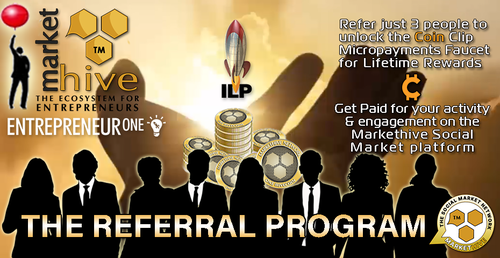
REFER THREE TO MARKETHIVE TO RECEIVE BONUS AIRDROPS AND ACTIVATE MICROPAYMENTS
As Markethive continues to gain traction with new members joining daily, Markethive is steadfast and in preparation to take a large share of the new Market Network that is the next generation following the social media craze of Web 2.0. Markethive is a Social Market Broadcasting Network. It sounds like a mouthful, and it is!
Markethive is an all-encompassing platform that has integrated;
As Markethive’s foundation is Blockchain-driven, it has its consumer coin, currently named Markethive Coin (MHV), but soon to be renamed Hivecoin (HVC - the Ticker Symbol). It is fully integrated into the system and has created an Ecosystem for all Markethive members, free and upgraded Entrepreneurs.
So Markethive has established its niche as the only Social Market Broadcasting Network with an infinity Airdrop and a system that rewards the users for engaging on the platform and learning how to use it with ongoing, real-time micropayments, otherwise known as a Faucet.
Markethive has the combined power of Facebook, LinkedIn, Marketo, and Amazon, with the real advantage of deriving income within the Markethive system while promoting your business and enjoying the social media interface. Read More

Ethereum NFTs Are Driving Crypto Adoption in Central and South Asia: Report
Of all the crypto-related web traffic in the region, more than half of it is going to NFT sites.
NFTs have become the biggest crypto on-ramp for countries in Central and Southern Asia, as well as Oceania, according to a report from Chainalysis on Wednesday.
The blockchain analytics firm noted that, in Q2 2022, 58% of web traffic from these countries to crypto services was NFT-related.
NFTs are unique blockchain-based tokens that are used to represent ownership over other digital or physical items. These tokens are frequently traded as speculative collectable items, but may also provide additional functionality and benefits to their holders.
The market for NFTs exploded within the last two years. Sales for these digital assets reached $23 billion in 2021 and are on pace to break that record this year, even though the NFT market has cooled in the second half of 2022. NFT collections like CryptoPunks and Bored Apes have helped make digital collectables mainstream—and, according to Chainalysis, the NFT boom has been particularly impactful in broadening crypto adoption in Central and Southern Asia. Read More
OpenSea implements a new protocol that ranks NFT rarity
The OpenRarity project was a collaborative project between various NFT community entities, including Curio, icy.tools, OpenSea and Proof.
With thousands of nonfungible tokens (NFTs) getting minted every single day, trying to find rare pieces can be a challenge for NFT collectors. However, as the industry continues to progress, the hassles in finding rare NFTs may soon become a thing of the past.
In a tweet, NFT marketplace OpenSea announced the implementation of OpenRarity, a protocol that provides verifiable rarity calculations for NFTs within its platform. The protocol uses a transparent mathematical approach to calculating rarity.
OpenSea said that rare NFTs will be awarded lower numbers like 1 or 2, while NFTs that have attributes similar to many other NFTs will have higher numbers. With this, the marketplace highlighted that buyers would be able to view a reliable “rarity ranking” when considering purchasing NFTs.
The feature will not be automatically applied to all NFT collections. According to the NFT marketplace, creators will still have control if they want to choose to apply the OpenRarity feature to their collections or not. Read More
Opera browser integrates Elrond blockchain services to bolster Web3 adoption
Elrond is one of the first carbon-negative blockchains in Europe, and its integration with Opera will help millions of new users to access the Web3 ecosystem.
Web3 crypto browser Opera announced plans to integrate Elrond blockchain services for over 300 million users. The integration would help Opera users directly access a host of decentralized applications (DApps) and other popular services through the integrated Opera wallet.
Elrond is a scalable blockchain network that offers various infrastructure services for DApps, enterprise use cases and the new internet economy. The blockchain’s adaptive state sharding makes it one of the fastest and more efficient networks.
With the integration, Opera users will have access to the Elrond Standard Digital Token (ESDT), a native token issuance standard, in addition to the native EGLD tokens, making it a great entry point for Web3. Users will be able to take part without relying on a third-party wallet, ensuring seamless transactions and added security.
In an exclusive conversation with Cointelegraph, Danny Yao, senior product manager at Opera, said that the company is actively pursuing a multichain policy, having integrated Ethereum, Bitcoin, Polygon, and BNB Chain earlier. He explained:
“Our aim is to be an understandable and secure entry point to Web3 for anyone interested in crypto. This also means we have provided a wallet selector feature that lets our users choose which wallet they want to use to interact with a particular DApp.” Read More
Helium Community Approves Crypto Wireless Network's Migration to Solana
Decentralized wireless network Helium has voted to ditch its own blockchain in favor of a move to Solana's network.
Helium, a blockchain-based network that powers wireless communication protocols powered by thousands of individual users, will migrate its own purpose-built Layer 1 blockchain to the Solana blockchain.
The network, which initially focused on powering the Internet of Things (IoT) devices like sensors and trackers, currently has more than 950,000 nodes, or hotspots, with operators being incentivized with crypto tokens.
The Helium Foundation announced the move after a community vote that saw a total of 7,447 votes cast ended on Thursday morning showing 81.41% support for the Helium Improvement Proposal (HIP 70).
Solana, which was designed to support massively scaling decentralized applications (dapps), is currently the industry’s ninth-largest blockchain network with a market capitalization of about $11.3 billion, per CoinGecko.
Today’s news comes hot on the heels of news that Nova Labs, the creator of the Helium Network, is partnering with German telecom giant T-Mobile to launch Helium Mobile, a 5G wireless service for smartphones. Read More
Disclaimer: These articles are provided for informational purposes only. They are not offered or intended to be used as legal, tax, investment, financial, or any other advice.















