x






Image Source: Pixabay
Blockchain.com Launches Crypto Visa Card With 1% Cashback Crypto Rewards
Crypto firm Blockchain.com has announced the launch of a new crypto-centric pre-paid Visa card and so far, 50,000 users have registered for the waitlist signup. In addition to launching its crypto Visa card powered by the card issuing platform Marqeta, Blockchain.com Visa users will earn 1% back in crypto whenever they spend funds using the card.
Blockchain.com Introduces Crypto Visa Card
Blockchain.com is joining the likes of Crypto.com, Ripio, Bitso, Coinbase, Bitpay, Blockfi, and FTX by announcing the launch of a new crypto-loadable pre-paid Visa card. According to the announcement on Wednesday, Blockchain.com Visa users can “spend from a crypto balance fee-free and offer the opportunity to earn crypto rewards.”
Moreover, 50,000 registered users have already signed up for the company’s new crypto payments card. “As one of the crypto industry’s oldest and most trusted platforms, we’re excited to roll out the natural next step to make crypto easy to use in the real world and accessible to as many people as possible,” Blockchain.com’s CEO Peter Smith said in a statement sent to Bitcoin.com News on Wednesday. Read More
Visa's trademark applications suggest more involvement in crypto space
The company's trademark owner applied for its name to be used in software “to view, access, store, monitor, manage, trade, send, receive, transmit, and exchange” crypto and NFTs.
Major credit card company Visa may be planning to explore digital wallet services based on two recent trademark applications.
According to records submitted to the United States Patent and Trademark Office (USPTO) on Oct. 22, the Visa International Service Association filed two applications for its character mark to be used in software “to view, access, store, monitor, manage, trade, send, receive, transmit, and exchange” crypto assets and nonfungible tokens, or NFTs. The filings also suggested the credit card company may be exploring a move into the metaverse, with its namesake used in “virtual environments in which users can interact for recreational, leisure or entertainment purposes.”
Some reports suggest that there are more than 1 billion Visa cards in circulation around the world. The company has previously partnered with crypto firms to offer credit and debit cards tied to crypto payments. The trademark filings followed those of Mastercard, which applied to the USPTO in April to use its logo in the metaverse and o NFTs. Read More
Google launches blockchain node engine for Web3 developers
The service will simplify node infrastructure and onboarding for blockchain developers.
According to an Oct. 27 announcement, tech-giant Google is launching an in-house Blockchain Node Engine (BNE) based on Google Cloud. As a node-hosting service, BNE enables Web3 companies to relay transactions, deploy smart contracts, and read or write blockchain data directly on Google Cloud. Ethereum will be the first blockchain supported by BNE. As told by Google:
“Today, manually deploying a node is a time-intensive process that involves provisioning a compute instance, installing an Ethereum client, and waiting for the node to sync with the network. [...] Google Cloud’s BNE can make this process faster and easier by allowing developers to deploy a new node with a single operation and specify the desired region and network.”
The service intends to place nodes behind a virtual private cloud firewall, allowing only trusted machines and users to communicate with endpoints. Additionally, services such as Google Cloud Armor would help protect the nodes from distributed denial-of-service attacks. Being a fully managed solution, BNE will also have its own developer team on-call to monitor for potential outages. Read More
Why the battle for low or no transaction fees really matters
High transaction fees stand in the way of crypto achieving its full potential and being embraced by the masses — but it is possible to make transfers for free.
During the frenzied bull run, transaction fees were running rampant. Over on the Ethereum blockchain, they hit eye-watering highs of $196.638 back in May — rendering the network unusable for most everyday consumers.
The Bitcoin blockchain suffered from a similar issue the year before, accelerating to a record-breaking $300.331. When demand is high, it's easy for Proof-of-Work networks to get congested — prompting miners to prioritize the transactions with the highest fees.
Here's the problem: high fees undercut one of crypto's most potent use cases — a decentralized way of offering peer-to-peer transfers. If sending funds from A to B is impractically expensive, millions of would-be users aren’t going to leverage this technology.
Heavyweights in the crypto sector know this. Over the summer, Ethereum co-founder Vitalik Buterin warned that the cost of single transactions "potentially takes up people's entire daily income" — especially in developing economies. Read More
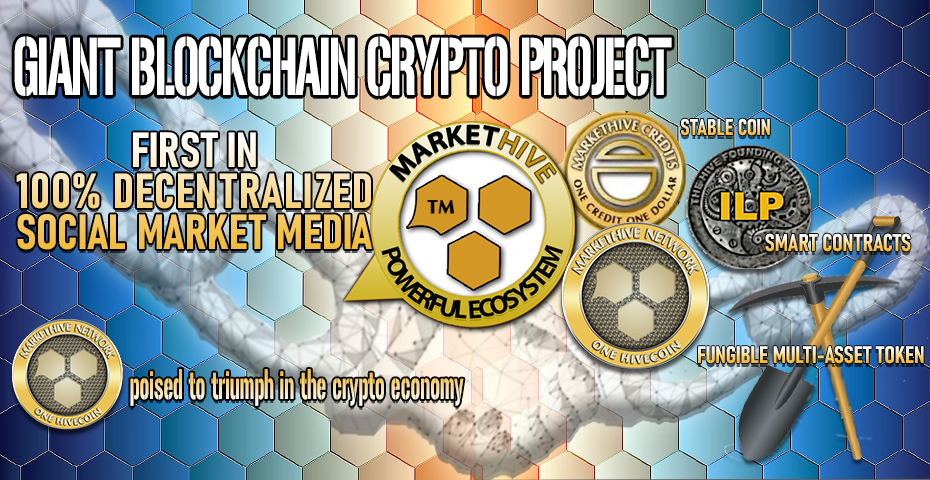
HVC is poised to triumph in the crypto economy.
Markethive is a monolithic blockchain project currently operating as a social network, an entire inbound marketing platform with email, blogging, and digital media capabilities that broadcast to the vast internet. It’s a complete Market Network and the first of its kind.
Markethive is predominantly a free system where users can access a platform that can cost more than $2,500 offered by other marketing platforms. There are, of course, upgrades that open up more tools and monetization opportunities, the first being the Entrepreneur One Loyalty Program, and coming soon is the Premium Upgrade.
The many domains Markethive has and its autonomous cloud systems that ensure its sovereignty and longevity make it untouchable and immune from the tech giants’ rule and biased agenda. But can still remotely infiltrate the social media platforms and reach the multitudes either locked in or looking for an alternative meritocratic medium.
In other words, wherever you go, Markethive is there, anywhere and everywhere, delivering its message via its community of entrepreneurs to a far-reaching audience. This next-generation social market media is poised in the wings, and when the time is right, it will emerge as a shining light to lift people up and bring financial sovereignty and hope in this gloomy and uncertain world.
The video platform, conference rooms, the unique four specific news feeds currently in development, and many other projects and incentives add to the credibility and need for an ecosystem in the social media and digital marketing space. Read More

Another NFT Marketplace Goes Zero Royalties in 'Race to the Bottom'
The token rewards-driven marketplace LooksRare will no longer enforce royalties and instead pay a share of protocol fees to creators.
LooksRare, an Ethereum NFT marketplace, has made paying creator royalties optional when trading NFTs.
The platform will let buyers opt into paying royalties, and also give a share of its protocol fees to NFT creators.
Another domino has fallen amid the rising trend of NFT marketplaces bowing out of enforcing creator royalties, with Ethereum marketplace LooksRare announcing today that it will no longer require traders to pay these fees on transactions.
LooksRare wrote in a blog post that it will “no longer support creator royalties by default” when traders sell NFTs, it will instead allow buyers to “opt-in to pay optional royalties.” That’s a similar approach to what Solana NFT marketplace Magic Eden did when it announced its own move to make creator royalties optional earlier this month.
LooksRare also said, however, that it will direct 25% of its protocol fee—the fee that it charges sellers to transact their NFTs—to creators. LooksRare charges a 2% total fee on the sale price, which means that 0.5% of the sale price will now be directed to creators in place of their respective royalty rates. Read More
Telegram Launches Username Auction Using TON Blockchain
Users of the privacy-forward messaging service can bid on rare handles or sell their own.
The popular instant messaging service Telegram launched its marketplace for Telegram handles on Thursday.
“This will enable Telegram handles, comprising both usernames and channels, to be bought and sold using Toncoin,” explained Telegram in a press release.
Toncoin (TON) is the token of The Open Network, which is the spiritual successor to Telegram’s independent blockchain ambitions—thwarted by federal regulators two years ago.
The auction is being hosted on Fragment.com, a dedicated “detached website” for users wishing to participate. From here, users can search for and purchase three-to-four character domains, auction their existing handles, and “bind pre-bought handles to off-chain accounts.” Read More
Twitter Will Allow Users to Buy and Sell NFTs Through Tweets
Twitter will let users display NFT marketplace listings from certain platforms, including a button to let them buy and sell collectibles.
Social media platform Twitter today announced that it will let users buy, sell, and display NFTs directly through tweets in partnership with four marketplaces.
The integration, called NFT Tweet Tiles, displays the artwork of an NFT in a dedicated panel within a tweet, and includes a button to let users click through to a marketplace listing.
The integration—which is still in testing—currently works with marketplaces from four specific partners: Solana-centric marketplace Magic Eden, multi-platform NFT marketplace protocol Rarible, Flow blockchain creator Dapper Labs, and sports-centric platform Jump.trade.
Collectively, those marketplaces span several blockchain networks, including Ethereum, Solana, Flow, Polygon, Tezos, and Immutable X. Read More
Charles Hoskinson Makes Cardano (ADA) Prediction, Says Ecosystem Will Become Network of Blockchains
Cardano (ADA) creator Charles Hoskinson is making a long-term prediction for the future of the Ethereum (ETH) rival’s ecosystem.
In a new video update, Hoskinson says that he thinks criticisms of proof-of-stake blockchains like Cardano are often inaccurate, especially ones that claim proof-of-stake chains are less accessible to the average person than proof-of-work.
Hoskinson says that anyone can buy a small computer such as the Beelink GTR5 and be a Cardano stake pool operator (SPO), or someone that runs a node that keeps the stake pool running.
“This is one of the big differences to me, between Bitcoin mining and proof-of-work and proof-of-stake. When you see all these people in the Bitcoin world say ‘well proof of stake is just a replication of central banking.’ Okay, so I can go to Amazon and buy an $800 computer, read some tutorials and manuals, and then boom, I’m participating in this system, and that’s a replication of the world banking system? I don’t think you really understand how the world banking system works.
It’s a lot more expensive to be a Bitcoin miner and be competitive in that respect and actually make a profit and do things there. You can certainly buy miners but ASICs are expensive and the odds are the vast majority of people that do well in that business are vertically integrated and spend hundreds of millions of dollars." Read More
Disclaimer: These articles are provided for informational purposes only. They are not offered or intended to be used as legal, tax, investment, financial, or any other advice.















