x





Image Source: Pixabay
Argentine Province Allows Millions to Pay Taxes Using Stablecoins
Inhabitants of Mendoza can now pay for government services in USDT or DAI.
The Province of Mendoza in Argentina now supports stablecoins as an option for tax payments, the region’s government announced Saturday.
The Mendoza Tax Administration (ATM) is giving its roughly two million residents more online payment options for their taxes in an effort to move toward “modernization and innovation,” according to the government website.
In an 11-page document outlining the new crypto payment process, Tether’s USDT and MakerDAO’s DAI stablecoins are shown as two cryptocurrency payment options.
Taxpayers can use their Binance, Ripio, Buenbit, Bitso, Lemon, or Bybit crypto wallets, to name a few. The ATM’s site will generate a QR code for users to scan with their crypto wallets after filling out preliminary information.
Upon receiving the stablecoins, the ATM will convert the US-tethered stablecoins into pesos for processing and provide payers with a receipt of the transaction.
Mendoza province is located in western Argentina, south of San Juan and east of the republic of Chile. It is the fourth most populated province of the country, with over 1.7 million inhabitants.
Argentina—a nation with a history of state bankruptcies and severe inflation—is no stranger to crypto. With a 64% inflation rate year-over-year as of August, it may not be surprising that the Mendoza government sees value in giving residents the ability to use cryptocurrency that’s being touted by some as a hedge against inflation. Read More
Helium Developers Mull Migration of Crypto Wireless Network to Solana
The proposed change is would be 'momentous,' bringing more speed, stability, and scalability.
Helium, the blockchain platform that uses crypto token incentives to fuel decentralized wireless networks, may soon undergo a significant transformation if a newly-revealed proposal passes: it could move from its own blockchain to Solana.
Published today, the HIP 70 proposal details why Helium’s core developers want to move the network from its own bespoke chain to Solana, a leading smart contract platform used for decentralized apps (dapps), NFTs, and decentralized finance (DeFi) protocols. In short, the developers think it will improve Helium’s speed, stability, and ability to serve more users.
“Solana offers significant benefits to Helium that include, but are not limited to, scale, community, and composability,” reads a blog post from The Helium Foundation. “This change will be momentous in scope, impact, and benefit to the Helium network and its users.”
Under the proposal, the Helium network would move all of its tokens—HNT, IOT, MOBILE, and DC (Data Credits)—from its own blockchain to Solana. It would also rely on oracles, or third-party data sources not on the blockchain, to manage Helium’s proof-of-coverage infrastructure and data transfer accounting functionality. Read More
GameSwift CEO Wojciech Gruszka Explains Why Developing a Steam-Like Web3 Platform Is a Gamechanger
GameSwift is a one-stop gaming ecosystem that aims to introduce cross-chain interoperability to web3 gaming. Chain, Web3 Infrastructure, Platform, and Gaming Studio are the four well-designed and integrated pillars of the ecosystem. Its original infrastructure facilitates implementing blockchain technology and sharing in-game resources for game developers and lets the players enjoy their gaming experience to the fullest.
Wojciech Gruszka, the Founder and CEO of GameSwift, is commonly known on Twitter as PanParagraf. He recently joined the Bitcoin.com News Podcast to talk about the market:
Wojciech is a lawyer and blockchain projects advisor. Thanks to his experience gained in international corporations such as Deloitte and Shell he’s been successfully advising various fintech organizations. Known to a wider audience for his Twitter profile based on extensive tokenomics analysis. Listen to the podcast
Input Output Global Collaborates With Stanford University
Input Output Global has announced plans to collaborate with Stanford University by establishing a peer-reviewed research Hub at the university. Blockchain Research Hub will be worth $4.5 million and will be led by some of the most brilliant minds at Stanford University.
The Hub starts accepting proposals for research in September 2022, with a deadline tentatively set in November 2022. The Hub will dedicatedly work in the field of blockchain technology. All the involved departments will be tasked with the following pointers:-
Increase the collation of the scientific knowledge of the blockchain industry.
Tackle important queries in the blockchain space.
Promote the need for research in the blockchain industry.
It has rarely been mentioned, but research is necessary to solve some of the most common issues in the blockchain space. For instance, bridge hacks and blockchain collapses have been troubling networks for some time.
What makes the matter worse is a new entry without the conduct of any research, and it further accelerates the issue, and the resolution is pushed away. Read More
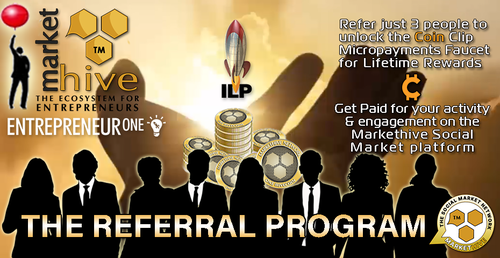
REFER THREE TO MARKETHIVE TO RECEIVE BONUS AIRDROPS AND ACTIVATE MICROPAYMENTS
As Markethive continues to gain traction with new members joining daily, Markethive is steadfast and in preparation to take a large share of the new Market Network that is the next generation following the social media craze of Web 2.0. Markethive is a Social Market Broadcasting Network. It sounds like a mouthful, and it is!
Markethive is an all-encompassing platform that has integrated;
As Markethive’s foundation is Blockchain-driven, it has its consumer coin, currently named Markethive Coin (MHV), but soon to be renamed Hivecoin (HVC - the Ticker Symbol). It is fully integrated into the system and has created an Ecosystem for all Markethive members, free and upgraded Entrepreneurs.
So Markethive has established its niche as the only Social Market Broadcasting Network with an infinity Airdrop and a system that rewards the users for engaging on the platform and learning how to use it with ongoing, real-time micropayments, otherwise known as a Faucet.
Markethive has the combined power of Facebook, LinkedIn, Marketo, and Amazon, with the real advantage of deriving income within the Markethive system while promoting your business and enjoying the social media interface. Read More

Ticketmaster Chooses Dapper Labs' Flow Blockchain for NFT Tickets
In a pilot program, five million Ticketmaster NFTs were minted in six months.
Event ticketing behemoth Ticketmaster announced today that it will adopt the Flow blockchain from Dapper Labs for minting tickets as NFTs for select events.
The NFTs—unique blockchain tokens that signify ownership—will function primarily as collectable digital memorabilia, but also as a shareable “proof of attendance.”
Over the past six months, Dapper Labs and Ticketmaster quietly launched an NFT pilot program. In it, Ticketmaster automatically issued ticket NFTs as memorabilia to attendees of specific events like the Super Bowl LVI this year.
In the pilot program, more than five million Flow NFTs were minted in a six-month period, according to Dapper.
As a result of the partnership, Ticketmaster has built a wallet and marketplace feature into its site, said Maher, and that’s where holders will be able to view and trade the NFTs they receive as a result of the partnership. Read More
Unstoppable Domains Users Can Now Send Private Emails With Skiff
Unstoppable Domains has integrated with Skiff Mail to enable users to send and receive end-to-end encrypted messages.
Unstoppable Domains is a San Francisco-based startup that provides NFT-based domain names for crypto wallets and websites.
It has integrated with Skiff Mail to enable users to send and receive end-to-end encrypted messages.
Privacy is a hot topic after the U.S. government banned crypto privacy tool Tornado Cash earlier this month.
But the unprecedented crackdown on a Web3 product doesn’t mean builders aren’t working hard to protect Web3 users’ privacy.
San Francisco-based startup Unstoppable Domains today announced an integration with Skiff, a privacy-focused email service designed for crypto wallets. The idea is to enable more ways for Web3 users to send end-to-end encrypted emails. Skiff already works with wallets on Solana and Ethereum as well.
Unstoppable Domains is a San Francisco-based startup that provides NFT-based domain names for crypto wallets and websites. Now those with an Unstoppable Domains domain name can send end-to-end encrypted emails using Skiff’s tools. Read More
Sneaky fake Google Translate app installs crypto miner on 112,000 PCs
Dressed up as legitimate desktop software, this sneaky malware has infected thousands of machines across 11 countries, forcing them to unknowingly mine Monero (XMR).
Crypto mining malware has been sneakily invading hundreds of thousands of computers around the world since 2019, often masquerading as legitimate programs such as Google Translate, new research has found.
In a Monday report by Check Point Research (CPR), a research team for American-Israeli cybersecurity provider, Check Point Software Technologies revealed the malware has been flying under the radar for years, thanks partly to its insidious design which delays installing the crypto mining malware for weeks after the initial software download.
Linked to a Turkish-based-speaking software developer claiming to offer “free and safe software,” the malware program invades PCs through counterfeit desktop versions of popular apps such as YouTube Music, Google Translate and Microsoft Translate.
Once a scheduled task mechanism triggers the malware installation process, it steadily goes through several steps over several days, ending with a stealth Monero (XMR) crypto mining operation being set up. Read More
A16z proposes a set of licenses especially for NFTs, based on Creative Commons model
The six licensing templates devised by VC firm Andreessen Horowitz are irrevocable and amendable, and give creators the power to set five variables for the future use of their works.
Venture capital firm Andreessen Horowitz (A16z) announced Wednesday that it had devised a set of six licenses tailored to nonfungible tokens (NFTs) that are based on the model pioneered by Creative Commons. Like Creative Commons licenses, there is a range of rights available through a variety of the proposed NFT licenses, titled Can’t Be Evil licenses.
In a blog post, A16z general counsel Miles Jennings and general partner Chris Dixon wrote that, while some NFT creators use Creative Commons licenses and others customize their terms, many NFT projects have no licenses or poorly drafted licenses, leading to copyright and other legal issues. NFT buyers, they added, usually have no idea what rights they receive with their NFTs.
The new set of licenses have the following goals:
“(1) to help NFT creators protect (or release) their intellectual property (IP) rights; (2) to grant NFT holders a baseline of rights that are irrevocable, enforceable, and easy to understand; and (3) to help creators, holders, and their communities unleash the creative and economic potential of their projects with a clear understanding of the IP framework in which they can work.”
The licenses also aim to make creators responsible for the use of third-party material without permission. Read More
Disclaimer: These articles are provided for informational purposes only. They are not offered or intended to be used as legal, tax, investment, financial, or any other advice.















