x



Image Source: Pixabay
NFT Steez and Lukso co-founder explore the implications of digital self-sovereignty in Web3
NFT Steez chats with Lukso co-founder Marjorie Hernandez about how Universal Profiles onboard and empower users with digital self-sovereignty
Sovereign identity has been a hot topic in blockchain and cryptocurrency, especially with the rise of the creator economy. Currently, there are two types of digital identities. One is federated and centralized whereby data is in the control of the service provider. Self-sovereign digital identity is often cited as a human right that can reclaim agency using blockchain technology, but what frameworks exist that aid in governing it?
On Aug. 2, NFT Steez, a bi-weekly Twitter Spaces hosted by Alyssa Expósito and Ray Salmond, met Marjorie Hernandez, the co-founder of LUKSO and The Dematerialized to discuss the state of blockchain-based identities and “Universal Profiles.” According to Hernandez, in the future, “everything will have a digital identity.”
Onboarding into the digital realm should be frictionless for sovereign “Universal Profiles”
During the interview, Hernandez explained the paradigm shift between centralized platforms to a more “platform-less future” and stressed that users need to be in control of their identities and creation on more “agnostic platforms,” where they can own their intellectual property via “Universal Profiles.”
Lukso’s integration of Universal Profiles enables users and creators to reclaim their identities and issue their IP in a symbiotic manner between creator and user. According to Hernandez, the Universal Profile can be seen as a personal operating system (OS) whereby one can authenticate themselves, but also send, receive and create assets. Read More
Cardano Vasil Hard Fork Gets a Hard Date
Cardano founder Charles Hoskinson says the Vasil hard fork was “the hardest update we’ve ever had to do.”
Developers at Input Output and the Cardano Foundation today announced that Cardano’s Vasil hard fork will occur on September 22, just one week after the Ethereum merge’s anticipated date of September 15.
“Vasil is the most significant Cardano update to date, bringing increased network capacity and lower cost transactions,” Cardano developer Input Output tweeted Friday.
A hard fork is when participants on a blockchain network decide to split the chain, which can happen for various reasons, resulting in two versions of the same network or protocol. Hard forks can be contentious, such as the expected ETHPOW hard fork following the Ethereum merge, or they can happen as part of a planned upgrade, such as the beacon chain hard fork that will place on September 6 leading up to the merge.
While Cardano’s Vasil hard fork aims to be a major effort to scale and expand the Ethereum competitor, it also intends to improve the developer experience for Web3 engineers creating decentralized applications on Cardano.
“The upgrade will also bring enhancements to Plutus to enable devs to create more powerful and efficient blockchain-based applications,” Input Output shared (Plutus is Cardano’s smart contract development platform). Read More
What the Ethereum Merge Means for NFTs
Are your NFTs safe? What’s up with duplicate NFTs on forked chains? Developers and builders answer these and other questions.
Ethereum is about to execute its long-awaited “merge” that will dramatically cut down the environmental impact of the network.
There may be forked versions of Ethereum, which could cause confusion and lead to scams as duplicated NFT assets enter the market.
We’re days away from Ethereum’s long-awaited merge, in which the leading network for dapps and NFTs will shift to a more energy-efficient system. It’s years in the making, but as the mid-September target draws near, many users are wondering what could go wrong—and whether anything will change with their owned assets.
That’s especially true when it comes to NFTs, with tens of millions of profile pictures, collectables, and pieces of artwork now running on Ethereum—some of which have commanded eye-popping sums amid the NFT market’s propulsive surge over the last couple of years. What happens to your NFTs after the merge?
The simple answer is: probably nothing. They’ll still be in your wallet and should function as usual on marketplaces and within dapps. But the overall picture is more complicated than that, primarily due to the expected emergence of community-led forks of Ethereum following the merge. Duplicate NFTs will appear as a result, potentially leading to confusion and scams. Read More
What is decentralized identity in blockchain?
A decentralized identity is a self-owned, independent identity that enables trusted data exchange.
Decentralized identity is an emerging Web3 concept based on a trust framework for identity management. Such decentralized identity management includes an approach to identity and access administration that allows people to generate, manage and control their personally identifiable information (PII) without a centralized third party like a registry, identity provider or certification authority.
Considered to be private and sensitive data, PII refers to the body of information about specific individuals that directly or indirectly identifies them. Usually, it combines name, age, address, biometrics, citizenship, employment, credit card accounts, credit history, et cetera. In addition to PII, information that forms a decentralized digital identity includes data from online electronic devices, such as usernames and passwords, search history, buying history and others.
With a decentralized identity, users can control their own PII and provide only the information that is required to be verified. Decentralized identity management supports an identity trust framework where users, organizations and things interact with each other transparently and securely. Read More
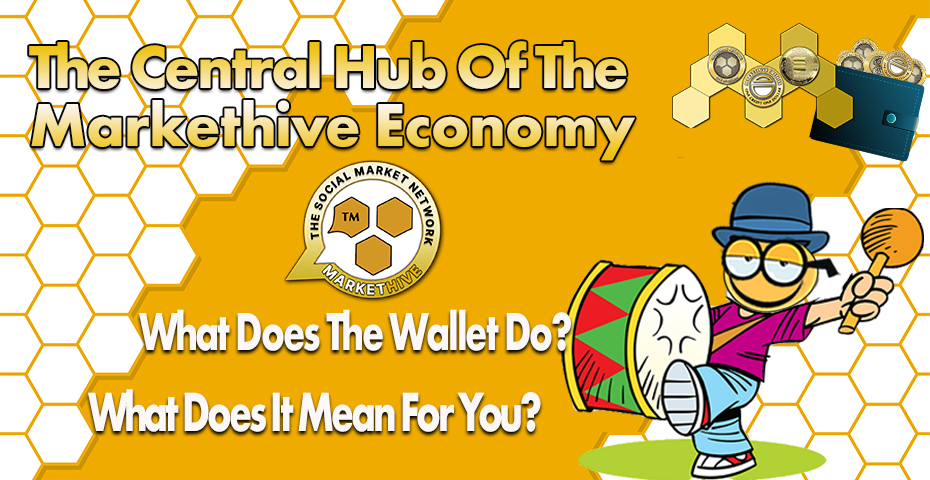
What Does The Wallet Do? What Does It Mean For You?
The launch of the Markethive wallet is approaching, so it’s time to start beating the proverbial drum. It is the start of an exciting time with the advent of many integrations to follow the release of the wallet that will bring Markethive into prominence as an unprecedented platform. The combination of inbound marketing, social media, digital broadcasting, video, conference rooms, e-commerce, gamification, etc.
Markethive is a blockchain-driven crypto economy, all-inclusive, with a distributed database system required for this decentralized, monolithic global project. We’re almost there with the release of the wallet that will initiate entrepreneurial sovereignty and open the floodgates of this divine enterprise with its plethora of systems and services, including the new interface and dashboard.
We now have a complete working wallet with the Solana Network, and we also have a fully functional crypto merchant account. The Markethive wallet is being polished with the finishing touches, keeping mindful that it’s not just a simple wallet but a comprehensive, dynamic engine centralized for you that powers your platform and business.
Markethive is fundamentally a sophisticated inbound marketing and storefront platform, integrated with a social network, and not just another social media platform you see popping up to counter the media tech giants we’ve come to know as oppressive, censoring you and using your personal data for their own gain. Read More

Gaming makes up over half of blockchain industry usage, DappRadar
The gaming sector accounts for nearly 51% of the activity in the blockchain industry with hundreds of millions in transactions, according to August data.
New data from DappRadar suggests that gaming remains a vital organ to the blockchain industry. According to the report, the gaming sector accounts for approximately 50.51% of industry usage month-over-month (MoM), as per August numbers.
While overall the numbers are a good indicator for the sector, it is a decrease from the previous month. Last month, the gaming sector made up approximately 57.30% of industry usage (MoM).
The data from DappRadar comes from the daily Unique Active Wallets (UAW). According to the surveyor, there are around 847,230 gaming-related UAW active daily with nearly $698 million in transactions.
Gaming has long been touted as a gateway to the world of Web3, blockchain, and crypto. Another recent survey from ChainPlay highlighted that of 2,428 surveyed GameFi investors, 75% said they joined the space solely on the premise of gaming.
It’s not just GameFi investors that believe in the sector as a proponent for mass adoption. In a panel at Korean Blockchain Week 2022, experts said GameFi and crypto naturally go together. Moreover, there was speculation that the majority of games will have an in-game crypto economy within the next few years. Read More
Forget About DeFi Summer: NFT Autumn is Arriving
Sudoswap is doing for NFTs what Uniswap did for altcoins.
That simple but provocative idea is part of why Sudoswap, which just announced a governance token (SUDO), is quickly becoming the “it” place for NFTs these days.
Sudoswap launched in July—its name is a riff on Uniswap for reasons that will soon become apparent— and it’s the first, honest-to-god, working decentralized NFT exchange with an on-chain automated market maker (AMM).
In other words, Sudoswap is a protocol, and as such it's meant to work in conjunction with other protocols. The liquidity it provides via its AMM can be accessed by other protocols, dapps and even marketplaces. By contrast, a massive NFT marketplace such as OpenSea is a closed ecosystem with a closed order book; though the customers provide liquidity, the platform gets to take transaction fees.
Removing the middleman, as always, is a big idea. Though others have tried to solve the NFT liquidity problem, Sudo—created by the pseudonymous team of Statelayer, 0xmons, 0xHamachi, and boredGenius—was the first to actually solve it. Platforms like OpenSea and LooksRare are marketplaces, but Sudoswap operates more like an exchange. Read More
Nigeria, Binance in early-stage talks for crypto-friendly economic zone
The proposed partnership aims to build a crypto-friendly digital city similar to the virtual free zone in Dubai.
The Nigerian government has held a preliminary meeting with crypto exchange Binance to potentially establish a special economic zone aimed at supporting crypto and blockchain-related businesses.
According to a Friday post from the Nigeria Export Processing Zones Authority (NEPZA), the authority has held preliminary talks with Binance and technology infrastructure company Talent City to discuss the proposed digital city, referred to as a “Virtual Free Zone.”
NEPZA managing director Adesoji Adesugba said the proposed zone will be a first in West Africa and act similar to Dubai’s virtual zones, which are designed to provide crypto-friendly laws, regulations and tax incentives for crypto businesses.
Speaking to Cointelegraph, a Binance spokesperson said the motive behind the plan was to drive long-term economic growth through digital innovation:
“As we continue to support blockchain adoption across the African continent, Binance is keen to collaborate with The Nigeria Export Processing Zones Authority to establish a virtual free zone with the aim of generating long-term economic growth through digital innovation." Read More
Network outages have been Solana’s ‘curse,’ says co-founder
The high-speed smart contract platform has suffered full or partial outages at least seven separate times over the last twelve months.
Network outages continue to be the Solana network’s biggest challenge, according to its co-founder Anatoly Yakovenko.
Launched in 2020, the Solana network has suffered a number of network outages, which have come from a number of different congestion and spam events, according to Yakovenko.
In a Friday interview with Real Vision co-founder Raoul Pal, Yakovenko said the network outages had been Solana’s “curse,” but said the outages have resulted because of the network’s low-cost transactions.
“That’s been, I guess, our curse, but it’s because the network is so cheap and fast that there are enough users and applications that are driving that.”
However, while the outages have “prevented users” from using the network, the Solana co-founder said the network itself hasn’t been compromised. He also argued that each blockchain is built differently and has its own “failure case.” Read More
Disclaimer: These articles are provided for informational purposes only. They are not offered or intended to be used as legal, tax, investment, financial, or any other advice.















