x






Image Source: Pixabay
DAOs: Where humans may fail, AI could succeed
Without robots, DAOs may never be more than a pipe dream, as fully automated DAOs eliminate the barriers related to human bias.
Decentralized autonomous organizations (DAOs) offer a new way of organizing businesses in a non-hierarchical structure that encourages participation from every member of a community. With no central leadership and decisions made collectively, DAOs could revolutionize the way we think about work, but their implementation is not without challenges.
The term DAO is sometimes used to refer to a system of software processes that coordinates and operates itself in a fully automated way, relying on humans only indirectly via outsourcing specific pieces of work to them as needed. The classic example would be a blockchain-based network that sells file storage space or machine learning model training services, advertising its wares, renting hardware, accepting payment, and so forth via automated scripts or smart contracts.
The automated network could take care of every aspect of the organization — potentially, it could even include code enabling it to summon and pay a human accountant or lawyer when necessary. Read More
Social Commerce on Cardano: Meloot to hold a seed sale on KICK.IO
KICK.IO is a Cardano-based fundraising platform and project accelerator, designed to provide transparent, efficient, and fully decentralized crowdfunding services. KICK.IO is set to mature into a cornerstone of the new Cardano-dominated DeFi landscape, becoming the place where Cardano’s extensive community can come together to fund projects characterized by the immense potential for future success.
Our next-generation decentralized launchpad will be built according to the best DeFi industry practices, ensuring real-time settlement, top-notch security, interoperability, true decentralization, zero counterparty risk, while also being fully scalable to meet the needs of institutional investors. Unlike our competitors, we offer full support of Cardano native tokens and a suite of advanced DeFi tools that upcoming projects need to thrive and prosper. Read More
Polkadot Allocates 993,286 DOT to Boost its Ecosystem and Web3 Development
Polkadot has allocated $21 million for ecosystem development as it emerges as the blockchain network with the smallest carbon footprint.
Popular blockchain protocol Polkadot recently announced the allocation of over $20 million in DOT to stimulate the development of its ecosystem and the highly anticipated Web3.
Polkadot Allocates $21M For Ecosystem Development: In a press release shared with CryptoPotato, Polkadot noted that the bounty proposal, dubbed the Polkadot Pioneers Prize, is a series of challenges that have been carefully created to push technical innovation on its network.
The first two challenges will be revealed later this year and will include research and development on zero-knowledge and the Polkadot infrastructure.
So far, the blockchain project has allocated about 993,286 DOT, its native cryptocurrency, worth over $21 million. The funds will be split between the first two challenge categories and subsequent ones. Read More
Web3: Why it Needs Better Infrastructure to Stop Centralization
Blockchain networks are growing rapidly, but the number of nodes is not keeping pace.
This can lead to centralization, which could have negative consequences for the networks.
This issue can be addressed by building a more decentralized node infrastructure.
For Ethereum and other blockchain networks to work as intended, they need to be decentralized. This means that no single entity or group should have control over the network. But studies have shown that blockchain networks are not as decentralized as people think. In fact, they have incorporated many of the same problematic practices and centralized infrastructure that plague Web2.
One issue is node centralization. A website called Are we decentralized yet? highlights that many blockchains have low node counts, in addition to a small number of entities in control of the majority of voting/mining power.
This creates risks of outages and even location-dependent latency. Cloud services are a popular way to store data and run applications, but they’re also a major contributor to node centralization. A study by researchers at the University of Illinois at Urbana-Champaign found that “Ethereum nodes operate primarily in cloud environments.” This means that a single outage or delay at one of these providers could have a significant impact on the network. Read More
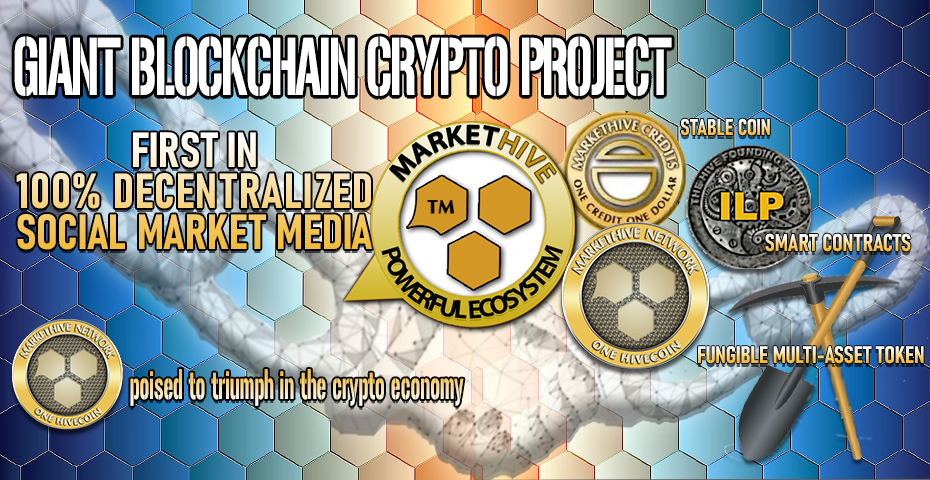
Markethive is a monolithic blockchain project currently operating as a social network, an entire inbound marketing platform with email, blogging, and digital media capabilities that broadcast to the vast internet. It’s a complete Market Network and the first of its kind.
Markethive is predominantly a free system where users can access a platform that can cost more than $2,500 offered by other marketing platforms. There are, of course, upgrades that open up more tools and monetization opportunities, the first being the Entrepreneur One Loyalty Program, and coming soon is the Premium Upgrade.
The many domains Markethive has and its autonomous cloud systems that ensure its sovereignty and longevity make it untouchable and immune from the tech giants’ rule and biased agenda. But can still remotely infiltrate the social media platforms and reach the multitudes either locked in or looking for an alternative meritocratic medium.
In other words, wherever you go, Markethive is there, anywhere and everywhere, delivering its message via its community of entrepreneurs to a far-reaching audience. This next-generation social market media is poised in the wings, and when the time is right, it will emerge as a shining light to lift people up and bring financial sovereignty and hope in this gloomy and uncertain world.
The video platform, conference rooms, the unique four specific news feeds currently in development, and many other projects and incentives add to the credibility and need for an ecosystem in the social media and digital marketing space.
In 2018, Markethive released its coin, with the ticker symbol of MHV that enabled the distribution of the coin to the members within the Markethive system by way of infinity airdrops and subsequently a micropayment faucet. The coin is currently in the process of being labeled with a new name, HiveCoin, with the ticker symbol HVC.
Now in the final stages of BETA, Markethive will officially launch with the release of its first wallet developed from scratch to service the community’s needs. Read More

Blockchain Investments in 2021 Surpasses Past 3 Years' Total Capital Raised: KPMG
The blockchain ecosystem might still be relatively tagged as new. However, when it comes to funding and recognition by Venture Capital (VC) Firms, they are arguably fast attaining maturity.
According to a new report by Big Four auditing firm KPMG, investments pumped into blockchain startups in 2021 topped $30 billion, a figure that surpasses funding received in 2018, 2019, and 2020 combined. Investments in blockchain protocols have been steady over the past few years, with a progression that showcases more VCs are becoming aware of the potentials inherent in this space.
While a total of $8.2 billion was realized in 2018, fueled by the first massive growth trend of Bitcoin (BTC) to an all-time-high (ATH) above $17,000 in December 2017, $5.6 billion was recorded in 2019, and $5.5 billion in 2020. In 2018, the total transaction record was placed at 901 deals, while the current data published by KPMG pegs this number at 1,332 deals for last year.
“Investment in the crypto and blockchain space soared in 2021, rising from $5.4 billion in 2020 to over $30 billion. Globally, there was an incredible increase in the level of recognition for the potential role of crypto and its underlying technologies in modern financial systems,” the report reads. Read More
Google Cloud to detect crypto-mining malware on virtual machines
Bad actors using malware to steal GPU power to mine crypto may have to up their game to deal with Google Cloud's latest security protocol.
It’s a shot in the arm for Google Cloud users at risk of cryptocurrency mining attacks. The Security Command Center Team has created a threat detection service to shield “poorly configured” accounts that attackers use to mine cryptocurrency.
In a blog post, Google Cloud announced the Virtual Machine Threat Detection (VMTD) release in its Security Command Center (SCC) area. A means of scanning compute engines in Google Cloud, the VMTD successfully detects threats, including crypto-mining malware used inside virtual machines.
Crypto-mining malware attacks, sometimes called “cryptojacking,” are an ongoing nuisance in the industry. While browser-based cryptojacking activity spiked in the 2019 bear market, cloud-based crypto mining continues to beleaguer the space.
Cointelegraph reported in November last year that of the 50 analyzed incidents relating to compromised Google Cloud protocols, 86% were related to crypto mining. The Google “Threat Horizons” report highlighted that hackers may seek to hijack GPU space to mine crypto as it is a “cloud resource-intensive for-profit activity.”
As part of the product roadmap, the Security Command Center Team sought to build better protection for its Virtual Machine users. Read More
Swiss BSV to establish blockchain academy in the Middle East
The BSV Association and SDA will collaborate in providing training and developing resources through the blockchain academy in Riyadh
The first blockchain school in the Middle East will open in Riyadh, Saudi Arabia, according to an announcement by the BSV Blockchain Association. The new institution will reportedly provide training and development tools for government organizations and enterprises interested in adopting or experimenting with blockchain technology.
Per the announcement, the Saudi Blockchain Academy (SDA) will work with the Swiss-based Bitcoin SV (BSV) blockchain industry association to educate experts about new technologies, assisting in implementing Saudi Vision 2030.
The Ministry of Communications and Information Technology (MCIT) of the Kingdom of Saudi Arabia established the SDA as a major national project to develop both human capital and digital skills for the future and prepare its youth for employment in communications and information technology sector. Read More
NFT-powered startup aims to revolutionize events and ticketing industry
The NFT ticketing and events industry might have a new savior.
Scalping is a massive problem in the event ticketing industry. From touts and bots buying out events the second they go live to reselling tickets on the secondary market at exorbitant prices, both artists and fans are suffering from those taking advantage of the ticket markets for profit.
The problem is growing, and artists like Ed Sheeran have attempted to solve it to varying degrees of success. However, none of these solutions have worked, and an alternative is necessary to fix the scalping phenomenon. Fortunately for ticket holders of all sorts, one startup is offering a lifeline: SeatlabNFT.
SeatlabNFT has built a non-fungible token (NFT) powered event ticketing system for artists and event organizers to regain control of the secondary ticketing market and prevent counterfeiting. By utilizing blockchain technology and smart contracts, ticket issuers can mint NFT tickets and retain an unprecedented level of control over traceability, subsequent transfers, and resales. Issuers can attach conditions and royalty splits to tickets which will open up a previously untapped revenue stream for artists and reduce the negative effect of scalping. Read More
Disclaimer: These articles are provided for informational purposes only. They are not offered or intended to be used as legal, tax, investment, financial, or any other advice.