x





Image Source: Pixabay
AP To Launch NFT Marketplace For Its Critically Acclaimed Photography
The Associated Press has revealed that it is launching a non-fungible token (NFT) marketplace, where some of the agency’s most iconic photographs will be available as NFTs, which collectors and enthusiasts can purchase. Blockchain technology provider Xooa will build the marketplace.
AP’s marketplace and the first batch of NFTs are set to debut on January 31st.
The first collection on the marketplace will feature photographs by former and current photojournalists from AP, with a selection of digitally enhanced depictions of their photos. The collection will also include Pulitzer Prize-winning AP images.
Each NFT will also include metadata, which will help collectors to know the time, date, equipment, location, and any technical settings that have been used for the photo.
Speaking about the collection, AP Director of blockchain and data-licensing, Dwayne Desaulniers, commented,
“For 175 years, AP’s photographers have recorded the world’s biggest stories through gripping and poignant images that continue to resonate today. With Xooa’s technology, we are proud to offer these tokenized pieces to a fast-growing global audience of photography NFT collectors.” Read More
Ryan Serhant: The evolution of cryptocurrency, blockchain and the Metaverse in real estate
In the not too distant future half of all real estate transactions will be completed with cryptocurrency, according to the agent behind the most followed brand in real estate.
In his annual letter to clients and colleagues, Million Dollar Listing New York star Ryan Serhant said “cryptocurrency has created the largest wealth transfer of our lifetime”.
“Many of our buyers in 2021 have either used those profits to make home purchases or actually transacted in crypto, wallet-to-wallet,” he said.
“I see a world very soon in which 50 per cent of all real estate transactions are done with crypto, and where contracts are recorded on the blockchain and ‘signed’ as NFTs (non-fungible tokens).”
Globally, Mr. Serhant said many businesses were hyper-focused on the blockchain, NFTs, and the concept of metaverse integration.
A metaverse is a network of 3D virtual worlds focused on social connection. Read More
Blockchains Allow Reimagined Shopping Experiences
Blockchains have enabled us to embed currencies within a decentralized network and create smart contracts to exchange economic value. We can simply imagine an eCommerce transaction on blockchain as a direct agreement between a buyer and seller, verified by the entire network of validators. In case, there is a disagreement (for example, goods being below par or wrong product being sent), the smart contract can reverse the transaction automatically.
In a nutshell, blockchains are creating a globally decentralized network of businesses, creators, merchants, and shoppers who can capture the entire value of the transaction without paying any extra fees to an intermediary. In that retrospect, eCommerce represents one of the largest use cases for blockchains, from both consumers’ and business’ points of view. Read More
Problems Of The US Air Force And How BLOCKS, DAO Seeks To Solve Them In Partnership With BizSecure
The aviation industry has experienced a colossal increase in fraud-related activities, from the falsification of flight hours to falsifying training records for personal gains, absence of a proper tracking tool, errors and inaccuracies in medical records, and most recently, the falsification of vaccination records across the world, the industry has become breeding ground for all kinds of egregious activities.
Identifying these problems, BLOCKS, DAO LLC, a project designed primarily to lead the migration of traditional systems and organizations to blockchain technology, has recently announced, via a press release, its partnership with BizSecure, a privacy-focused blockchain company. The idea behind this collaboration is to devise a solution to these aforementioned problems, in the process reducing the threat to national security while promoting a secure and transparent system.
Using Secure, Private Technology to Establish Verifiable Credentials for Pilots’ Test Flight Cards. Read More
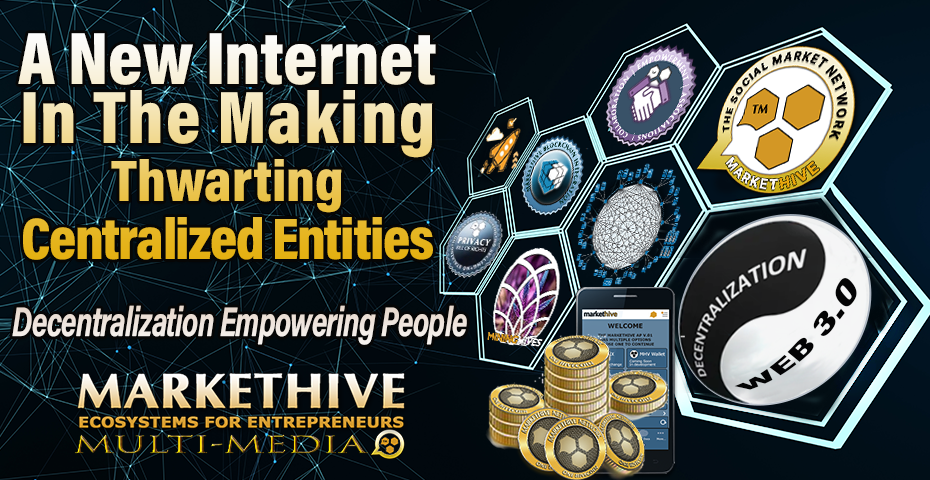
Decentralization Empowering People
A few companies are working hard to make Web 3 a reality. A pioneer in the social media and marketing realm is Markethive. The company has successfully bypassed the centralized web services, like AWS and Microsoft, and operates on its own cloud system. Markethive is working on expanding its clouds, called Mining Hives, throughout the world.
This means all data pertaining to Markethive and its users will not be stored on servers owned and controlled by a centralized entity. Instead, it is a distributed database on the Markethive Blockchain with no single point of failure and no internet disruption or censoring by the likes of dictatorial authorities who may decide to shut off the internet.
With the recent news of the U.S. Senate’s proposal to onerously regulate the crypto industry, which will stifle the United States, the importance of decentralization has escalated. It shows that the government views crypto as a real threat and, of course, another way to refill its coffers. This bombshell has the crypto industry in an uproar, with U.S. companies moving offshore to more crypto-friendly countries.
To protect all Markethive associates and continue to build the entrepreneurial ecosystem to bring financial and self-sovereignty, Markethive is in the process of building a new offshore corporation for launching its decentralized exchange (DEX) and wallet. This Web 3 development is an inspiring and timely milestone that should be ready by September this year. Read More

‘Centralization issues’ are the biggest culprits of DeFi attacks: CertiK
DeFi is one of crypto's biggest growth stories, but it's also riddled with the most controversy. The sector lost $1.3 billion due to exploits in 2021.
Decentralized finance, better known as DeFi, may not be “decentralized” enough as attackers exploited centralized weak points to drain users of billions of dollars in 2021, according to research from blockchain security firm CertiK.
In a new report on the state of DeFi security in 2021, CertiK researchers said “centralization issues were the most common attack vector” within decentralized finance. The blockchain security firm cited 44 DeFi hacks totaling $1.3 billion in lost funds in 2021. That’s an increase of over $500 million compared with 2021.
“This underscores the importance of decentralization and highlights the fact that many projects still have work to do to reach this goal,” CertiK said, adding:
“Centralization is antithetical to the ethos of DeFi and poses major security risks. Single points of failure can be exploited by dedicated hackers and malicious insiders alike.” Read More
Fully-featured crypto wallet speeds up the DeFi experience
User experience is a make-or-break factor for DeFi adoption; fortunately, a wallet may be the bridge needed to overcome this barrier.
The sad reality is that most decentralized finance (DeFi) wallets and protocols are complicated to use, especially for beginners. Although rich in functionality, these products are often designed by technologists and not for the everyday user who needs more guidance to get started.
With consumers used to the simple interface on apps like Tinder, the “swipe left, swipe right mentality” has since transcended into all other consumer-facing products, finance included. The result is that while cryptocurrency assets and DeFi grow, so has the breadth of their functionality, and therefore, their complexity, as features become split across multiple chains and applications. Users may have to navigate multiple interfaces, in addition to a combination of hardware and software wallets, just to track portfolios.
Rising up to meet the challenges is Ambire, previously known as the AdEx Network.
The team behind Ambire has launched an innovative non-custodial smart wallet to solve UX problems and offer quick and easy onboarding for both novices and experienced crypto users. The experience is simplified with an email, password registration setup, and a possibility to purchase digital assets through three different on-ramp methods, including wire transfer and credit card. Read More
NFTs will be Everywhere in the Future because of Proof of Ownership, Expert says
Caroline Alexander, a finance expert at the University of Sussex, believes that non-fungible tokens (NFTs) will be everywhere in the future because anything that requires proof of ownership will be an NFT.
Alexander added that NFTs can be instrumental when eliminating the bureaucracy involved in tracking documents and transactions. She pointed out:
“The public attention went on to NFTs. They are going to be everywhere. Once the public realized this, they became very interested in the technology.”
Nevertheless, she noted that the skepticism around NFTs is being fueled by the suspicion that they are speculative assets operating in an unregulated market. Read More
Blockchain Network Downtimes Are Stifling Growth; Can Alternative Ecosystems Provide A Reprieve?
The blockchain ecosystem is now over a decade old and a lot has changed since the first Bitcoin block was mined on January 3, 2009. This burgeoning technology has given rise to more blockchain communities, with notable innovations such as the Ethereum blockchain which introduced the concept of smart contracts.
Today, innovators in the crypto ecosystem can develop decentralized applications (DApps), allowing anyone across the globe to access the featured products. However, it has not been a smooth ride for the upcoming smart contract blockchains; Ethereum, which leads the pack, is still trying to solve its scalability issues with the much-awaited 2.0 upgrade.
Back in 2017, this leading smart contract blockchain experienced a major slow down following the crypto kitties craze which increased the number of transactions on its network by sixfold. Similar situations have befallen rival Layer-1 chains with notable downtimes on leading platforms such as Solana within the past few months.
Though touted as ‘Ethereum killers’, one cannot ignore the fact that upcoming Layer-1 chains also face some network challenges. So, what could be the reason for the frequent downtimes on native blockchain ecosystems? The next section of this article will highlight some of the trends, featuring alternative solutions that could facilitate the mainstream adoption of cryptocurrencies. Read More
Disclaimer: These articles are provided for informational purposes only. They are not offered or intended to be used as legal, tax, investment, financial, or any other advice.