x






Image Source: Pixabay
AI-generative art predicted to be next trend for NFT sector
NFT art created by AI algorithms brings new meaning to nonfungible tokens, but can artificial intelligence be trusted to produce a new genre of art?
Known as “AI-generative NFTs,” these nonfungible tokens are becoming increasingly popular within the art community, along with those interested in emerging technologies like artificial intelligence, blockchain, and the Metaverse. In order to create AI-generative NFTs, one would typically use generative adversarial networks or GANs. These are algorithms that leverage computers to use data to train models to produce machine-made images resembling art.
Claire Silver, an AI-collaborative artist, told Cointelegraph that AI-generative NFT art is a relatively new genre, noting that the basic principle is that art is created in tandem with some semblance of artificial intelligence, like GAN:
“There are code-heavy options and completely code-free tools that anyone can work with. I use the latter in my work. Being able to work with an AI to bring your ideas to life is an experience like no other, it augments creativity in a way that feels like freedom, a type of play you haven't experienced since you were a child.” Read More
The Associated Press is starting its own NFT marketplace for photojournalism
It’s offering collectors ‘exclusive, historic, and stunning visual content’
The Associated Press, or AP, has announced that it’s starting a marketplace to sell NFTs of its photojournalists’ work in collaboration with a company called Xooa. It’s billing its foray into NFTs as a way for collectors to “purchase the news agency’s award-winning contemporary and historic photojournalism” and says that the virtual tokens will be released at “broad and inclusive price points” (though it’s hard to tell what types of prices resellers will want on the AP marketplace).
The news outlet says its system will be built on the “environmentally friendly” Polygon blockchain and that the NFTs will “include a rich set of original metadata” to tell buyers when, where, and how the photos were taken. It says its first collection, launching January 31st, will include NFTs featuring photos of “space, climate, war and other images to spotlights on the work of specific AP photographers.” Read More
Decentralized cloud computing network shares news of successful testnet and upcoming mainnet launch
Blockchain technology is still relatively new in concept, and as a result, requires a scalable solution.
Blockchain has evolved significantly since its founding in 2008. However, with so many new developments, many forget that blockchain at its core is still a new technology and, as such, has a few limitations. Looking more specifically at Ethereum (ETH), the most popular blockchain for smart contracts, transactions have typically taken a long time to clear, in addition to being costly as transactions add up. Together, these symptoms have resulted in a larger and more generalized scalability problem, a bottleneck resulting from each node in the network needing to process a given transaction.
The solution, in part, is said to be sharding, an upgrade that will improve the capability by distributing the network’s load across 64 new chains. Alongside Ethereum 2.0 are several other solutions looking to rise to the challenge; the only caveat is that these offerings are limited in scope and are not cost-effective.
Cudos is addressing this market as a decentralized cloud computing network that acts as one of the first in the world to run nonfungible tokens (NFTs) on the Cosmos network. In practice, users will be able to bypass the requirement to set up a new smart contract for each NFT while minting, approving, and transferring them directly on their accounts.
The scalable network is designed to generate value for all participants, helping to unlock new functionality by using off-chain data and computation at competitive costs while utilizing spare computing in the future of a decentralized, sustainable and connected world. Read More
Metaverse Project Pavia Debuts on the Cardano Blockchain
Cardano-based metaverse project Pavia is similar to Decentraland, but there’s one big difference – it is being built on Proof-of-Stake (PoS).
Pavia – the recently launched gaming application on the Cardano blockchain – has some big plans for this year. So far, the project has issued at least 100,000 “land parcels,” each is being minted as a uniquely numbered Cardano NFT (CNFT) based on coordinates. More than 60% of the land parcels were pre-sold in October and November last year. The rest is slated to go on sale in the current quarter.
According to the official website, Pavia has more than 8,300 landowners. At this stage, however, they cannot visit or deploy any content onto their respective land parcel. The platform revealed that the team was working “to deliver the in-game Pavia experience.”
Similar to other metaverse projects, Pavia also has an in-game currency – PAVIA – used for utility purposes inside its metaverse ecosystem. 25% of this native token was airdrop to Pavia NFT landholders right after a blockchain snapshot in December 2021. Read More
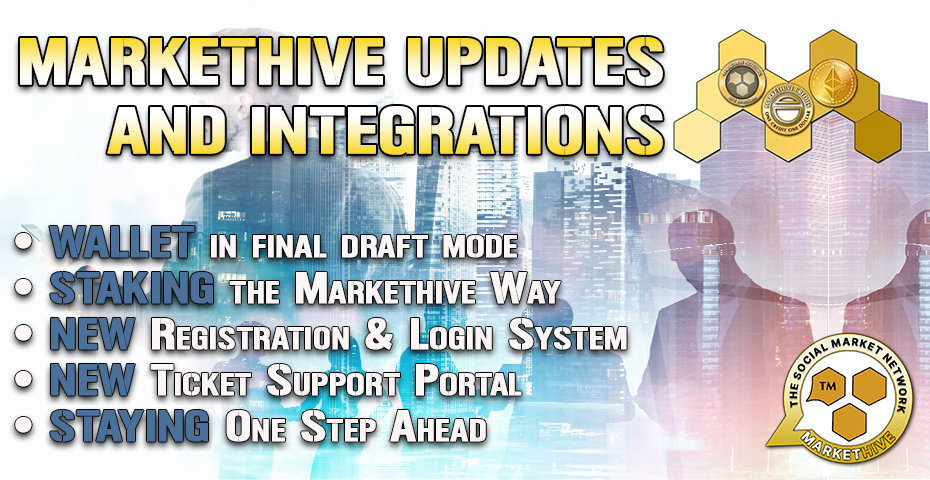
Wallet in final draft mode
Staking the Markethive Way
Staying One Step Ahead
Markethive started out as a sophisticated inbound marketing platform with a social media interface harvesting a robust collaborative culture. The entrepreneurs of the Markethive community have been using the free system and tools, promoting their businesses, and branding themselves across the internet with much success.
With the advent of Blockchain technologies, Markethive set its path on an unprecedented journey of combining marketing, social media, digital broadcasting, e-commerce, gamification, etc., with cryptocurrency and decentralized Blockchain, distributed ledger technology. An ongoing project of massive proportion to deliver sovereignty, financial and self, and freedom of self-expression for all equitably, without bias.
Markethive is a Vision from the Divine Source. Its mission is to fill the vacuum for the world's entrepreneurs - To empower and enrich the lives of every individual on every level across the globe. And the timing couldn’t be more perfect as we witness the soul-less destruction, tyranny, and surveillance of humanity gift wrapped and delivered to us as protection and for our own good.
We are building an ecosystem, and there’s an absolute need and use for our coin (HVC) for everything we do; therefore, the potential for the open market to accept and embrace HiveCoin is very promising. Binance has done similar to what Markethive is doing. Read More

NatWest Markets establishes new blockchain team
NatWest has created a new digital team within its capital markets business to upscale its blockchain strategy.
Leading the team will be Chris Agathangelou, who was recently appointed as NatWest’s head of digital capital markets.
The team will focus on delivering credit and rates products to issuers and investors through digital channels and currencies that are underpinned by distributed ledger technology.
With financial markets increasingly embracing blockchain technologies, the bank believes “the time is now right to formalize [our] strategy” in this area.
“Distributed ledger technology will increase transparency, minimise costs, lead to faster execution and increase capital efficiency for NatWest Markets’ clients,” NatWest said in a statement. Read More
The Growing Use Of Blockchain In Financial Transactions Processing And Digital Contracts
Initially designed as the technology that supports Bitcoin, Blockchain technology has been praised to have a wide range of applications. Besides its use for digital currencies, Blockchain also serves as a platform for smart contracts. Smart contracts are self-executing, independent computer programs that execute, enforce, and facilitate commercial arrangements between two or more parties.
Both Blockchain technology and smart contracts individually have their enormous advantages. However, when both techs are integrated, the benefits are endless. Blockchain-based smart contracts have huge potential to simplify financial transactions and limit counterparty risks linked with enforcing and managing contractual obligations. Read More
Crypto Needs to Get Real About Compliance
To achieve mainstream adoption, crypto needs to work with existing financial regulations—which is why Concordium's blockchain is designed with built-in regulatory compliance.
Cryptocurrency has come a long way since the enigmatic creator of Bitcoin, Satoshi Nakomoto, invented Bitcoin in 2008. Slowly but surely, major investment banks, publicly-traded companies, and even a government have come to embrace crypto.
But as far as crypto has come, its further growth is hamstrung because of the underlying properties of the blockchain technology that underpin it. That's because to date, blockchains haven't been designed to reflect the world as it is; instead, developers expect the world to mold itself around the quirks of the blockchain's underlying code.
And while “Code is law” is the common refrain of crypto advocates, that code doesn't take account of existing regulations such as identity verification, or KYC (know your customer) requirements. Read More
How Layer 2 Is Breathing New Life Into Legacy Blockchains & Expanding Their Reach
Think of layer 1 as the original blockchain networks like Bitcoin and Ethereum. Layer 1 most often is qualified as the settlement layer, where all transactions are settled and added to the ledger.
However, the original layer 1 blockchains are hampered by a few restrictions that inhibit their overall functionality. In the case of Bitcoin, the Bitcoin Core architecture is considered among the most secure. However, the flip side of its focus on security and decentralization is sluggish transaction throughput and limited scalability in terms of how many transactions the network can process.
Ethereum has been running up against similar limitations, but the situation has grown even more dire than that of Bitcoin. Ethereum’s layer 1 blockchain is so clogged that small transactions are costly and slow to process, leading to widespread network congestion and skyrocketing transaction fees. Layer 2 effectively aims to resolve these shortcomings of layer 1 in terms of transaction throughput and scalability while maintaining layer 1’s embedded decentralization and security.
This feat is accomplished by processing transactions on layer 2 instead of layer 1 and eventually combining these layer 2 transactions into a single transaction that is settled back on layer 1. Together, this is termed a rollup, and it has multiple variations. Yet, the more critical part of these solutions is that they address the scalability and throughput issues suffered on layer 1 blockchains while maintaining the decentralization and security of layer 1. Read More
Disclaimer: These articles are provided for informational purposes only. They are not offered or intended to be used as legal, tax, investment, financial, or any other advice.