x






Image Source: Pixabay
What is the importance of blockchain in the RegTech ecosystem?
RegTech is the management of regulation, compliance, reporting, and monitoring through technologies like big data, data mining, artificial intelligence, and blockchain to provide robust, reliable, and effective solutions.
The technologies offer data on money laundering activities and help to reduce the risk of financial fraud. However, regtech is facing some challenges like operational barriers, lack of recourse, high cost, and cumbersome process of automating manual procedures.
After the global financial crisis, regulators started to focus more on the compliance element in the business, and thousands of rules and provisions were introduced all around the world. According to the Financial Conduct Authority (FCA), about £189.8 million has been paid against the regulatory violations. The cost of doing compliant business is higher, which is why all global regulators are showing interest in blockchain technology for regulatory purposes.
Whether it is a big bank like HSBC or a small organization, the cost of compliance is high, and getting higher with time. Currently, all the global financial regulators are putting efforts to collaborate with organizations that employ software-as-a-service (SaaS) or cloud computing technologies to assist businesses in complying with laws more efficiently and cost-effectively.
This article aims to discuss various regtech use-cases in compliance and the application of blockchain technology in the regtech ecosystem. Read More
We are all going public: Privacy rules, tax shelters and the future history of art
Nonfungible tokens, or NFTs, exchanges will need to navigate conflicting aims for the required transparency and the desired anonymity.
After a banner year of 2021 for individual object sales through nonfungible tokens (NFTs), 2022 is poised to be the year of MetaFi. A recap of Beeple, Christie’s, Visa, and endless aping-in celebrities hardly feels necessary, except to point out that we seem to be standing on (or perhaps have already crossed over) a fundamental precipice. While the rocket-propelled ascent of NFT prices will not continue forever, numerous voices have predicted that a mature tech stack for discovering, vetting, valuing, trading, and protecting collections of digital assets will soon emerge, without a crash.
But these optimistic takes may even be selling the area short. Namely, the premise of the “NFT-Fi” sector is to create value through liquidity, but it has remained an unstated assumption that this liquidity would be confined fundamentally to the world of crypto itself. While it is still early days, those boundaries may be eroding, and we may all need to open our meta-apertures even wider. Read More
Top Indonesian Football Club Enters the Blockchain Gaming Arena, Partnering with LGG
To offer its fans new experiences in the blockchain gaming sphere, two-time Indonesian football league champion Persib Bandung has partnered with Liberty Gaming Guild (LGG).
Gabriella Witdarmono, the vice president of partnership and activation at Persib, acknowledged that intertwining football and innovations like blockchain gaming is a step forward in the digital era. She noted:
“Persib, as one of the football clubs that have the largest fan base in Indonesia, must keep up with technological developments, one of which is the development of the gaming industry, which is now favoured by loyal Persib fans, known as Bobotoh.” Read More
A beginner’s guide to blockchain: Public vs private vs consortium
Blockchains use peer-to-peer (P2P) networks to store data across millions of servers.
A public blockchain is a non-restrictive, permissionless distributed ledger technology, implying that anybody with an internet connection may join and participate in a blockchain network.
A private blockchain, in contrast to a public blockchain, is a permission-based blockchain that works in a closed network.
Blockchain technologies and cryptocurrencies have surged in popularity since their inception. Many individuals have raced to invest in cryptos, and the increased interest has prompted developers to explore technologies. As a result, many blockchains have emerged. There are three common types of blockchain networks – public, private, and consortium – each of which serves a particular purpose, solves a specific problem and has its own set of features.
A blockchain uses peer to peer(P2P) network to store data across millions of servers. It is sometimes referred to as decentralized, distributed ledger technology since it operates without the involvement of any third-party mediator or central authority. A distributed ledger is a type of database synced and shared by several people across different institutions and regions.
Moreover, a blockchain provides greater transparency and security which is why it is currently the most talked-about technology.
In this article, we’ll give you an overview of the three blockchain technologies that are commonly in use – public, private, and consortium. Read More
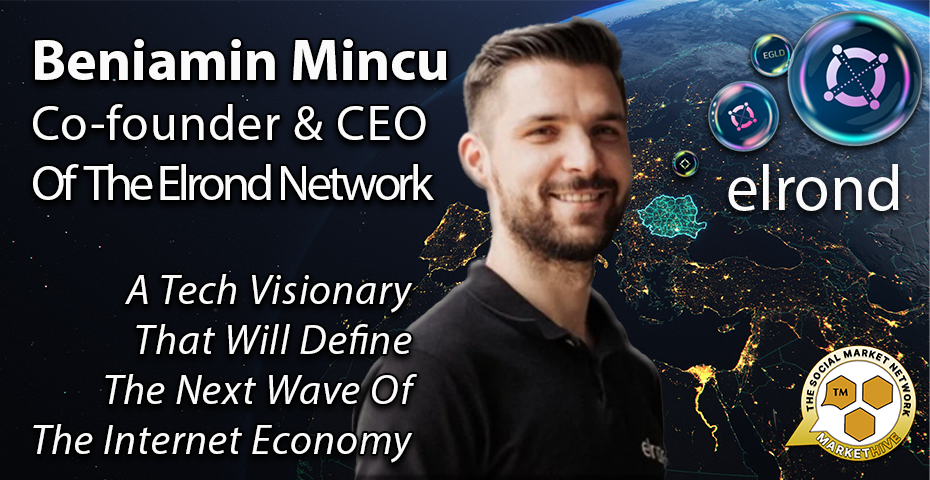
A Visionary That Will Define The Next Wave Of The Internet Economy
Who Is Beniamin Mincu?
Beniamin Mincu is an entrepreneur, investor, and Blockchain pioneer born in Romania with a vision to reshape economies, opening an era of unparalleled opportunity on a global scale. Beniamin (also pronounced Benjamin) is a humanitarian with his heart in the right place and the Co-founder and CEO of the Elrond Network.
Beniamin undertakes to accelerate the onset of a high-bandwidth, open, permissionless, globally accessible financial system. The dedication of Elrond’s diverse team of engineers and researchers that have a wide range of technical experience and significant Blockchain expertise is bringing this vision to life.
Elrond, as described by Coingecko,
“Elrond aims to build a high-throughput blockchain that aspires to build the next internet-scale blockchain. Recognizing that most scalability efforts by other projects are not sufficient in that the efforts are merely “kicking the can down the road,” Elrond set out to create a blockchain that is capable of 1000x throughput than most existing blockchains. This improvement of transaction throughput allows Elrond to handle even the most aggressive wave of user adoption.” Read More

Blockchain Oracles: Paving The Way for Decentralized Web 3.0
Oracles can be thought of as digital entities that can link blockchains with an external platform
Oracles serve as an ideal gateway for decentralized Web 3.0 systems to gain access to a wide array of data streams
Oracles have helped bring to life many of the core philosophies underlying Web 3.0
The continued growth of the crypto market over the past decade has helped spur the development of blockchain oracles in a big way. In their simplest, most basic sense, oracles can be thought of as digital entities that can link blockchains with an external platform, allowing the former to utilize smart contracts and execute commands based upon inputs and outputs received from various real-world sources.
To elaborate, oracles serve as an ideal gateway for decentralized Web 3.0 systems to gain access to a wide array of data streams, legacy systems, etc, thereby allowing for the development of “hybrid smart contracts”.
These offerings are capable of combining on-chain code and off-chain infrastructure so as to help in the creation of future-ready decentralized applications (dApps) that are capable of responding to real-world events while being fully interoperable with traditional systems. Read More
Pocket Network Becomes Primary Infra Provider To Decentralize Fuse's Open-Source Financial Blockchain
Pocket Network, a Web3 RPC infrastructure middleware protocol that provides abundant blockchain bandwidth from a globally-distributed network of 30k+ full nodes to applications in Web3 across 37 blockchains, including Ethereum, Polygon, Solana, Avalanche, and Harmony, has announced its extended partnership with Fuse, blockchain infrastructure for open source payment systems. With this extension, Fuse is now routing 20% of all its RPC traffic through Pocket Network's unstoppable network of infrastructure.
Fuse is one of the first blockchains to start utilizing Pocket's network. Since our partnership was forged both projects have grown exponentially, with DeFi project Fuse now driving tens of millions of relays to the Pocket Network daily. As a whole, Pocket Network currently serves over 300 million relays daily, a number that will soon reach the billions as additional blockchains are onboarded.
"Pocket Network enables potentially limitless scaling for RPC read calls for Fuse - it's exciting to see how scalable and open-source financial infrastructure is being built through this partnership," said Mark Smargon, CEO of Fuse. Read More
NFTs and social capital: How projects are collaborating to the mutual benefit of the entire sector
Behind every successful NFT project stands a strong community. Here’s how creators and community members are collaborating with thought leaders, marketplaces, and brands to strengthen their project’s fundamentals.
On Dec. 2, 2021, Bored Ape Yacht Club (BAYC) amassed the attention of culture-driven athletic brand Adidas and cemented their partnership, raising both its notoriety and value. Meanwhile, RTFKT Studios was acquired by Nike and has also garnered the community’s attention by airdropping the first Nike nonfungible token, MNLTH.
The MNLTH airdrop lives up to its name, as RTFKT has introduced a new concept to NFT reveals: The community triggers it. The MNLTH NFT is only revealed once the community collectively completes all required quests, with members speculating whether the contents are Nike goods.
These new developments show that NFT collections are realizing the value of partnering with strong thought leaders, brands, and communities as a way to increase their overall value in terms of social and investment capital.
NFT projects that establish key connections that assist with their social arm and increase the overall floor price value of the collection serve as proof that there is value in collaborations in the NFT ecosystem.
Here’s a look at a few projects that are using this strategy to make waves in 2022. Read More
Moonbeam Network Completes Launch With Cross-Chain Capabilities & New Features On Polkadot
Dubbed the “future of multichain,” Moonbeam Network, the fully EVM-compatible platform, has completed its launch process on Polkadot. Developed by PureStake, one of the leading API service and blockchain infrastructure providers, Moonbeam is among the most highly anticipated projects of 2022.
Earlier in 2021, the Moonbeam team participated and won a slot in the Kusama parachain slot auctions. Moonbeam’s canary network Moonriver secured the second Kusama slot by raising upwards of 205,000 KSM from more than 10,000 contributors. After winning the second slot of the ongoing Polkadot parachain auctions by collecting almost 38.5 million DOT from more than 200,000 contributors through its crowdloan initiative, Moonbeam launched as a “parachain” on December 17, 2021. To put the figures in perspective, Moonbeam’s crowdloan had both the largest number of contributors and the highest amount of DOT received by any parachain on Polkadot to date.
Following this, the Moonbeam development team started adding the decentralization feature and new collators and removed the Sudo key, thereby successfully concluding its launch process. Read More
Disclaimer: These articles are provided for informational purposes only. They are not offered or intended to be used as legal, tax, investment, financial, or any other advice.