x






Image Source: Pixabay
Here’s What’s Coming for Cardano (ADA) in 2022, According to Developers
Cardano (ADA) developers say they’re focusing on improving the smart contract platform’s performance optimization and scalability in 2022.
In a new blog post, Input Output Hong Kong (IOHK) marketing and communications director Tim Harrison tells Cardano holders to expect powerful improvements and enhancements to ADA through upgrades over the coming year.
“Throughout the coming weeks and months, we will be optimizing, scaling and bringing new features through new release deployments. We will do this in well-defined incremental updates that groups new features for our technology stack into more manageable periodic releases. We’re now in the very final stages of preparing our February release, the first of three major code drops (June and October will follow) upgrading the core network in 2022.” Read More
Project aims to take on SAP ERP with decentralized apps
Energy Ledger CEO William Pete claims that their team has developed a decentralized ERP solution that integrates blockchain to supply chain management.
Enterprise resource planning (ERP) solutions can be quite expensive, especially for smaller companies. While ERP giants like SAP try their hands at blockchain-based solutions, a relatively small team now aims to provide an alternative that delivers similar functions using decentralized apps (DApps).
In a Cointelegraph interview, William Pete, the CEO of Energy Ledger explained that by integrating blockchain technology, their team was able to develop applications that allow tracking and tracing supply chain logistics for products like crude oil.
“Major oil and gas producers have been looking at blockchain technology for years but their internal think-tanks have failed to create a solution,” says Pete. He claims that their team has stepped up to the task and managed to build an ERP DApp, with a mechanism that integrates blockchain to supply chain management.
“In 2020, WTI oil prices collapsed to negative rates due to flaws in how commodities transactions are settled,” says Pete. Supply data discrepancies have made it very difficult to properly settle transactions. However, Pete mentions that blockchain's innate features solve this as it lets firms track their supply "down to the molecule." This prevents such trading issues. Read More
True Tickets powers blockchain-based Broadway tickets sales
The global events industry is an $800 billion market, and True Tickets CEO argues that on-chain tickets are the key to its growth.
True Tickets, the blockchain-based digital ticketing platform, made its Broadway debut last fall in collaboration with the Roundabout Theatre Company in New York City. After a "successful" run thus far delivering digital tickets to the Trouble in Mind play and Caroline, or Change musical, Matthew Zarracina, co-founder and CEO of True Tickets, talks blockchain and ticketing with Cointelegraph.
When a prospective theatre-goer completes a ticket purchase on the Roundabout website and chooses a digital delivery, as opposed to picking up a ticket at will call or printing it at home, that's True Tickets cue to come in. Built on the Hyperledger Fabric platform that runs on the IBM Blockchain and deploys to Google Cloud, True Tickets provides the infrastructure that generates dynamic QR codes integrated with distributed ledger technology. Read More
What Is Blockchain and How Is It Changing Marketing
The utility of blockchain in the digital world is increasing. Despite being new in this digital era, it is rapidly growing in popularity as one of the most efficient ways to store digital information and not have to worry about any unlawful access from hackers. This rapid distribution technique removes third-party sources to allow immediate transactions between two parties.
Blockchain is being used in every possible aspect of technology for digital businesses. It is being seen as a real solution to some of today’s marketing problems. Marketing experts say that “Blockchain is creating new ways of doing business across industries, particularly where greater trust and transparency is required.”
To put it simply, blockchain is a distributed ledger, a system where data and information can be recorded. It is impossible to change or hack the information stored in blockchain, which makes it so efficient in this digital age where we are bombarded with hackers and their shameful attempts to access our private information.
Blockchain can be used to compile sales and payment data as well. Every cryptocurrency transaction can be found on the blockchain. Read More
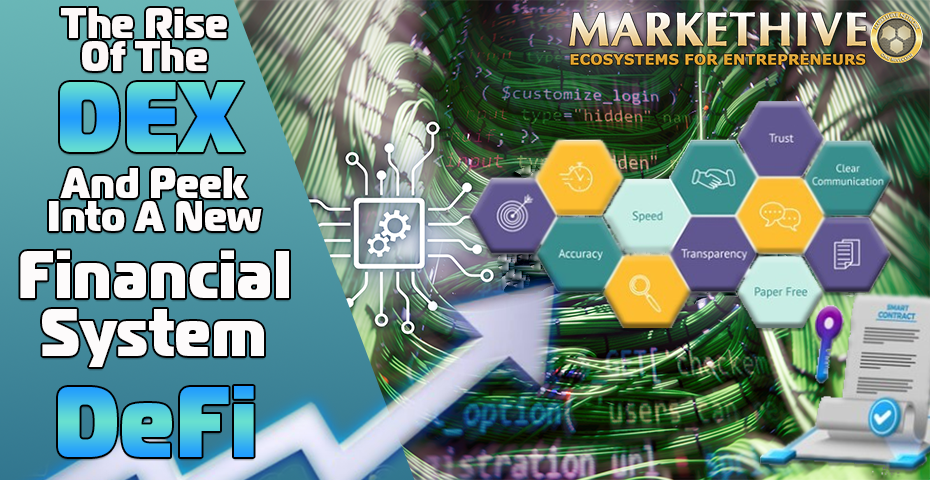
DeFi (Decentralized Finance) is a term used to cover various components and activities, including Decentralized crypto Exchanges or DEXs which are at the cutting edge of DEFI. The rapidly evolving market of the DEX allows peer-to-peer cryptocurrency transactions without the need for an intermediary.
DeFi is a system by which financial products become available on a public decentralized blockchain network. That makes them open to anyone to use, rather than going through middlemen like banks, brokerages, and even centralized crypto exchanges.
Unlike the legacy financial institutions and centralized crypto exchanges (CEXs), the KYC/AML (Know Your Customer and Anti-Money Laundering) protocol. These are usually government-issued ID, Social Security number, or proof of address. They are not necessary with the DeFi protocol and are welcomed by those concerned about their privacy and who cannot access valid documents.
More specifically, DeFi operates in a decentralized environment on public and permissionless blockchains, making it possible for buyers, sellers, lenders, and borrowers to interact peer to peer and use services encoded into open-source software protocols and smart contracts rather than a company or institution facilitating a transaction.
Historically, intermediaries have been the central hub acting as agents and brokers of trust, providing liquidity and security. Over the last century, the massive failings of this system, resulting in tumbling economies and the onset of a global recession, revealed a major flaw in the architecture. With the emerging technology, we can see a glimpse of a new financial services infrastructure.
Decentralized finance uses technology to disintermediate centralized models and provides financial services on a global scale to anyone regardless of ethnicity, age, or cultural identity. It also gives users more control over their money through personal wallets and trading services that expressly cater to the individual, not institutions. Read More

OpenSea updates banned countries list, sparking decentralization debate
The world’s largest NFT marketplace has confirmed that it blocks users based on the U.S. sanctions list.
United States-based NFT marketplace OpenSea has reportedly begun barring Iranian users from its platform, sparking outrage from NFT collectors and raising fresh debate about decentralization in the crypto space.
On Thursday morning, Iranian OpenSea users started posting on Twitter that their accounts were being deactivated or deleted with no prior warning. Iranian NFT artist “Bornosor” vented frustrations to their 4,700 followers in a tweet that quickly gained traction, garnering 342 retweets and over a thousand likes within a few hours.
Bornosor stated, “NOT A gm AT ALL. Woke up to my @opensea trading account being deactivated/deleted without notice or any explanation.” Read More
Billboard and Universal Music Group Partner to Launch Flow-Based NFT Collectibles
The American music and entertainment company Billboard has revealed it has partnered with Universal Music Group (UMG) in order to enter the growing NFT ecosystem. The company revealed on Wednesday that Billboard is launching an NFT project called Chartstars and the firm’s NFT compilation will leverage the Flow blockchain. Billboard further disclosed the Chartstars NFTs will feature “officially licensed art and creative including short visual clips from music videos, and album photography.”
“The launch of Chartstars marks Billboard’s first scalable NFT product geared toward music fans. Chartstars will be a collection of artist-focused digital artwork that commemorates achievements and milestones on the Billboard Charts,” Billboard’s announcement explains. Furthermore, the music and entertainment firm said that incentives will be implemented into the Billboard NFT project. Billboards Chartstars NFT announcement adds:
Collecting and gamification will be built into the platform through collector leaderboards, challenges and true utility baked into the smart contracts, including special access at Billboard Live Events. The first Chartstars products are expected to be available for purchase in May. Read More
What is the Algorand blockchain, and how does it work?
Algorand's PPoS consensus algorithm distinguishes it from other blockchain networks that help solve blockchain trilemma.
Algorand is a blockchain network created in 2017 by Silvio Micali, an MIT professor who won the Turing Award for his work in cryptography. Algorand is a decentralized permissionless blockchain protocol that anyone can use to develop applications and transfer value. The Algorand protocol is powered by a novel consensus algorithm that enables fast, secure, and scalable transactions.
Algorand addresses the common issues that most older blockchains have, specifically concerning scalability and consensus. The blockchain uses Pure proof-of-stake (PPoS), a consensus protocol that selects validators at random according to the weight of their stake in ALGO coins.
The Algorand protocol is designed to solve three of the biggest problems most blockchains face: security, scalability, and decentralization. Dubbed as the “blockchain trilemma,” the Algorand network claims to address the following three major issues. Read More
The post-consortia era: How enterprises are embracing Web3 structures
Though blockchain-enabled consortia became the modus operandi for enterprises, today, they are in a different Web3-infused landscape and it’s vital that they adjust well.
Now that the initial hype surrounding blockchain applications and the prolonged blockchain “winter” that followed are left behind, we now find ourselves in the middle of a “spring” that is helping organizations reimagine how they deliver value. So much so that blockchain is expected to add $1.76 trillion to the global economy by 2030, according to PWC.
A significant chunk of this uptick is expected to come from business-to-business (B2B) implementations, which stand to gain the most from the security, immutability, and streamlining opportunities afforded by blockchain-based transactions and relationships. With processes that involve multiple partners, dozens (if not hundreds) of products, and cumbersome bureaucracy for almost any business process, it’s hard to overstate how much enterprises stand to gain, especially when considering the emergence of more agile competitors.
But, while small and medium businesses (SMBs) are faster and more nimble in adopting new technology and products, enterprise adoption is slow. Sale cycles are long, there are more gateways and there remains strong incentives for multiple internal stakeholders to keep things as they are. Read More
Disclaimer: These articles are provided for informational purposes only. They are not offered or intended to be used as legal, tax, investment, financial, or any other advice.